




This article discusses suicide. If you or someone you know is struggling or in crisis, help is available. Call or text 988 or chat at 988lifeline.org.
The online creator "Elon Muscular" was 15, living with five people in a one-bedroom apartment in South Brooklyn, and feeling like he'd reached his breaking point.
He was suicidal and felt like no one was listening.
A Google search for "how to cure depression" first introduced him to the world of biohacking, a DIY approach to maximizing physical health and longevity that set the precedent for the rise of the "looksmaxxing" side of the internet.
The influencer Clavicular — who has gone to extremes such as hitting himself in the face with a hammer so his bones supposedly grow back sharper and taking
small amounts of methamphetamine in an attempt to suppress his appetite — brought looksmaxxing to the mainstream zeitgeist. But before him, before Andrew Tate brought the manosphere into focus, and before Bryan Johnson became synonymous with modern biohacking tips, there was Anthony Hughes.
Known by the persona "Tony Huge," the lawyer-turned-buff-bodybuilder amassed hundreds of thousands of followers on his YouTube channel for videos about using psychedelics, steroids, and other substances to reach what he deemed to be peak male performance — that included the use of illegal chemicals in extreme amounts.
That world, and the loneliness that draws young men to it, is at the center of "Get Huge: Looksmaxxing to Death," a three-part docuseries premiering on Hulu on Nov. 10.
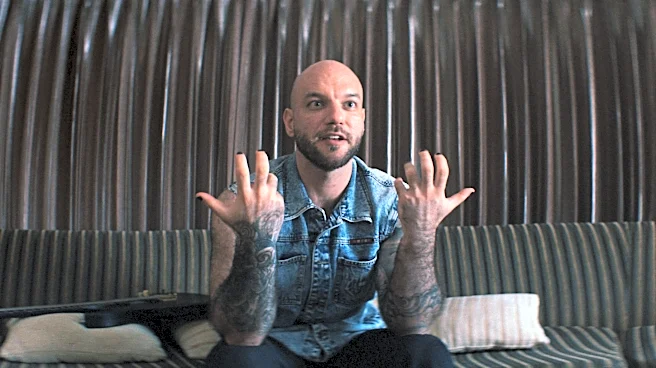
Muscular, identified only by his online moniker in the docuseries, recalled how he was entranced by Hughes, who lived by the mantra, "a day natty [natural] is a day wasted." Hughes had Ferraris, a mansion, and videos with bikini-clad women. It seemed like he knew something about life that Muscular didn’t.
"It made me feel like I wasn’t alone," Muscular said.
The series follows Hughes and the community of extreme biohackers around him, who experimented with illegal drugs, steroids, peptides, and risky body-modification techniques in pursuit of bigger muscles, bigger penises, improved sexual performance, and eternal youth. It also investigates a series of deaths among those in Hughes' inner circle, some of which remain unsolved, while charting how his brand of self-optimization at any cost helped lay the groundwork for today's looksmaxxing movement.
"When this series began, looksmaxxing wasn't even in the cultural conversation at that point," director Stacey Lee told USA TODAY. "I really felt it was important to tell a story that humanizes this very complex situation."

The scene of the story is Hughes' compound in Pattaya, Thailand. Muscular was 19 when he received an invite to join Hughes there after messaging the influencer on Facebook.
There, he interacted with close friends of Hughes, like Leo and Longevity, whose real name is Laith Abdallah Algaz, a fellow biohacker and penis-enlargement advocate who died mysteriously in January 2023 in the bathroom of their shared compound. Local police found Algaz dead from blunt-force head trauma, but the case is still unsolved.
Many of the young men initially drawn to this space were seeking community and spaces to ask questions openly, while improving their physical, economic, and romantic circumstances.
"So many of the young men that are drawn to this are using looksmaxxing as a means of solving what is incredibly complex societal issues, and I think therein lies some of the challenges," Lee said. "The need to make your muscles bigger, or your jawline a certain way, or your brow line a certain way, or your penis bigger, all of these things are superficial aspects of the self."
Much of the series explores the questions swirling around the deaths in Hughes’ inner orbit, which, besides Leo and Longevity, also included looksmaxxers Nick Weisser in 2018 and Josh Brooks in 2021. The deaths quickly fueled accusations, finger-pointing, and conspiracy theories, driving a wedge among the men who were part of this tight-knit community.
The series also features Connor Murphy, a looksmaxxing internet creator combining performance art, pick up lines, pranks and fitness who also spent time at Hughes’ Thailand compound. Four weeks after filming concluded, Murphy died at age 32 after drowning in a lake in Thailand.
"His passing kind of reinforced our responsibility to show that complicated, multi-dimensional side of him beyond just the online performance… that you know was I think in some ways misunderstood on the internet," Lee said.

'Young boys are looking at this content and thinking about it like a blueprint for their own life'
Lee grew interested in looksmaxxing after the 2024 presidential election, when she saw young men gravitate toward male lifestyle creators who merged fitness, politics and culture. President Donald Trump appeared on shows from creators like the Nelk Boys, Theo Von, Joe Rogan and Adin Ross, helping sway Gen Z men his way in a phenomenon some have since deemed the "bro" vote.
"These kind of masculine role models are emerging in the online sphere, and we're witnessing a lot of young males take upon these mantras," Lee said.
Lee pointed out that, as influencers, much of these creators' content was manufactured for clicks, likes, and engagement. But it’s hard for young viewers to discern the difference between performance and sound advice.
"I wanted to find what was real," Lee said. "If young boys are looking at this content and thinking about it like a blueprint for their own life, then what aspects of this are genuine aspects of masculinity?"
"So much of this world, so much of what they're doing, is performance," she added.

The combination of technology and the natural insecurities that arise during teenage years creates a "perfect storm" for innocuous sports and health spaces to tune young men into radical content, Gary Barker, the president of Equimundo: Center for Masculinities and Social Justice, an organization that advocates forhealthy manhood, previously told USA TODAY.
"You see with the story of [Muscular], as we follow him down that path, he's trying to cure depression… and what he finds is community, he finds belonging," Lee said. "He finds people that make him believe that he can become the best version of himself."
Lee, a mother to a 9-year-old-son and 6-year-old-daughter, hopes that adding context and nuance to the conversation around masculinity, and teaching her kids discernment about how much of what they watch online is performed, will teach them critical thinking around gender ideology.
"When the kids get nightmares or bad dreams, you turn on the lights. You help them show that the boogeyman's not so scary," Lee said, explaining that a large part of the project was leaning into discomfort rather than turning away from it. "I think the boogeyman is scarier when you don't understand it."
Rachel Hale’s role covering Youth Mental Health at USA TODAY is supported by a partnership with Pivotal and Journalism Funding Partners. Funders do not provide editorial input. Reach her at rhale@usatoday.com and @rachelleighhale on X.
This article originally appeared on USA TODAY: ‘Get Huge’: The dark side of looksmaxxing and the deaths that shocked many