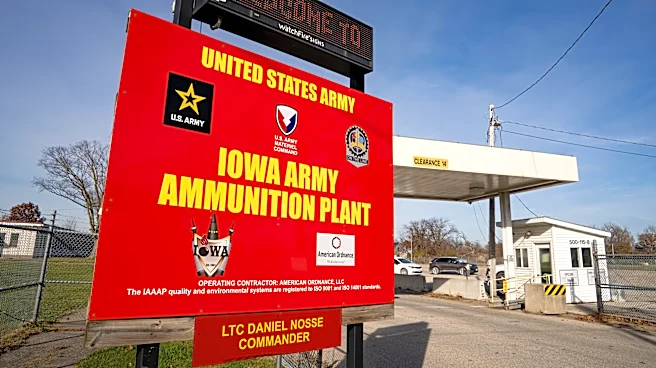









The U.S. Army has again postponed its controversial plan to detonate a stockpile of unstable lead azide in Iowa despite a federal court order putting its Environmental Protection Agency permit on hold.
The Justice Department said in a court document filed on Nov. 21 that the Army would invoke emergency powers to bypass the EPA's regulatory requirements to detonate 68 barrels of the aging explosive being held at the Iowa Army Ammunition Plant in Middletown by Nov. 24. The Army later said that the planned detonation, originally scheduled for Nov. 20, would instead occur on Nov. 25 "to allow for optimal weather conditions and all mitigation measures to be emplaced."
"Additional details on this situation will be forthcoming," the Army said in a statementon
Nov. 22. "The health and safety of all Americans has and always will be our first priority."
The Army previously postponed its planto detonate the nearly 9,500 pounds of degraded lead azide amid concern from residents, health experts and elected officialsabout the potential environmental and public health impacts. The permit for the detonation was then put on pause by a judge after the Iowa Environmental Council and the Sierra Club's Iowa chapter filed a lawsuit echoing those concerns and seeking to stop the plan from moving forward.
The DOJ, however, argued the planned explosion had to proceed without the permit because a coming drop in temperature could cause the unstable material to detonate on its own, posing a "more significant threat." Temperatures in Middletown, a small town in southeastern Iowa near the Illinois border, are expected to plummet to lows in the 20s in the evenings leading up to the delayed detonation, according to the National Weather Service forecast.
Here's what we know about the planned detonation:
When will the Army detonate lead azide in Iowa?
The explosion is currently scheduled for Nov. 25. Lt. Col. Orlandon Howard told USA TODAY the Army has not yet set a time for the detonation.
The EPA approved an emergency permit for the detonation on Nov. 13, and the Army publicly announced its plans on Nov. 15.Since then, the blast has been delayed multiple times amid a last-minute legal challenge and growing public concern.
The Sierra Club's Iowa Chapter and Iowa Environmental Council filed suit Nov. 19 challenging the permit and asking for a court order to halt the blast. That same day, Adam Telle, acting secretary of the Army, announced the explosion would be pushedfrom Nov. 20 to Nov. 23, which he described as "the latest possible moment prior to a forecasted temperature drop, which would risk further destabilization of the material."
A judge then placed an administrative stay on the permit to review the groups' emergency motion. The Army told the Eighth Circuit Court of Appeals on Nov. 21 that the stay does not stop them from continuing the planned detonation under "a separate legal authority" and "the Army intends to act on November 24, 2026."
One day after that filing, the Army announced the detonation had been delayed again to Nov. 25. The government has asked the court to deny the plaintiffs' motion and lift the stay on the EPA permit.
Environmental concerns over planned blast grow
Maps released by the Army ahead of the initial planned detonation showed lead particles could travel close to 100 miles from the Iowa Army Ammunition Plant after the blast. Depending on weather conditions, the plume could have extended across portions of southeastern Iowa and northwest Illinois.
Officials have said that the blast would result in temporary and limited environmental impacts. "It's not lead paint where it's a chronic exposure by children. It's the equivalent of living in a mining town for one hour," Justine Barati, deputy chief of public and congressional affairs for Army Sustainment Command, previously told the Des Moines Register, part of the USA TODAY Network.
But the plan raised concerns among health and environmental experts and officials who question whether the Army has disclosed enough information about potential exposure risks and cleanup plans. According to the Centers for Disease Control and Prevention, no safe blood lead level has been identified in children, and even low levels of exposure can affect learning, ability to pay attention and academic performance.
Environmental groups warned, in a filing early on Nov. 22, that there may be hazards to the public beyond lead contamination as well.
Ranajit Sahu, an engineer and expert in explosives and environmental testing, wrote in a declaration that an environmental assessment noted the blast will release toxic gases such as hydrazoic acid, a "colorless, volatile, and explosive liquid at room temperature and pressure" that is also highly toxic. Despite this, he wrote, the EPA appears to have only assessed the risks of lead contamination and not of other potential hazardous byproducts.
Why is the Army exploding lead azide?
Lead azide is a primary explosive used to initiate munitions, according to a Q&A sheet from the plant. The barrels had been moved to the Iowa Army Ammunition Plant for use in munitions production but were not all used, Barati previously said.
The explosive material, which has been stored at the plant for more than 20 years, was deemed hazardous waste and was found to be drier and more volatile than expected, Barati said. The Army considered multiple ways to dispose of the barrels, including treating them with chemicals, building a structure around them, transporting them elsewhere or simply leaving them in place, EPA Region 7 Administrator Jim Macy said in a letter to Iowa Governor Kim Reynolds on Nov. 20.
"After ruling out all other possible measures that could be taken to adequately protect human healthand the environment, the Army concluded the only viable option was a controlled detonation in placewith extensive mitigation measures," Macy said.
Those mitigation measures include building additional barrier walls around the barrels to channel blasteffects and using a misting system to wet the surrounding area to limit the amount of dust produced by the detonation, Macy said.
The Army and U.S. Environmental Protection Agency have also said air sampling, environmental monitoring and post-detonation cleanup efforts are planned. The Army has said it intends to follow the mitigation provisions required by the EPA permit, whether or not it is formally reinstated.
Researchers are also planning to conduct independent monitoring of the detonation.
Contributing: Brian Smith, William Morris, Kyle Werner, Thao Nguyen, Lucia Cheng and James Powel, USA TODAY NETWORK
This article originally appeared on USA TODAY: Army still planning a controversial explosion in Iowa. Latest updates