




Some people put a lot of stock in first impressions. I guess if I had, Pat Patterson and I might never have become friends.
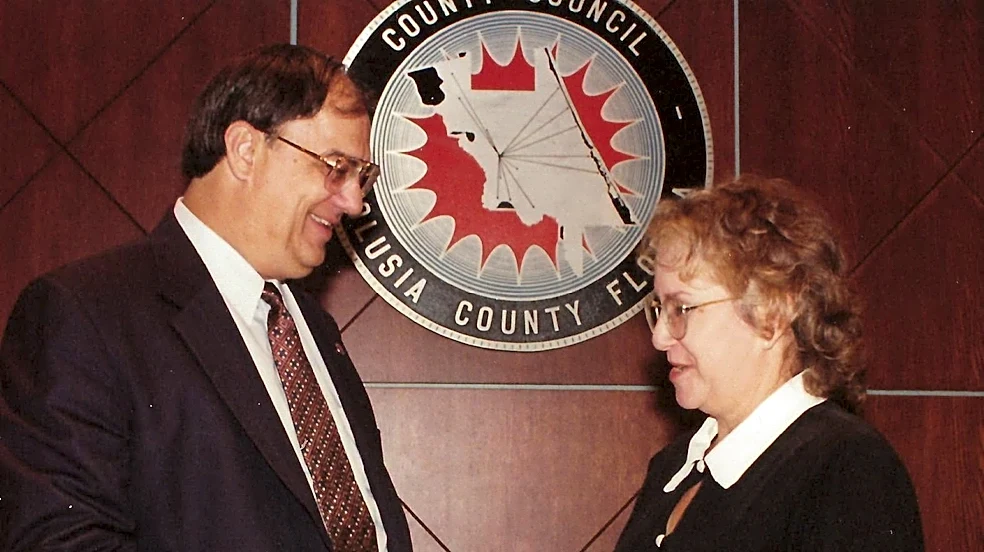
Our paths first crossed in the 1990s, when he won a seat on the Volusia County Council
and I was covering Volusia County government for The Orlando Sentinel. (Volusia County is perhaps best known for Daytona Beach, a community made famous by NASCAR, spring break and motorcycling events.)Like a lot of elected officials, especially newly elected ones, Pat struck me as being a little bit full of himself. Then again, so was I.
It was impossible back then to imagine that, 30 years later, we'd spend hours watching marathon sessions of "Blue Bloods" and "Magnum, P.I." over bowls of ice cream in his living room as he battled Stage
4 pancreatic cancer.
But how we got there tells a lot about the type of person Pat was. And, as we approach these highly contentious midterm elections, Pat's approach to life offers a great model for how people of opposing political views can communicate with each other.
The lost art of disagreeing without being disagreeable

It wasn't long after Pat's first election that we ended up clashing in the way government officials and journalists often do.
He supported an ordinance to charge out-of-county residents more to drive on local beaches. I wrote several stories suggesting the move would backfire because Orlando area residents would simply choose to visit beaches farther south rather than paying the higher fees.
That's what did happen, which led the council to rescind the ordinance after a short time.
Pat could have taken that very personally. Over the course of my career, I've had elected officials grow to despise me over far less.
Pat never let those types of disagreements or setbacks rattle him. He was the type of person who knew there would always be another day and another issue to try to resolve. Nursing grudges made less sense to him than forging alliances.
During what turned out to be a lengthy political career, Pat spent many years representing the northwestern part of Volusia County on the council and the state legislature.
My own career took me to other cities in distant states, but we remained friends. When I returned to Florida to visit, which was fairly often, he and I would get together to catch up.
These reunions occasionally stretched well into the wee morning hours, fueled by alcohol and cigars in the years before both of us gave up those vices for health reasons.

We talked about politics, life and everything else under the sun. Sometimes, it fell to Anne, Pat's infinitely patient and loving wife, to tell us it was time to knock it off and go to bed.
It wasn't that we agreed on everything. We frequently didn't. Pat was a Republican. Over the course of my life, I've identified as both a Republican and a Democrat before becoming a very committed independent.
Yet we found ways to talk about issues without getting mad at each other. Our conversations were filled with jokes and sarcasm, which can take the edge off even the tensest situations.
Making friends rather than enemies
I never believed his intentions were anything but good. I'm pretty sure he believed the same about me. So we were just two guys trying to solve the world's problems together, using whatever limited means were at our disposal.
I wouldn't say Pat was the only news source I met who became a personal friend, but it's more the exception than the rule. There's usually tension in a journalist-source relationship.
If there's not outright animosity, there's certainly a professional distance.
Pat was different, though. And not only with me. I know he had many friends of different political persuasions.
He didn't believe every action taken by a member of his political party was right or defensible. He was willing to admit when he was wrong about something, especially after receiving new information that helped better inform his view.
For him, politics wasn't like a sporting event, where fans pledge their undying loyalty to their respective teams and support them at any cost. It wasn't about humiliating one's neighbors or getting some measure of validation by winning an election or a policy debate.
Politics was a means for bringing about change for the better in the world. The right answers didn't always break cleanly along partisan lines. Pat had the wisdom to realize being flexible and pragmatic was more effective in real-world situations than following some preapproved list of talking points.
What we can learn from my friend's life

Not long after I moved back to Florida a few years ago, I found out about Pat's cancer diagnosis. This wasn't one of those situations where he was given a fighting chance of beating the disease and having a fairly normal life afterward.
Doctors essentially gave him a death sentence. Many patients with his diagnosis lasted only three or four months.
Under similar circumstances, many people I know would have quit their jobs to see the Great Pyramids of Giza or petition Make-A-Wish for a meeting with Taylor Swift. Pat wasn't interested in that. He'd already seen a lot of the world during his younger years, particularly during his time in the Navy. What he wanted most was to stay close to the people and causes he had loved throughout his life.
Although he was already well into his 70s, he continued to operate the insurance business he owned in Daytona until his health no longer made it practical. His career as an elected leader had ended years before, but he continued to serve on various community boards as long as he could.

Pat lived more than two years after his cancer diagnosis. He died in September after saying his final goodbyes to friends and family members. Flags flew at half-staff at government buildings in Tallahassee and his hometown of DeLand in honor of his years of public service.
I'm going to miss my friend because of all he meant to me. As we draw closer to the Nov. 3 elections, I also mourn the loss of someone who could have been a voice of reason as tensions mount, telling people that no matter how the election results break, we're all people who are more alike than different.
Our world needs more people like Pat. I hope we can all see that before it's too late.
Blake Fontenay is USA TODAY's commentary editor.
This article originally appeared on USA TODAY: As midterm tensions mount, here's how to have civil disagreement | Opinion