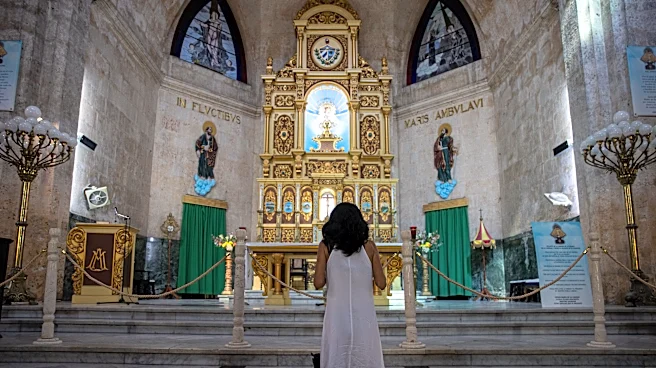




HAVANA – In the cool darkness of the church’s sacristy, the Rev. Ariel Suárez Jáuregui pulled on his vestments – a white ankle-length robe and bright green stole – and entered the 19th-century sanctuary of Our Lady of Charity Catholic Church.
Hints of incense wafted among the soaring columns up to the Baroque-style domed ceiling. Eight small fans blew onto about 35 parishioners scattered among the wooden pews, a luxury in power-starved Havana. They swayed on their feet in the heat like Cuban palms as Father Suárez read from the Old Testament, sang hymns and urged the faithful to look to the Holy Spirit for solutions to today’s “grave and urgent problems.”
After the service, most of them filed into a single line to speak with Suárez, a tradition
he’s maintained after every Mass for the 27 years he’s been a priest. In hushed voices, they whispered their anxieties and asked for his help.
For decades, the Roman Catholic Church in Cuba has served as a savior to many Cubans, operating as a de facto social safety net. Once the bane of Cuba’s communist, atheist government, the church has stepped in as a powerful advocate for the Cuban people, a broker for those caught between warring political ideologies.
In May, the United States earmarked $100 million in aid to Cuba. The Vatican agreed to act as an intermediary and distribute it through Caritas Cuba, a group associated with the Catholic Church. Cargo planes filled with pallets of rice, beans, cooking oil, sugar and toothpaste started flying into Cuba this summer.
As Cuba sinks deeper into crisis, priests like Suárez are on the front lines, securing supplies and ministering directly to his parish’s flock.
On a recent Tuesday after Mass, one woman asked him to pray for her pregnant daughter, who had fallen and had to be rushed to a hospital. Another who had traveled from Matanzas to Havana found herself alone in Cuba and asked him to find her a place to live. One man desperately needed medicine for his diabetes.

To some, Suárez offered a quick blessing, tracing a cross in the air in front of the parishioner. To others, he gifted a pack of disposable diapers or prenatal vitamins. Always, he told them to cling to their faith. God would see them through.
Over the years, Suárez, 53, has led congregations through periods of prolonged blackouts, economic crises, mass migrations and violent protests in Cuba.
Today, by far, is the worst he’s seen his country, he said.
“It’s the toughest – and probably the saddest – of all the times I have lived through,” Suárez said from his church office in an interview with USA TODAY. “We are witnessing a growing deterioration in recent months across every aspect of national life.”
When the United States imposed an oil embargo on Jan. 29 and began stepping up sanctions against Cuba, it exposed decades of mismanagement of Cuba’s power grid, leading to blackouts that last for days and food and water shortages.

To fill the gaps, priests, bishops, nuns and volunteers across the island have ramped up their aid: starting soup kitchens, ferrying clean water, opening laundromats and delivering food to the homeless.
But Caritas and the Cuban authorities don’t have the resources to get all the supplies where they need to go, said Miami Archbishop Thomas Wenski, who is helping to oversee the transport. Lack of warehouses to store supplies and fuel to transport them cripples aid distribution, he said.
“There are miracles happening all the time,” he said. “But it’s a drop in the bucket.”
‘A certain hope and joy’
Suárez was born in Havana and ordained in 1999, and became the parish priest at Our Lady of Charity in February 2015, a critical time for Cuba.
Later that year, Pope Francis visited the island, improving ties between the Church and Cuban officials. And in March 2016, President Barack Obama announced a rapprochement between Washington and Havana that encouraged private enterprise on the island and benefited scores of Cubans economically.
“The people and church lived with a certain hope and joy,” Suárez remembered.
The situation started to noticeably deteriorate after the coronavirus pandemic as tourism dried up and the economy cratered, he said. Conditions worsened each year and spiraled after the United States imposed the oil embargo in January.
Earlier this year, using funds raised in part by parishioners’ families in the United States, his church launched soup kitchens twice a week, opened a free parish laundromat for families without electricity and began cooking meals for Havana’s burgeoning homeless population, Suárez said.
“There are vast voids here,” he said. “And unfortunately, as far as I can see, there doesn’t seem to be much of a glimmer of hope.”
Suárez’s day starts at 6 a.m. with his morning prayer (“O God, come to my assistance. Lord, make haste to help me …”), followed by morning coffee and cookies with his staff. By 8 a.m., he’s meeting with congregants or visiting the sick in their homes.

Suárez, who also serves as adjunct secretary of the Conference of Catholic Bishops of Cuba, meets with church officials on some days. On others, he secures a water truck to replenish the parish’s supply or finds fresh food for the kitchen staff to cook.
Drug use ‘destroying young people’
Walking the city’s streets offers Suárez a glimpse into the hardships of life in Havana.
Some families he visits go weeks without running water. Others are in dire need of medicine.
Most alarming is the growing number of young people slumped on park benches, high on el químico, a synthetic, cannabis-based drug commonly laced with antiepileptic medication, formaldehyde or animal-grade anesthesia.
“It’s destroying so many young people,” he said. “They’re caught in a cycle of escapism, radical disorientation, and a lack of purpose in life.”
As blackouts grew more frequent last year, Suárez raised funds to install a 16-panel solar power system for the church – making it one of the few buildings with constant power in this central Havana neighborhood.
He realizes his parish is one of the luckier ones. Other churches rarely have power. Their workers cook meals over firewood and return each night to dark, sweltering homes.
Besides 22-hour blackouts and lack of running water, what’s really hurt the island is the recent mass exodus, Suárez said. Many of the parish’s younger congregants have fled Cuba, including youth ministry leaders and other volunteers, he said.
An estimated 1.8 million Cubans have fled the island in the past five years. The majority, about 75%, are between the ages of 15 and 49, according to a 2025 analysis by the University of Navarra in Spain. They left behind a growing population of aging family members who can’t survive on meager government pensions.

Every Wednesday and Friday, his parish dining hall fills with more than 200 older residents, many getting their first full meal of the week, Suárez said. On Thursdays and every other Saturday, he and other church officials deliver meals to more than 100 people living in parks and squares around the Vedado and Old Havana neighborhoods.
“It just keeps growing,” Suárez said of the number of people his church feeds.
In between helping parishioners survive a worsening crisis, Suárez also organizes one of the most important events of the Cuban Catholic calendar: the annual half-mile procession of La Virgen de la Caridad del Cobre, Cuba’s patron saint.
Throngs of adherents clog the street as a statuette of the Virgin Mary as La Caridad is wheeled around the neighborhood. A marching band blares music and prayers are recited through loudspeakers as residents scatter colorful confetti over the procession from balconies.

It’s one of the most anticipated events of the year for Cuban Catholics, some years drawing more than 20,000 faithful into the streets outside the church.
But it wasn’t always allowed.
Castro clashes with Catholics
Before Fidel Castro’s 1959 revolution, about three-fourths of Cubans considered themselves Roman Catholic. Castro, a product of a Catholic education himself, expelled hundreds of priests suspected to be anti-revolutionaries and denounced the church’s role in society.
Churches closed. Catholic colleges were nationalized. Attendance plummeted as Catholics avoided Mass and fled Cuba.
Castro’s ire against the church erupted in September 1961 – outside Our Lady of Charity Church. The priest at the time, Monsignor Eduardo Boza Masvidal, led an unauthorized procession of La Caridad del Cobre through the streets. Police fired into the crowd and killed a young man, according to an account by Time magazine.
Days later, Masvidal and more than 130 other Cuban priests were expelled from the island on Castro’s orders.
La Caridad’s street procession was halted for nearly four decades – until Pope John Paul II’s historic visit to Cuba in 1998 helped rekindle relations between Havana and the Vatican. It’s been a yearly occurrence ever since.

On Sept. 8, more than 1,000 people crowded the streets near Our Lady of Charity Church to follow the statuette on her 11-block journey around the neighborhood. Some wore yellow, the saint’s historic color; others hoisted their own statuettes of the Virgin they affectionately call Cachita. White-robed clergy walked among the crowds, swinging incense and filling the street with fragrant clouds.
“It reminds us that God walks with us, that we are not alone,” Suárez said, “that God and the Virgin Mary walk among men.”
The church as diplomat
The church for years has interceded in negotiations between Cuba and the United States.
The clergy helped broker a deal between Havana and Washington in 2015 that restored relations after more than five decades of hostility and laid the groundwork for Obama’s historic visit to the island in March 2016. President Donald Trump later reversed many of those policies. And in May, Secretary of State Marco Rubio met with Pope Leo XIV at the Vatican to discuss the church distributing the $100 million in U.S. aid.
The church also voices its concern when relations between the two countries fracture. Two days after the White House announced the oil embargo, the Conference of Catholic Bishops of Cuba released a tersely-worded statement, warning of the harm it could inflict on Cubans.
“The risk of social chaos and violence among the children of the same people is real,” the statement said. “Cuba needs changes – changes that are becoming increasingly urgent – but it certainly does not need any more anguish or pain.”

Suárez called the statement prophetic – and a reminder that government decisions often inflict the most harm on the most vulnerable.
“Why don’t we set aside partisan interests to truly seek the common good of people, the good of the nation, the good of a people who are suffering?” he said.
‘Looking for hope’
On a recent Tuesday, Suárez wrapped up morning Mass by listening directly to the faithful who had come to church.
Among them was Barbara Díaz, 68, of Havana. She attended Mass regularly here as a child with her grandmother but stopped coming after becoming involved with local communist party committees. She returned in the 1990s.
Lately, more and more of her relatives are attending church, she said.
“A lot of people who stopped coming to the church are coming back,” Díaz said. “They’re looking for hope that this situation will change.”

Ileana Serrano, 57, said she had traveled from Matanzas to Havana, looking for a place to stay after her family left. Serrano said she didn’t have any other financial options, so she turned to the church.
“I’m all alone. I never have electricity. I can’t live like that,” Serrano said. “I’m a believer … If they let me live in the church, I would.”
Suárez listened to all the congregants’ needs, helping where he could, until everyone filed out and the church emptied.
He returned to the dressing area, removed his vestments and sat for a minute on a couch in his office. Statues of the Virgin Mary and crucified Jesus looked down on him from atop a bookcase next to five wall-mounted monitors blinking with the kilowatts captured by the church’s solar panels.
It’s not always easy listening to the hardships of his parish and coming up with solutions, Suárez said. Often, there are none.
“It’s overwhelming,” he said. “But I tell myself, ‘Go – because you became a priest to serve people, not lock yourself away in a glass bubble.’”
It was time for a quick lunch. Then Suárez needed to visit sick parishioners and ensure his volunteers had enough food and clean water. The clock was ticking. In a few hours, Havana would be cloaked in darkness.
He stood and got back to work.

Jervis is a national correspondent based in Austin, Texas. He reported this story from Havana. Follow him on X: @MrRJervis, or Instagram: @rjervis5905.
This article originally appeared on USA TODAY: 'Looking for hope:' In Havana’s darkness, Cubans turn to faith