
The National Park Service supports plans to build a massive arch proposed by President Donald Trump despite finding that it would negatively affect the views of other monuments and historic sites in Washington.
A report released Aug. 28 said that the Park Service would endeavor to mitigate or minimize the harms, but that the planned archway, dubbed the "Triumphal Arch," would "celebrate 250 years of American independence byhonoring America’s founding principles."
Constructing the 250-foot arch in its planned spot, where Arlington Memorial Bridge and George Washington Memorial Parkway intersect in front of the entrance to Arlington National Cemetery, would be "consistent with the avenue's established role as a ceremonial gateway and 'Avenue of Heroes' celebrating valor, sacrifice, and American heritage," the report said.
What is the Triumphal Arch
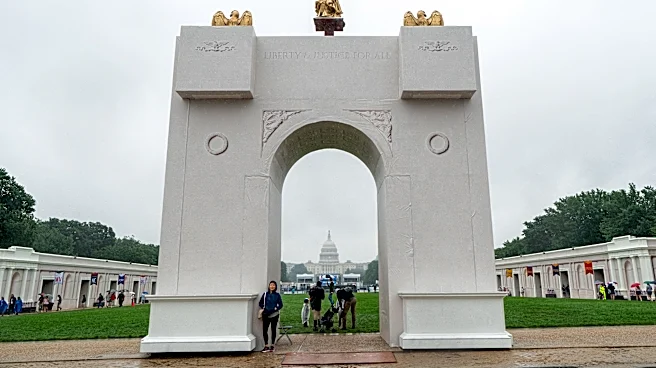
The arch is planned for the spot near the entrance to Arlington Cemetery, across the Potomac River from the Lincoln Memorial. Despite concerns about its planned height of 250 feet, which would exceed the height of the Lincoln Memorial and come close to the height of the Capitol building at 288 feet, the Park Service dismissed plans for a smaller structure. The 250 feet is representative of America's 250th anniversary, the report said.
The arch will be a reinforced concrete structure clad in granite, with a central winged figure and two eagles. An observation deck will give visitors a view of surrounding landmarks, the report said.

The arch is one of multiple projects spearheaded by Trump to leave his mark on Washington's landscape. They include the controversial remodeling of the Reflecting Pool at the Lincoln Memorial and the building of a new ballroom attached to the White House, along with a granite helipad outside the executive mansion.
How will other monuments and sites be impacted?
According to the report by the Park Service, dozens of sites will have adverse effects. The impacts mostly have to do with disrupting the views of or from the locations, rather than impacts on the structures themselves.
Adverse effects are found when a project may "alter, directly or indirectly, any of the characteristics of a historic property ... in a manner that would diminish the integrity of the property's location, design, setting, materials, workmanship, feeling, or association," according to the report.
The most impacted properties would include Memorial Circle, Arlington Memorial Bridge, Memorial Avenue, Arlington National Cemetery, Arlington House and the Lincoln Memorial corridor, the report said. Dozens of other monuments or historic sites would also see impacts.
The Park Service dismissed alternative plans that would have scaled down or moved the arch. Making the arch smaller, for example, would block views of the Lincoln Memorial rather than frame it. Moving it elsewhere would defeat the point, the report said: The arch was planned specifically for that location.
But it said it would work to mitigate or minimize the negative impacts. It plans to take steps to minimize the disruption of the arch's construction, rehabilitate the other architecture along Memorial Avenue and the bridge, and create educational materials for visitors.
"The NPS recognizes that the selected location contributes to the undertaking’s adverse effects because Memorial Circle is part of a highly sensitive historic and commemorative landscape," the Park Service said. "However, the same characteristics that make Memorial Circle sensitive from a preservation perspective are also the characteristics that make it the historically appropriate location for the undertaking."
This article originally appeared on USA TODAY: Park Service supports Trump's huge arch, despite harms to other landmarks