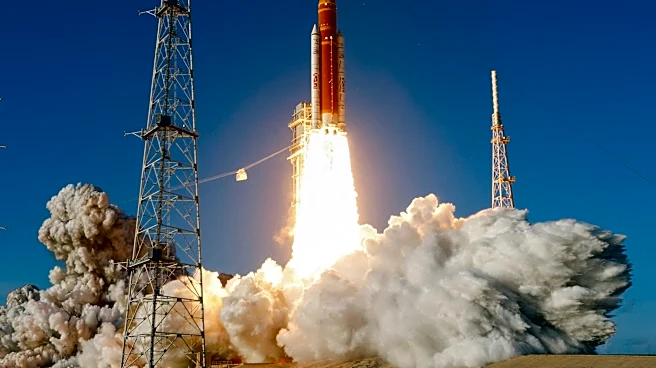




Back in April, people around the world paused their days to collectively watch in awe as four intrepid astronauts were launched into space toward the moon atop NASA's most powerful rocket ever.
That mission, known as Artemis II, captivated the public for 10 days as three Americans and one Canadian made a trip around the moon and back to Earth. To many observers, Artemis II signified the dawn of a new era of space exploration as NASA aims to return Americans to the lunar surface for the first time in more than 50 years.
But these days, rockets are already launching almost every day from U.S. soil – most without people aboard. In fact, just one other mission so far in 2026 – a joint NASA and SpaceX mission launched Feb. 13 to the International Space Station
known as Crew-12 – sent astronauts to space.
Rocket launches in the United States have become so routine that most barely warrant news headlines. Americans, meanwhile, have become so accustomed to them that most barely bat an eye even when SpaceX launches its Falcon 9 rocket multiple times a week and then makes it look easy to return its first-stage booster for a bullseye landing on a ship in the middle of the ocean.
And while both the east and west coasts have ushered in record year after record year for launches, rockets are only due to fly more and more frequently in the years ahead.
Here's why rocket launches are predicted to dramatically increase in the United States, and what that means for Americans and the spaceflight industry.
FAA predicts commercial rocket launches to spike in next decade
As NASA increasingly cedes spaceflight missions to commercial companies that were once the realm of government space agencies, those sorts of missions have steadily been increasing year after year.
For instance, SpaceX, the commercial spaceflight company founded by tech mogul Elon Musk, has launched its Falcon 9 rocket hundreds of times from California and Florida – making it by far the most active rocket in the world. The two-stage 230-foot rocket is not only used to deliver SpaceX's Starlink internet satellites to Earth orbit, but is also used to propel astronauts to the space station and is contracted for a variety of commercial, civil and military payload deployments.
Now, the Federal Aviation Administration – which licenses commercial rocket launches – says the rate of rocket launches across the United States is only expected to grow in the next decade.
The FAA is predicting nearly 4,300 launches between fiscal 2026-2036, with spaceflights increasing annually from more than 200 a year to more than 500, according to the agency's 10-year forecast released in July.
Florida, California have record year in 2025 for rocket launches
The projection should be no surprise to even casual observers of the spaceflight industry in the United States.
Florida and California – the states where rockets are most commonly launched – both saw record years in 2025.
The Vandenberg Space Force Base in Santa Barbara County in Southern California hosted a record 71 rocket launches last year, thanks to SpaceX and its workhorse Falcon 9. The base is on track to shatter that record in 2026 after hitting its milestone 50th launch July 21 – about two months earlier than in 2025.
In Florida, where rockets launch from NASA's Kennedy Space Center and the nearby Cape Canaveral Space Force Station in Brevard County, the 51st rocket just got off the ground Aug. 11. The state may be behind its 2025 pace, when a record 109 rocket launches were conducted, but that's only because SpaceX is prioritizing readying Launch Complex 39A at the Kennedy Space Center for flight tests of its mammoth Starship rocket.
Starship, the world's largest rocket – standing at more than 400-feet tall when fully stacked – has so far launched exclusively from SpaceX's Starbase headquarters in South Texas on 13 flight tests since 2023. The two-stage spacecraft is vital not just to Musk's own personal dreams of colonizing Mars, but NASA's Artemis lunar ambitions.
Why are rocket launches increasing in the US? Artemis moon missions, Starlink satellite deployments drive surge
The upcoming surge in rocket launches is due to a variety of circumstances that have increased the demand for launch providers to up their cadence.
Most prominently, NASA is racing against China to return Americans to the moon under its Artemis campaign.
The next mission under the complex program, Artemis III, would set the stage for a crewed moon landing as early as 2028 known as Artemis IV. From there, NASA looks to use a series of crewed and uncrewed missions to build a $20 billion moon base by 2032 close to the south pole where rotating crews of astronauts can live and work longterm.
Then, there's the fact that more and more aerospace startups are looking to get in the satellite deployment business that SpaceX has seemingly cornered with its lucrative Starlink venture, which has boomed into a massive constellation.
Space tourism also remains profitable industry, with Virgin Galactic looking to capitalize on Blue Origin's two-year hiatus from the sector as Jeff Bezos' company focuses on its towering New Glenn rocket and lunar landers.
What other aerospace companies are ramping up activity?
SpaceX and Blue Origin have largely become household names, thanks not just to each's prominence in the aerospace industry, but the famous wealthy men who founded them.
Plenty of other launch providers, though, are on the rise.
Here's an at-a-glance look at what a few of the most prominent companies are planning in the years ahead:
- Blue Origin suffered a massive setback at the end of May when its New Glenn rocket exploded on the launch pad at Launch Complex 39A at the Cape Canaveral Space Force Station. Since then, the company has begun efforts to restore those operations and on Aug. 12 announced that it would develop a second larger launch pad at nearby Launch Complex 36B for a larger version of New Glenn – pivotal to a variety of future missions.
- Rocket Lab likely won't be debuting its Neutron rocket in 2026 after all at in Virginia at NASA's Wallops Flight Facility, but the California-based company is already inking deals with the Defense Department and other commercial ventures for the medium-lift rocket's services.
- Firefly Aerospace announced Aug. 11 that it had reached a deal with Lockheed Martin to continue launching the Texas company's small-lift Alpha rocket through 2031, which has only gotten off the ground seven times since 2021.
- The United Launch Alliance, a joint venture between Boeing and Lockheed Martin, has appeared to ground its new Vulcan rocket amid an "anomaly" observed during a February mission. But the ULA is still launching its tried-and-true Atlas V, mostly on missions to help Amazon build up its own new satellite constellation.
Trump administration seeks to ease regulations on commercial spaceflight
President Donald Trump and his Republican administration have long sought to strip away regulations on the commercial spaceflight industry.
Most recently, for instance, the Department of Transportation proposed at the end of July to exempt commercial space launch licensing from many environmental regulations. The proposal, officials said, builds on the groundwork Trump laid in August 2025 when he signed an executive order meant to make it easier and quicker for commercial providers like SpaceX to obtain licenses to launch rockets.
Proponents in the spaceflight industry have lauded the moves as a way to do away overly-restrictive bureaucratic red tape that burdens launch providers. Critics, however, say such regulations are designed to not only protect the environment, but ensure the safety of the public.
US considers offshore launches to accommodate demand
Of course, only so many spaceports in the United States are equipped to handle the growing need for rockets to launch on a variety of missions – and officials say a backlog is already growing.
For that reason, the Interior Department is now considering converting some offshore locations into launch pads. The department issued a request for information – an opportunity for the public to comment on the idea – at the beginning of July before a specific proposal is put forward.
Inactive offshore oil-and-gas platforms, for instance, could be converted to a place where rockets can launch away from inhabited areas to east congestion on coastal areas where rockets can launch over the ocean away from land.
"It’s actually not as crazy of an idea as you might think,” George Nield, a consultant and former Federal Aviation Administration official who oversaw commercial space transportation, told the Washington Post. "We’re running out of space and places to be able to fly from."
Eric Lagatta is the Space Connect reporter for the USA TODAY Network. Reach him at elagatta@usatodayco.com
This article originally appeared on USA TODAY: Rockets launch almost every day in the US. Here's why even more are ahead