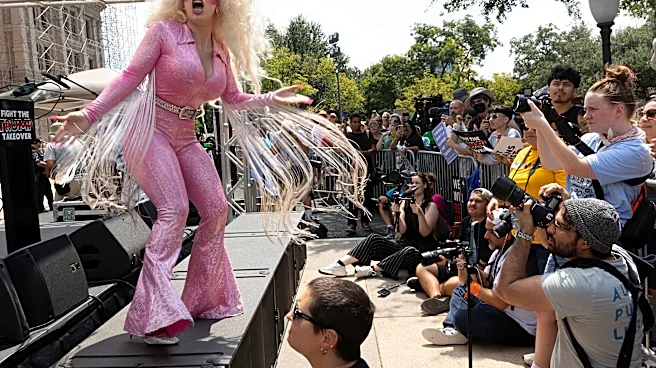






Drag performer Brigitte Bandit was only able to celebrate for a moment on Aug. 25, when a federal district court judge in Texas overturned the state’s drag ban for a second time. As she was awaiting the American Civil Liberties Union of Texas announcement about the win, she saw the video posted to Dolly Parton’s Instagram account that the singer had died that day.
“It kind of shot down my excitement, but I think the rest of the world got the news in opposite order,” Bandit told me on Aug. 28.
Bandit, a plaintiff in the ACLU's lawsuit, has a special relationship to the late country music legend. She went viral in 2023 for testifying in drag at the Texas Capitol against the now-overturned legislation, quoting a children’s book about the late country music legend’s
love of big hair and makeup. Later that year, she was gifted a rhinestone-studded guitar signed by Parton, who had seen the video.
"Dolly was discussed throughout this entire case, so for us to lose her the same day that it's struck down – literally what a surreal week it's been," Bandit said.
But despite the bittersweet feeling of the day, the new Texas ruling offered a glimpse of hope for the LGBTQ+ community in the South who have been caught in the crossfire of the Republican Party’s culture wars waged through government action.
Texas' drag show ban was part of the Republican playbook

The law, Senate Bill 12, was passed by the legislature in 2023 and signed by Republican Gov. Greg Abbott during a time when drag was being contested in states like Florida and Tennessee, and when members of the Proud Boys were showing up at drag queen story hours across the country.
"I watched this happen in real time," Bandit, a Texas native, told me. "They literally targeted me so many times."
The rule was struck down for the first time in 2023 after Bandit and the ACLU took the state to court. Then, in 2025, the ban was allowed to take effect by a Court of Appeals.
The law did not specifically mention drag performances, but referenced “sexually oriented performances” that could be seen by minors. What U.S. District Judge David Hittner,an appointee of President Ronald Reagan, pointed out in his ruling is that this overly broad definition could apply to swim meets or other innocuous activities.
Drag is not inherently sexual, even though the right wants you to think that it is. In a statement through the ACLU, Bandit noted that drag artists "use our performances to assert liberation, power, and joy with our community."
On X, Republican Texas Attorney General Ken Paxton called the ruling "a profoundly flawed decision that endangers our children and is an affront to Texas values," vowing to challenge it once again.
It's worth noting that Paxton has had a scandal-ridden political life, including an impeachment in the legislature and an extramarital affair.
Bandit noted that people should apply the same logic they have about government overreach and parental control to this scenario: "You want to talk about Texas values? How about you use those values across the board, instead of picking and choosing."
Dolly Parton's impact on drag, and the case, can't be overstated

Parton was known for her support of the LGBTQ+ community, and drag was a big part of that. She famously said, “It's a good thing I was born a girl, otherwise I'd be a drag queen.” A well-known anecdote she told was about her entering a Dolly Parton look-alike contest at a Los Angeles bar and losing.
"We could all be a little bit more like Dolly and support local drag," Bandit said.
Parton’s role in the court case is undeniable. She was mentioned in the ruling from Hittner. He compared the legislation against performances that appeal “to the prurient interest in sex” to Parton’s appearance as “a voluptuous sex symbol because of her big hair, flamboyant clothes and breast exposure.”
Hittner also noted in the ruling that Bandit needed to exaggerate her appearance using “a prosthetic breastplate and various accessories like wigs, false eyelashes, high heels, corsets, jewelry, and clothing” to emulate Parton and other female celebrities.
Bandit noted this in our conversation, pointing out that Parton is a great framework for explaining drag’s appropriateness for all ages.
“Dolly is such a wonderful example of heightened, exaggerated femininity that is not inherently sexual,” she told me.
It's something I have thought about in my own life, when I put on winged eyeliner that extends to the tip of my eyebrow.
Drag is where a whole community explores gender
Parton is inextricably linked to my own experiences with drag. As I wrote previously, my first drag show was a celebration of the singer’s birthday in Durham, North Carolina, while I was in college. As I’ve grown older and grew into my identity as a member of the LGBTQ+ community, drag took on a new meaning for me.
Drag, especially in the South, is necessary for the LGBTQ+ community. It is a place where we can explore gender expression in a welcoming space. Drag brings joy to people – in our conversation, Bandit mentioned performing in people’s front lawns during the COVID-19 pandemic as part of a “drag queen telegram” service called Extragrams, which was also a plaintiff in the lawsuit.
"The entire street would come out and watch the performance and have a moment where we could all be together even when we had to be apart," Bandit said. "It brought so much joy to people – people saw drag for exactly what it was."
Yet Bandit has also been the bearer of the intense hate the right has for drag performers, and notes the chilling effect that the now-lifted drag ban has had on performers.
"I watched it in real time," she said. "I watched as hate groups posted videos of me performing at a 21-and-up place next to me reading a book for children. And you wouldn't do that for an actor who's been in a rated R movie, and say that a rated G movie that he's been in is inappropriate. You know that actors and other entertainers can change and modify their acts for the audience."
People who believe that drag queens are mocking femininity or are inherently sexual have clearly never been to a drag show. And like Hittner said in his conclusion, “For those who find such activities as described in this case offensive, the solution is relatively simple… just don't go.”
I feel bad for people who don't understand what artists like Bandit do for our communities, and how necessary drag is to our culture. I feel bad that there are people so hateful, so stuck in rigid gender roles, that they will never know the joy that comes from seeing someone in a stunning costume perform a lip sync, read a story or do stunts that make your knees hurt just watching.
Ultimately, this ruling in Texas will make the state a better place for everyone.
Follow USA TODAY columnist Sara Pequeño on Bluesky: @sarapequeno.bsky.social
This article originally appeared on USA TODAY: A Reagan judge just read Texas' drag ban for filth | Opinion