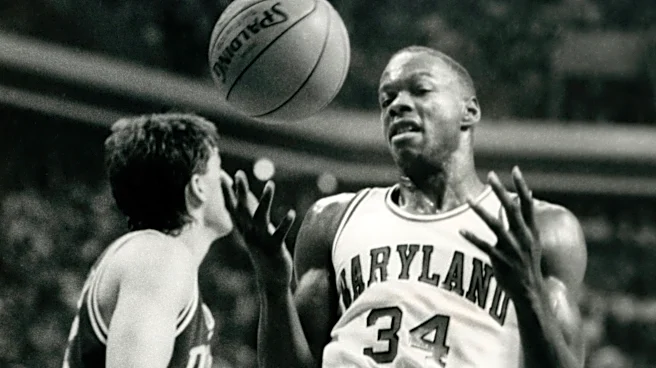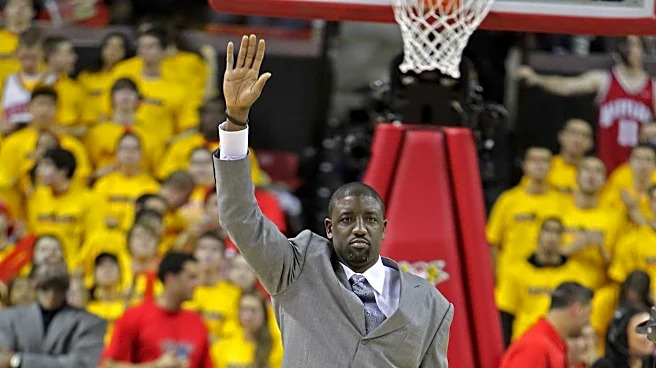

COLLEGE PARK, MD – If you liked college basketball in the late 1980s and early 1990s, you might remember “The Wizard.”
He could play every position but center. He came to the University of Maryland because he wanted to be like Len Bias.
“I remember playing pickup games on the playground, and right before the game started, we’d yell out who we were going to pretend to be that day,” he says. “I'd always yell out Bias. And that had a profound impact on me.”
Williams stayed at Maryland through a probation. Slicing and dicing, he kept his overmatched team hanging around against Christian Laettner and top-ranked Duke and played in the NBA for 11 years.

He came home and settled into the background, becoming first a youth coach for his sons and then a financial
advisor.
“I just thought that I learned so many things from playing a sport,” he told USA TODAY Sports. “And I didn't think that that's all I could do was just play basketball, so I always felt like if I set my mind to whatever I want to do, I can get it done. And I think the reason why I've always felt that way is because of the lessons I learned from playing the game, whether it was pickup games as a youth, or playing in high pressure situations at the college or pro level. It was always a learning experience for me.”
Williams’ sons are grown up now and he doesn’t coach anymore – “It takes a lot of time, he says, “I'm the type of guy that gets into it” – but loves to visit with kids.
He spent an afternoon in May along with Washington Nationals great Ryan Zimmerman and Washington Commanders standout receiver Terry McLaurin at a Bank of America “Golf With Us” event. The program has enrolled nearly 200,000 youth since its launch.
As he reflected on his childhood and his ensuing sports journey, Williams quickly went to his family.
“I knew whether I failed or I succeeded, I have so many people that love me, so it made me just say, ‘Hey, I might as well just go after it,’” he says.
Williams, 56, spoke with us about what it took to fulfill his sports dreams, but also the support that has carried him through his life and how we can show it to our kids while still pushing them to be their best.
From team manager to carrying the team: Riding a growth spurt, but also personal growth
Williams lived down the street from a middle school where he could join a Boys & Girls Club. Football was big and kids would play right in the streets, and he says they would even tackle there.
Williams can still hear the Pow!
"Something just made me go 'let me work on my basketball game,'" he says and then laughs.
He threw himself into playing on local courts but by the time he reached Crossland High School in Temple Hills, a Washington, D.C., suburb, he was about 5-foot-10. He started out as team manager of the junior varsity team but halfway through the season, when grades were released, some players got cut.
That’s how Williams got an opportunity to play. His father, who died in 1992, loved sports and watching his son play. Williams told The Washington Post for a 2016 story he could still see his father’s proud look when he spotted him in the stands. He lived for that look.
His mother worried about his grades, and he strove to please her academically.
“She pointed out to me the importance of education as it pertained to your opportunities in sports,” he says. “So I understood that connection pretty early on.”
 YouthonCourse.org" id="92869154007">
The growth spurt came, too. By his sophomore year, he was around 6-2, his junior year, 6-5, and his senior year, 6-8.
“My knees were killing me in high school,” he says.
He didn’t play much his sophomore year, when his team won the state championship, but as a junior and senior, he led Crossland back to the title game. They lost both times.
“I just felt like when it came championship time, I took a back seat to others and didn't step up in that leadership role,” he says. “And man, I can tell you, in college, my freshman year, I would think about those things. It wore on me. Even to this day, I can't believe I went to three state championships and only got one of them out of that.
“I just told myself if I was ever in that situation again, I'm not gonna take a back seat. I'm gonna accept that leadership role and I'm gonna step up to the plate. And ever since then, I just, it's just a mindset, that I felt like I wanted to have when faced with that situation and just understanding the magnitude of it, that people follow you and wanting the best for people. I think that it also humbles you, wanting the best for others.”
He didn’t reach the NCAA tournament in four years of college and had limited NBA postseason experience but, looking back, he sees what he really gained from all of those years on the court.
“Just so many lessons learned,” he says. “You can look at these kids and see the things they're learning out there, the growth in the game, as you watch them over time. So that's the best part for me to see that. As a player, I never understood that part because I wanted to just get into the game. But as a coach and a mentor, in that role, you like to see the practices, the growth in it all. And so that's really gratifying.”
Get to know everyone on your team. You can't coach them all the same way.
The feeling goes back to his connection to home. Williams was widely recruited – even by North Carolina’s legendary Dean Smith – but he didn’t want to leave his state.
“I could not leave my mama,” he says, laughing again. “I was like 17, 18 years old, couldn't get too far away from that lady ... and my girlfriend, my sister. I just wanted to play around my family and friends. I wanted to show them how good I could get.”
He wanted kids from his community to someday pretend they were him, as he had done with Bias. The silky smooth forward, also from Maryland’s Prince George’s County, had starred at Maryland and was the No. 2 overall pick in the 1986 NBA Draft by the Boston Celtics.
He never played for Boston, as he died from cocaine intoxication a couple of days later. Williams arrived at a program that would be troubled by a probation after committing NCAA rules violations under head coach Bob Wade.
Williams still wouldn’t leave Maryland, and Gary Williams, Wade’s successor, credits him with helping to hold the program together when it couldn’t play on television. During his senior year in 1991-92, he scored 26.8 points per game.
He credits the tutelage of high school coach Earl Hawkins, as well as Wade and Gary Williams, to help him become thick-skinned as a player, regardless of his environment.
He was an assistant at Sherwood High in Sandy Spring, Maryland, while two of his sons played there. He learned you couldn’t coach every player the same way.
“You gotta pay attention,” he says. “You gotta know your team, not only what they can do for you, in terms of whatever sport it is, but how do they learn, how do they have fun? Is it somebody that you need to joke around with? Just paying attention to those things. Because at the end of the day, you gotta make sure they're having a good time. …
“You just get attached to these kids, and just their process, wanting them to get better and wanting that growth to happen, and just figuring out the best way I could teach this kid and figuring that out and then watching them grow. There's nothing like that.”
When everyone has similar skills, how can you win out?
When he got to the NBA, Williams saw how everybody met a high skill level.
“When you watch a college game and you watch a pro game, it looks like those college players are playing so much harder,” he says, “but really what it is, is that they’re pros. They make it look easy.”
Williams learned to have a strong mental approach. The guys that lasted, like he would, learned to go beyond their skills and anticipate what would happen next.
Over his life, he had learned that whomever he was facing, he could overcome obstacles.
“These are the best in the world, and I'm right here with them,” he says. “It's a feeling that I really can't describe. Knowing that you can be at this level, it's a confidence that's within that carries across the line with just about anything I do.”
He’s now a financial advisor, who works with players in a world of Name, Image and Likeness that doesn’t appear to be going anywhere.
“You get your money at a young, impressionable age, but now the learning curve is earlier. You learn how to deal with those finances. You learn how to plan for taxes and monthly expenses and things like that a little bit earlier than we did in my day,” he says.

Players get NIL pay under terms of the House legal settlement with the NCAA. They can transfer every year without restriction. It’s a world, Williams says, that isn’t sustainable.
He says it’s just a matter of time before middle school kids get paid.
“You have to be able to control the environment to some degree,” he says. “I believe that these players should be getting paid at the college level. But I think it has to be regulated. I think you gotta put a cap on the age and I think that a player being a free agent every season, I think you gotta rule that out. I think it doesn't benefit the team, the coaches or the player.
“There's no way a college coach can come into your living room, offer a scholarship and then a year or two later come back and say, ‘Hey, I need that scholarship back because I need to go in the portal and I need to go get a better player who can impact the team right now.’
“From the other side, I can leave and go to another team, whoever the highest bidder is, now it’s all fair game. … I think that when you’re allowing kids that are so old to play in there, you hurt high school kid’s opportunity. It's supposed to be student athlete, and so I think that part is dwindling as we go down this path.”
Working with kids, including ones in the Youth on Course Program, he sees the other side.
“Sometimes parents can get focused in on how good the kid is and kind of supersede, ‘Are they having fun at this,’ ” he says. “And I think that, focusing in on that part, because it's about the and he’s learning, because at the end of the day, you can take things from that game that you can apply personally, professionally, whatever it is and help you succeed in life.”
Steve Borelli, aka Coach Steve, has been an editor and writer with USA TODAY since 1999. He played baseball in high school, rowed in college and spent 10 years coaching his two sons’ baseball and basketball teams. He and his wife, Colleen, are now sports parents to a college and high school baseball player. For his past columns, click here.
Order his "Youth Sports Survival Guide" for athletes and parents in time for the holidays
Got a question for Coach Steve you want answered in a column? Email him at sborelli@usatoday.com.
This article originally appeared on USA TODAY: College hoops 'wizard' is devoted to kid athletes. What's his advice?