







A coalition of six local governments led by New York City sued the Trump administration Monday to block its sweeping expansion of the public charge test, arguing the new policy could jeopardize immigrants’ green-card applications for using health care, food, housing and education benefits and frighten families away from assistance for which they are legally eligible.
The new rule, set to take effect Sept. 18, gives immigration officers greater freedom to consider whether applicants have used public benefits available based on income. Now, New York City, Chicago, San Francisco, Santa Clara County, California, Seattle and King County, Washington, want a federal judge to block it.
“Getting help when you need it is not the same as being dependent
on the government,” said Toby Merrill, litigation director at Public Rights Project, which is representing Chicago and Seattle. “But this administration is trying to blur that line to make it harder for immigrant families to access basic services. That will hurt families and entire communities, while leaving local governments to deal with the public health and financial consequences.”
The lawsuit, filed in federal court in Manhattan on Sept. 14, says the policy is so broad and unclear that immigrants may leave programs they are legally entitled to use rather than risk their future in the United States.
Receiving assistance would not automatically disqualify someone from obtaining a green card. But it could count against an applicant alongside factors such as age, health, finances and employment. The policy does not provide a complete list of which benefits immigration officers may consider. Federal guidance points to programs including Medicaid, food and housing assistance, tax credits and even financial aid for college.
But the local governments say the consequences could extend well beyond the immigrants whose applications are reviewed.
In Chicago, fewer residents with Medicaid could mean less federal reimbursement for ambulance services provided by the city’s fire department, leaving the city to shoulder more of the cost, according to the lawsuit.
In New York, the public hospital system estimates that more than 16,000 patients could lose Medicaid coverage under one projected scenario. That could cost the system tens of millions of dollars in its first year as more uninsured patients seek care.
New York City health researchers also modeled how the policy could affect immigrants younger than 65 and U.S.-citizen children in mixed-status households. Over five years, they projected that access to primary care could fall by as much as 9.9% and premature deaths could rise by as much as 10.6%.
Even the Trump administration expects the rule to have wider effects. In its economic analysis of the rule, DHS estimated that families leaving or avoiding assistance programs could reduce federal and state benefit payments by about $13 billion a year. The department acknowledged that hospitals, grocery stores, farmers and landlords could also feel the loss.

At the center of the fight is the meaning of “public charge,” a term in federal immigration law for someone considered likely to become dependent on the government. For decades, the test generally focused on whether someone was expected to rely primarily on cash assistance for income or need long-term institutional care paid for by the government.
President Donald Trump broadened the test during his first term to include several other forms of assistance, including food benefits, certain Medicaid coverage and housing subsidies. The policy prompted lawsuits and widespread confusion before taking effect in 2020.
The Biden administration reversed that expansion and restored a narrower standard in 2022.
Now, the second Trump administration is broadening the test again. DHS said the Biden-era standard was “unduly restrictive” and hampered officers’ ability to accurately decide who was likely to become a public charge. The department said the new policy allows officers to examine each applicant’s individual circumstances.
The cities and counties argue the administration has instead erased clear limits and given individual officers too much power, opening the door to unpredictable or discriminatory decisions.
They also say the rule could spread fear among people it does not directly cover. In some circumstances, officers may consider assistance received by an applicant’s child or another household member. The rule itself does not change who qualifies for benefits.
Past experience suggests those fears can change families’ behavior. One study found that food-aid participation fell disproportionately among noncitizens after Trump’s first public-charge expansion was announced, although nearly all were likely exempt. Another linked the earlier policy push to delayed prenatal Medicaid coverage among immigrant mothers in New York and lower birth weights among some newborns.
The lawsuit names DHS, U.S. Citizenship and Immigration Services and the leaders of both agencies as defendants. DHS did not immediately respond to a request for comment.
New York Attorney General Letitia James led a separate group of states in filing another challenge to the rule Monday.
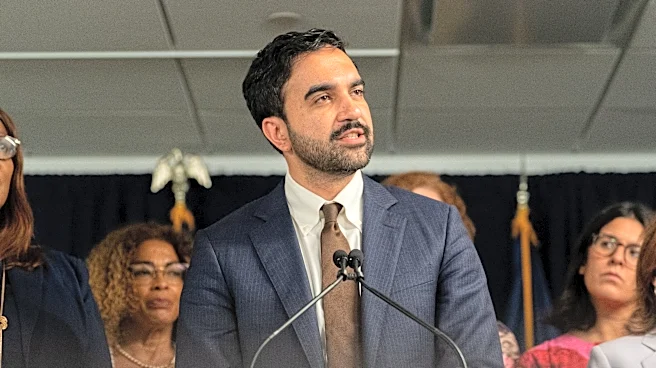
“The fear will not stop at the families that the federal government is targeting,” New York City Mayor Zohran Mamdani said. “Families who remain fully eligible for benefits will feel a chilling effect, and all New Yorkers will pay for it.”
This article originally appeared on USA TODAY: NYC leads lawsuit over Trump rule linking benefits to green cards