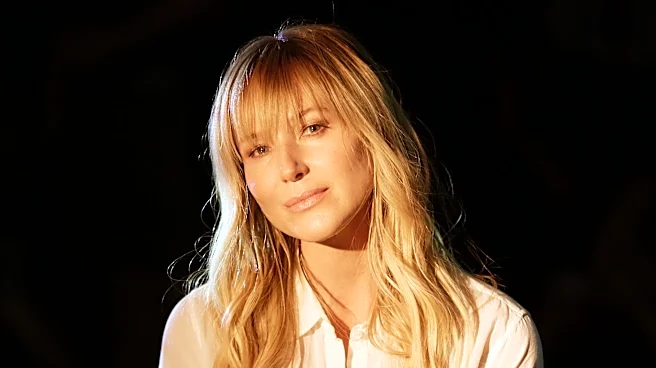








Jewel was 9 years old when she learned an important lesson about pain that would follow her for the rest of her life.
While she was a child performing in bars with her father, she watched the adults around her turn to alcohol, drugs and unhealthy relationships as coping mechanisms, observing that none of it seemed to make them feel any better.
“I remember I wrote down in my journal you can't outrun pain,” Jewel tells USA TODAY. “About a month after that, I learned that the buffalo is the only animal that moves into the heart of a storm, and it just hit me that the quickest way is through. It made a world of sense for me that rather than avoid my pain, I should move toward it.”
This realization shaped how the Grammy-nominated singer navigated her
own life. Years before therapy and mental health became part of the mainstream cultural conversation, Jewel was developing ways to understand her emotions, confront difficult experiences and change how she responded to them.
Now, at 52 Jewel has spent more than 25 years trying to share what she learned with other people. That work continues this year with the second annual Not Alone Summit and Awards which will take place from Nov. 2–4 in Las Vegas, bringing people together from entertainment, science, business, philanthropy and wellness to talk about mental health and emotional well-being.
For Jewel, that mission is rooted in experience.
“I moved out when I was 15. I had a lot of traumatic experiences in my life, and I was really determined to learn what to do with it,” she says. “I didn't want to accept the fact that I might have learned an emotional way of relating to the world in a dysfunctional house, that meant it would predetermine my future relationships.”
Without access to therapy or other traditional safety nets available to young people, Jewel says she began developing what she now calls her own “behavioral health toolkit.” Those strategies would eventually become part of the work she does through the Inspiring Children Foundation, which connects with young people on their mental health and well-being, and informs the mission behind the Not Alone Summit, which aims to give people practical tools they can use in their own lives.
Jewel's songs started as 'medicine' for herself
For Jewel, writing has always been one way to address her feelings and mental state. Long before songs like, “Who Will Save Your Soul,” “You Were Meant for Me” and “Foolish Games” made her famous, she says she used writing to change her own emotional state.
“Writing was the most effective tool I had at that age, and continues to be still the most effective tool I have,” Jewel says. “It's amazing what journaling will do for people. It helps you calm down, it helps your nervous system dilate, and it helps your blood pressure drop. Just the act of journaling gets you in a different physiological state and psychological and emotional posture.”
Eventually, the words she wrote to help herself became the foundation of her career.
“These songs that I wrote were medicine, I really wrote these songs because I desperately needed them,” she says. “I desperately needed ‘Angel Standing By,’ because I needed to hear somebody say that to me so I could fall asleep.”
She would write the words she needed to hear and say them to herself.
“It helped me, and it was amazing that my entire career has been based on these songs that I built as sort of medicine for myself and ended up feeling like medicine for other people,” Jewel says.
This philosophy continues to shape her work. Jewel recently released “Upon Meeting the Goddess of Love,” a six-minute poem she says has helped anchor how she thinks about life and her own emotional health. She's also expanded into visual art, creating sculptures that use environmental data to generate sound.
But after decades spent figuring out how to live with uncertainty, Jewel admits there is at least one thing she would tell her younger self to do differently: work a little less.
As a young artist who had experienced homelessness, Jewel says the possibility of failing and ending up back on the street terrified her. So she compensated by working relentlessly, at times performing five or six shows a day.
“I didn't want to have a regret of saying I didn't give it everything I had,” she says. “But oh my gosh, everything I had was like inhumane levels of work.”
What Jewel learned about fame and self-worth
When Jewel's career took off in the 1990s, she was among the artists who embraced the internet as a way to communicate directly with fans. She made a deliberate decision to be honest about herself rather than trying to maintain a pristine public image, but social media has fundamentally changed the scale of that exposure.
“My life changes from the inside out. My life does not change from the outside in,” Jewel says. “What fame does, or what social media does, is it tries to lure you and seduce you into thinking you can change how you feel if you can just get your outer world to change, and that's ... just never going to work.”
Jewel says she’s had to learn this lesson while navigating her own celebrity. While fame can offer the appearance of external validation without necessarily changing how someone feels about themselves, she now sees how social media exposes far more people to a version of that same dynamic, where likes, followers and other people's opinions can become measures of self-worth.
“Fame is very dramatic. It isn't a healthy thing,” she says. “It's like interacting with a heroin or a nuclear substance, and thinking it's going to work better for you than somebody else. It's toxic.”
Jewel on the pressures facing young people today
The mental health landscape looks radically different from when Jewel began doing this work more than two decades ago. Therapy and mental health are discussed more openly, but young people are also navigating pressures that didn't exist when she was their age.
“The youth are overwhelmed. There's so much coming at them all the time,” Jewel says. “Their worlds are noisy.”
As a parent herself, Jewel says one of the most useful ways to help young people is to “simplify what has access to them, and what has access ultimately to their nervous system.”
The problem isn't exclusive to teenagers, Jewel says, admitting she can't keep her own phone's notifications on because the constant alerts have become a “Pavlovian experience.”
That relentless access also means ordinary teenagers are now confronting something once reserved largely for public figures: the feeling of being watched, evaluated and criticized by an audience.
“You can have a 14-year-old trying to navigate that much public awareness, that much critique about their appearance every day, and they're just a normal 14-year-old that isn't having a music career,” she says.
Jewel wants to expand what mental health care can look like
For someone who didn't have access to therapy when she was struggling as a teenager, making practical tools available outside of a clinical setting has become an important part of Jewel’s work. It's also informed by what she's learned over more than 25 years working with young people through the Inspiring Children Foundation.
The summit grew out of the foundation's Not Alone Challenge, a social media campaign created by the young people involved with the organization, and has since evolved into an event recognizing people working to change how mental health and emotional well-being are addressed.
“We decided to do an awards show and a summit … to really honor the people, the pioneers and the heroes that are fighting for our emotional well-being,” Jewel says.
Jewel sees the summit as a way to expand the conversation around what mental health care can look like, giving people more ways to take care of themselves in their everyday lives beyond just therapy.
While the awareness surrounding mental health has changed considerably since Jewel was a teenager, she believes simply talking about it isn't enough. The next step, she says, is making sure people have tools they can actually use. For Jewel, that's ultimately what the Not Alone Summit is about: taking lessons she once had to figure out for herself and making them easier for someone else to find.
“People just started sharing and connecting and communicating,” Jewel says, talking about what she’s experienced and witnessed at the summit. “We need connection. You know, we're starving for meaningful, real connection.”
This article originally appeared on USA TODAY: Jewel says her top songs were 'medicine' amid mental health issues. Now, she's helping others