




Has it really come to this?
In 1971, 24 college men took part in what became known as the"Stanford Prison Experiment," a psychological experiment of questionable methods meant to study the effects of prison life. What it ended up was one of the most infamous examples of institutional abuse, pseudo-science and unethical behavior on record.
The flawed and failed "study" prompted a new level of scrutiny and review in the American scientific community and is widely regarded as both unscientific and fraudulent. It led to real harm and abuse to the participants involved. And yet, 55 years later, Netflix has decided this is a great place to find its next great reality TV show.
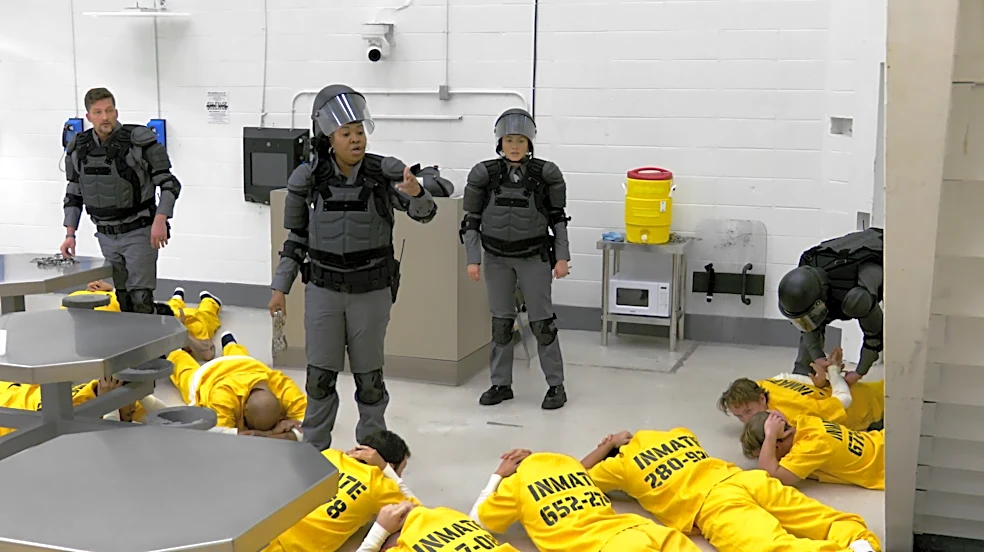
The "New Stanford Prison Experiment" (now streaming) is a recreation of the
original "study": Participants are randomly assigned roles as guards or prisoners in a simulated prison environment. And, of course, it happens while cameras catch the action and record "Love Is Blind"-style confessionals with each participant. And, of course, they each have a heart-wrenching and thematic back story.

Although theoretically "supervised" by a Harvard behavioral psychologist, a journalist and a retired federal corrections officer, "Stanford" is not an experiment but an entertainment show, just like "Blind" or any other reality TV show which puts real people in artificially heightened environments to try to wring drama out of their behavior.
"Stanford" turns the approach of reality TV quite literal: The participants are in an actual prison, but it uses all the same tactics that "The Bachelor" and "Survivor" have used for decades. The cast of "Love Island" is confined to a single space, albeit quite more lush. Reality TV show contestants are routinely denied food, freedom of movement, access to the outside world and even clocks as part of the artificial environment producers create. Faux power dynamics are routinely created, whether it's who gets to decide who to couple up with on "Island" or who has the most dominant alliance on "Big Brother."
"Stanford" pretends to be some kind of revolutionary experiment out to find some universal truth about humanity, but it is no different than "The Traitors" in prison jumpsuits.

But perhaps what is revolutionary about "Stanford" is the boldface admittance that reality TV is quickly ceasing to be a medium of interesting storytelling and simply becoming an arms race of shock, awe and disgust.
Streamers, in particular, can't wait to find the next most outrageous concept for the genre, from turning a show about mass murder into a game show ("Squid Game: The Challenge") to "romance" that draws lawsuits and emotional trauma("Blind") to yet more lawsuits from YouTube-ified stunt shows("Beast Games").
When Gene Wilder's voice is being ripped from his grave in an AI-travesty for a glorified combination of "The Amazing Race" and "Wipeout," we all need to take a step back and think, "What are we doing here?"
Constant conversations in 2026 are about what our post-COVID, politically divided and increasingly less civil world is supposed to be. The kids can't read or act properly in school. The "Gen Z stare" is plaguing baristas near you. You can't walk into the world without being assaulted by lights and sounds and sex and sports gambling ads. How do we act? What do we do? Is this what we need to be entertained, recreation of something that once turned regular college kids into torturers?
“Anyone can see we’re living in a moment where we are constantly confronting questions about authority, conformity, group identity, and the systems that divide us,” "Prison" executive producer Jane Lipsitz told Tudum, Netflix's content platform. “It felt like the right time to revisit that question with a new generation and ask whether power inevitably changes us − or whether we’re capable of resisting the roles, the rules and the systems we’re placed into. What we discovered during this process was something we never saw coming.”

The show doesn't discover anything new or revelatory. In the end, it is a very poor rendition of reality TV that started with the likes of MTV's "The Real World." It is dressed up the trappings of prisons and scientific experimentation to catch your attention. Most of the episodes feel more staged than your average awards show.
We live in an attention-seeking economy. Everyone is after your attention, be it Netflix and other TV networks and streamers, TikTok videos, billboards, AI memes on Facebook, scam text messages, Hollywood blockbusters, your group chat or any of the one million notifications on your phone. Everyone (every company and corporation) is trying to break through the noise.
And amidst this glut of stimulation and information, the content is going to get more desperate, more exploitative, more inflammatory and gratuitous. But we don't have to lower ourselves to those standards. If it doesn't deserve our attention, we can just move on.
For all the problems with other reality TV, almost every other show mentioned above is a better choice than "Prison" or "Squid Game: The Challenge" or "Beast Games." Almost every other one offers cultural value and a storytelling point of view that aims for something other than keeping your eyeballs affixed to the screen at all costs. There are plenty of regular TV dramas and comedies similarly doing worthy work.
Reality TV may yet sink lower, but "Prison" feels like we're at the bottom. Don't join the producers and Netflix down there.
This article originally appeared on USA TODAY: How depraved can reality TV get? Meet Netflix's 'Stanford Prison Experiment'