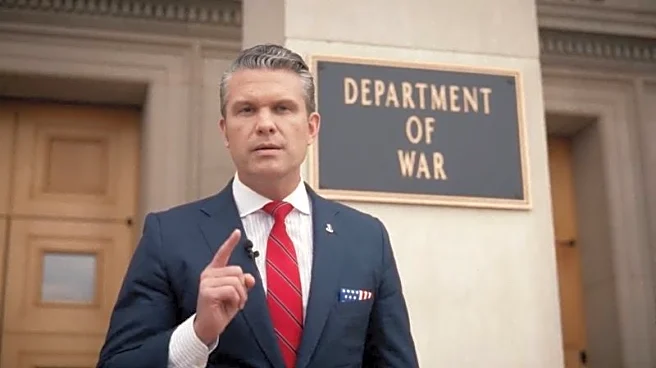






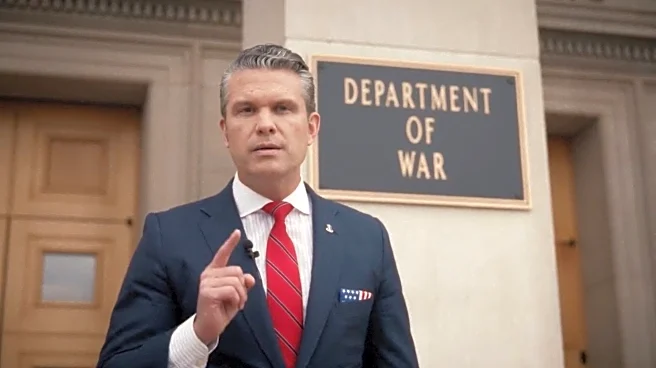

WASHINGTON – Pentagon chief Pete Hegseth’s impeachment fight will begin in the evening on Nov. 10, when the House of Representatives is slated to hold its first vote on the effort led by Rep. Thomas Massie, R-Kentucky.
The anti-war Republican filed eight articles of impeachment against Hegseth on Nov. 9, renewing a bid he launched in September to oust Hegseth from the Trump administration.
The first four articles of impeachment relate to the Iran war, specifically accusing Hegseth of violating the Constitution by conducting military actions without congressional approval and ignoring laws intended to minimize civilian casualties. The remaining articles deal with a range of issues, such as the capture of Venezuelan leader Nicolás Maduro and strikes
against suspected drug boats in the Caribbean Sea.

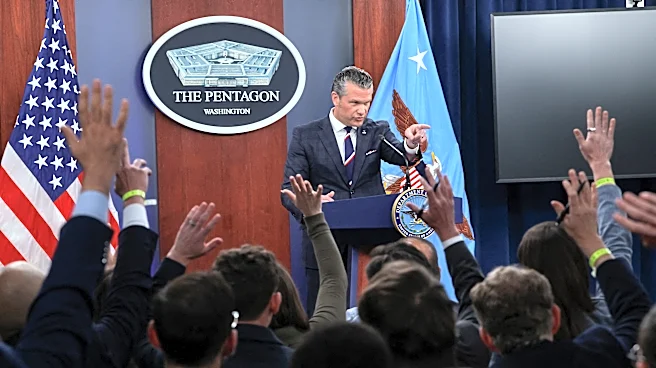
Hegseth called the impeachment effort a “farce” during a press briefing Nov. 10, dismissing it as a defeated congressman’s attempt at revenge after losing his seat in the House. Hegseth and President Donald Trump endorsed Rep.-elect Ed Gallrein, who beat Massie in the Republican primary election.
“What one disgruntled and defeated congressman is attempting is not oversight and it's not accountability,” Hegseth said. “It’s a stunt and everybody knows it.”
Massie has said that he wants this impeachment vote to make clear whether the power to wage war lies with Congress or the White House, and urged his fellow lawmakers to seriously consider the allegations against Hegseth.
“We’re not indicting him for being bad at his job,” Massie told reporters Nov. 9. “The argument here is that he’s broken laws and he's violated the Constitution.”
Here's what's in Massie's articles of impeachment, and what happens next:
Iran war front and center
The first three articles of impeachment allege that Hegseth violated the Constitution by directing the U.S. military to sustain hostilities against Iran despite the absence of congressional approval.
Massie’s impeachment resolution specifically cites the War Powers Act, which requires the president to end combat operations after 60 days unless authorized by Congress.
While the president serves as the commander in chief of the armed forces and has the power to command the military, the Constitution says that war must be declared by Congress. The House and the Senate have both adopted resolutions instructing Trump to end the war in Iran, but none have been binding.
“Secretary Hegseth continued to direct, authorize, and sustain the use of United States Armed Forces in hostilities in the Islamic Republic of Iran after the expiration of every potentially applicable statutory period,” Massie wrote in the impeachment resolution.
Frustration with the Iran war itself and the spike in gas prices it caused emerged as key issues in last week's midterms that overwhelmingly swept Democrats to power, a reality both President Donald Trump and Vice President JD Vance have since acknowledged.
But the focus on Iran in Massie’s impeachment resolution apparently alienated some fellow Republican critics of Hegseth, who may have otherwise supported the measure.
Rep. Don Bacon, R-Nebraska, told reporters on Nov. 9 that Massie's resolution didn't address his main problems with Hegseth, including his purge of high-ranking military officers and withholding of congressionally appropriated funds for Ukraine.
“We have eight articles and I’m not very sympathetic to those articles,” Bacon, who is retiring at the end of the term, said. “I see a need to have gone into Iran.”
Civilian casualties in Iran
The fourth article of impeachment alleges that Hegseth ignored laws directing the military to minimize civilian casualties at the start of the war against Iran.
Massie cited the U.S. missile attack against an Iranian primary school that killed at least 168 people, the majority of whom were children. The strike was the U.S. military’s worst civilian casualty event in decades.
The Pentagon has yet to release the findings of an investigation into the Feb. 28 airstrike on the Shajareh Tayyebeh school, which occurred on the first day of the Iran war.
The article of impeachment accuses Hegseth of acting “in a manner that foreseeably dismantled the safeguards necessary to distinguish civilian objects from military objectives.”
“We’re not indicting him for being bad at his job,” Massie said. “In fact, he was very effective at killing school children in Iran.”
Hegseth indirectly addressed the allegation during his press conference.
“The claim that the American military targets civilians, well, that is a lie and that is a slander against every professional who flew, sailed, and fought on these missions,” he said. “The only people who target civilians are the terrorists that we hunt, and I will dignify this claim no further.”
Military operations in Yemen, Venezuela, the Caribbean Sea
Three of the remaining impeachment articles accuse Hegseth of violating the law by conducting “extrajudicial killings” of alleged drug traffickers in the Caribbean Sea, risking the lives of U.S. service members in the operation to capture Maduro, and directing military action in Yemen without congressional approval.
U.S. Southern Command has led an operation to target suspected drug boats in the Caribbean Sea since September 2025. The U.S. military has killed more than 240 people since the start of the campaign.
Hegseth has alleged that the boats were carrying narcotics and the people killed were drug traffickers, but the Pentagon has provided scant evidence to back up its claims. Lawmakers on the congressional armed services committees in the House and Senate have repeatedly said they have serious concerns about the strikes.
“By subjecting persons merely suspected of criminal conduct to lethal military force without judicial process, without congressional authorization, and without establishing a lawful basis for treating such persons or vessels as military targets, Secretary Hegseth arrogated to himself and the Executive Branch the roles of judge, jury, and executioner,” Massie wrote.
The impeachment resolution also takes issue with the operation in Venezuela to bring Maduro to the United States to face criminal charges. Massie described the military operation as an “act of war against a sovereign country executed under the guise of narcotics law enforcement.”
The fourth military operation mentioned in the impeachment resolution is the U.S. campaign in Yemen in 2025, which Massie alleged was conducted without congressional authorization in contravention of the Constitution. U.S. Central Command targeted Houthi assets in Yemen to prevent attacks on commercial shipping vessels.
Hegseth has criticized Massie’s effort against him as “impeachment for success.”
“Let’s be clear about what this resolution actually does,” he said. "It tells our enemies: Iran, the cartels, every adversary watching, that the United States will actually punish its own warriors and its own civilian leadership for successfully executing lawful military operations.”
Pentagon investigation of Sen. Mark Kelly
A final article accuses Hegseth of violating the First Amendment and weaponizing the Pentagon to intimidate Sen. Mark Kelly, D-Arizona.
In November 2025, Kelly, a retired captain in the Navy, participated in a video with other Democratic lawmakers to tell U.S. troops they can refuse illegal orders. Trump accused the lawmakers of “seditious behavior, punishable by death.”
Hegseth subsequently censured the Arizona senator and ordered the Pentagon to open an investigation that could result in punishment, such as the reduction of Kelly’s military rank. In January, Kelly sued Hegseth and the Pentagon to block the effort to punish him. A federal judge sided with Kelly, but the Justice Department has appealed the ruling.
Kelly criticized Hegseth in comments to reporters on Nov. 9, saying that the Pentagon chief “should have never had the job to begin with.”
What happens next
House GOP leaders are set to hold a procedural vote tonight that could set aside Massie's resolution, essentially killing it.
If that motion fails, the House would likely set a vote on the articles of impeachment for Nov. 11. Massie indicated he would request separate votes on each article.
"I’ve heard from several members they agree with some of the Articles of Impeachment but not all of them," he wrote on social media. "If the motion to kill my resolution by referring it to committee fails, and we proceed to the Articles themselves, I’ll request a vote on each of the Articles separately."
Any articles that pass the House on a simple majority vote would be sent to the Senate, which would vote to either hold a trial or dismiss the charges. Dismissing the charges would require a simple majority vote.
It would take a two-thirds majority vote in the Senate to convict and remove Hegseth — a very high bar.
Only two Cabinet members have ever been impeached by the House. Neither was convicted in the Senate.
This article originally appeared on USA TODAY: Why Pentagon chief Pete Hegseth is facing impeachment