








COLORADO SPRINGS, CO – What drives Trevon Jenifer?
When he thought about the question six or seven years ago, he was an established elite athlete.
“Along my journey, I kind of felt like you always had to be bigger, stronger, faster in order to be good at a sport,” he says.
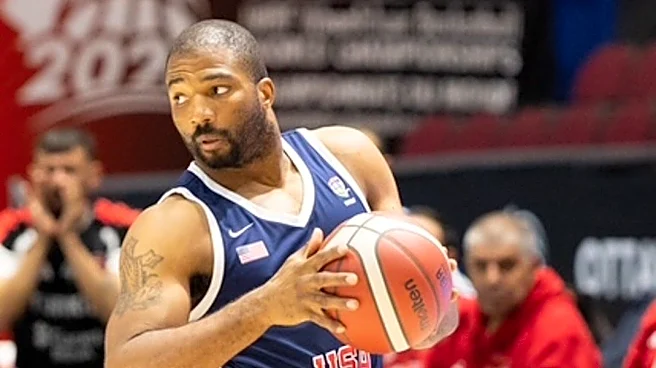
Jenifer, who goes by "Trey," had gone 32-8 as a high school wrestler his senior year in southern Maryland, competing against able-bodied opponents. He had won a gold medal as a member of Team USA’s wheelchair basketball team at the 2016 Rio Paralympic Games and a bronze in London in 2012.
He thought he was fueled by negative self-talk during games and competitions.
“What I didn't realize is that the negative talk actually had a physical impact on my body when we did a visualization
exercise,” he says, “where I felt, like, energy was actually being lost. So at that moment, I knew that the more uptight you are, the more you couldn't play loose.”
Jenifer was speaking with USA TODAY Sports at this week’s TrueSport Talks, which brought sports figures, coaches, administrators, medical professionals and others together to discuss mental wellness and the digital pressures athletes face.

Jenifer, 38, is an ambassador for TrueSport, founded by the U.S. Anti-Doping Agency (USADA) with a goal to change the culture of youth sports by providing athletes, coaches and parents with resources to promote positive life skills on and off the field and court.
“When it came to sports psych, I was just like, ‘It's not something I really need to dial in, because I feel like I know me better than anyone else knows me,’ ” Jenifer says. “And it wasn't until I started actually sitting in the sessions, and I started realizing that there's an in-depth version of myself that I didn't realize there was.”
Jenifer has congenital phocomelia, a more complicated way of saying he was born without lower limbs. He has gone on to win two more Paralympic gold medals in wheelchair basketball, including 2024 in front of his family in Paris.
He is a father of three, and a sports dad, who shared insight with USA TODAY Sports on how athletes can compete with a clear mind through their sports experiences.
Buy into what you believe. You never know how far it will take you.
One of seven children, Jenifer started playing basketball in Washington, D.C., at 4. His parents found him a team called Air Capital, which featured wheelchair basketball and track, and they continued to promote sports so it became a part of their son’s identity.
“They were really supportive in the sense that I was able to actually travel and compete against people that look like me,” Jenifer says. “And I think that that was huge, finding a community that looked like me, that could talk like me, understands the things that I've been through, because I'm the only one in my immediate and extended family to have a disability.
“So to be able to have a community that's like, OK, we see you, we accept you, but then we'll also compete against you and not hold back against you, that's something that you need to see at a young age.”
Jenifer stopped track and basketball and transitioned to theater, “but it didn't bite the edge,” he says. The family moved to Calvert County, Maryland, and his father suggested he pick up wrestling. After going 17-18 his junior year of high school, he finished third in the state as a senior at Huntingtown High.
“We knew that in between my first year and my second year wrestling, we needed to make changes for me as an individual with no legs instead of trying to wrestle the conventional way,” he says. “And that's what we worked on in that offseason. And eventually, we were able to get some success out of it.”
His handwork helped him transition back to wheelchair basketball, which he played at Division II Edinboro University of Pennsylvania.
He arrived raw and unpolished, having been away from the game so long, but made it his craft. Just watch the 2024 Team USA Paralympic gold medal victory over Great Britain to see Jenifer make pinpoint give-and-go passes and a long, easy arcing one to teammate Jake Williams for a layup.
The practice shots still come relentlessly – at least five days a week – and he plays weekly games. He plays as part of the National Wheelchair Basketball Association (NWBA) and his goal is to get back to the 2028 Los Angeles Games.
“You don't realize that 1% is better than nothing,” he says. “And I've gained more than 1% just buying into a certain aspect that I didn't think would be able to help me at all. Now, if I do buy into it, it doesn't help me at all, there's nothing lost. But if we're talking about gaining a 1% gain in order to be better for tomorrow, that's growth. And that's the growth that we're looking for.”
'It's a time for me to turn off': Relax, and allow your kids to find their sport
Jenifer and his wife, Laura, who live in Washington, D.C.’s Virginia suburbs, have three kids ranging in ages from 11 years old to 16 months.
Jenifer has ramped up his personal bar so high – three consecutive Paralympic gold medals with his team – that he has had to hold himself back with his kids’ sports.
His daughter Saraeya, 11, has gotten into softball, and he calls Keiden, 7, “a gifted athlete.” He plays baseball, soccer and flag football, but, really, whatever is in front of him.
“It's a time for me to turn off,” Jenifer says. “Put on my dad hat, be a spectator, love the sport for what it is.”
He holds back from getting too deeply involved. Keiden particularly loves basketball, and asks his dad to coach.
“Not yet, my guy,” Jenifer replies.
“This is their opportunity to find their identity,” he says. “And I think a lot of times with youth sports, a lot of that's lost because people are playing through the eyes of their children and not letting their children dictate it. Because I would hate for my children to be burned out because of me at such a young age.
“What it takes to play at this level, it's a lot of sacrifice,” Jenifer says. “A lot of time away from home. And when your kids want to have you as a coach, it's just one of those things where I know where I'll go when I'm in that mindset. And 9 times out of 10, it's not always the greatest, especially for a child looking to get into the sport. So for me, it's about allowing them to find their like and their love. I don't push them toward basketball because I don't want that to be their identity because of dad. I want them to find their sport.”
Watch your social media habits: Who are you giving power to?
Self-confidence, and knowing who you are, is everything as an athlete, and as an individual navigating life.
Jenifer brought up a scenario with which you’re probably familiar: His kids strike out, and they look to one of two places – a coach or a parent – for validation. At the end of the game, he tries to turn the scenario of “how did I do?” back to them.
“Why don't you tell me what you think?” he says.
It allows them, he says, to tell him they did well or they need to improve, and to own the answer. He then asks them why.
“I feel like we're empowering them to understand what they want, but also giving them the sense of being able to grow with their self-confidence,” he says.
It’s the idea of us having a strong impression of who we are as athletes, and not minding as much what others think of us. At the TrueSport Talks, Jenifer was part of a panel on “Hyperconnectivity, Social Media Pressure, and the New Performance Environment.”
He talked about how after games, our kids are on social media or listening to what people are saying. He and the other panelists – family physician Deborah Gilboa and University of Colorado-Colorado Springs basketball player Mya Wilson – acknowledged social media is here to stay and kids depend on it as part of their personal lives, as well as to get noticed by teams.
But how much are we looking to our likes and follows as validations?
“Social media gives you instant gratification or instant validation, whether that's positive or negative,” Jenifer said during the discussion. “I (say), ‘I played great (or) really terribly,' I can go to social media and guarantee I can find a comment that agrees with what I said. Or if I had a really great game, that gratification is going to be clipped in that situation. So I know that no matter what, I'm going to find something that is going to validate what I just thought about myself.”
But there is the danger of us falling in a pit if we don’t like what someone said.
“Whether I had a good game or I had a bad game, I don't want those external factors affecting me, but I also don't want to leave (out) other individuals that are reaching out for positivity or reaching out for a sense of inspiration,” Jenifer says.
His wife monitors his social media account so he can maintain his emotional stability for competition. Leading up to Paris, she noticed a Pokémon comparison she didn’t like.
“Who was it?” Trey asked her.
She didn’t know.
“Why does it matter?” he said. “She turned around and came back to me, and now that's affecting me. We’re giving power to these individuals in these posts. I tell my kids, ‘Does it matter what they say? How does that change you emotionally?’ ”
Nine times out of 10, he finds, he hasn’t seen or spoken to people who comment on his social media.
“You're saying somebody has to earn your response,” Gilboa, the family physician, said to him on the panel. “And that's maybe a way to talk about it with your athletes. Respond to the comments or the posts that earn your response by respectfully asking you a question or disagreeing about something or telling you a story that was moving to you or connected in some way, but they earned it. We don't all of a sudden work for everybody who comments on every post that we make.”
How to feed your mind in the heat of an athletic moment
Jenifer sees himself as a work in progress in terms of his self-talk. We all are, especially as athletes. Self-confidence was something he had to learn on the basketball court.
He also has realized it isn't just displayed on court.
“When I'm on the bench, my teammates are seeing that as well,” he says. “Man, I just messed up and everything is being observed. If we can get people to understand that, the buy-in of yourself, no one needs more than that.”
When he starts to identify negative self-talk, Jenifer thinks about a reset. A reset is something we can practice before the season and then implement in real time.
Kevin Chapman, a psychologist and the director of the Kentucky Center for Anxiety and Related Disorders, walked the group at the TrueSport Talks through a reset. It operates on the principle that emotions aren’t weaknesses, they’re information.
You can practice a reset, Chapman says, by taking one slow breath in through your nose for four seconds and out through your mouth for six seconds. Pick a word that will be your cue word to help lock you in: calm, next, steady, chill, focus, relax. And then think about the next play.
“When you're actually warming up and getting ready for the season, start implementing these strategies so that when you have two minutes left on the clock, when you are down six and you’ve got the ball with one timeout left, we have a skill that we're already using,” says Chapman, who has worked extensively as a mental performance coach for athletes.
The reset operates under the Ted Lasso “goldfish” theory of having a short-term memory in sports. Jenifer understands he can’t control the past and he doesn’t know what the future holds. He is present.
He admits he has good days and bad days, but he tries to stay even-keeled and be the best version of himself on the court, with his family and in his job with the U.S. Secret Service.
“I think all too often we try to be other things,” he says. “But when you start to realize that being the best version of you allows you to be a better basketball player, a better student, a better worker, a better parent, then you start to realize how many different things that you can actually have an impact on. But if I'm 50% in belief of myself, what does that mean that I am in the other hats that I wear? So being the best, it starts with me. And if I'm not OK, it doesn't help any of the other facets of my life.”
Steve Borelli, aka Coach Steve, has been an editor and writer with USA TODAY since 1999. He played baseball in high school, rowed in college and spent 10 years coaching his two sons’ baseball and basketball teams. He and his wife, Colleen, are now sports parents to a college and high school baseball player. For his past columns, click here.
Order his "Youth Sports Survival Guide" for athletes and parents here.
Got a question for Coach Steve you want answered in a column? Email him at sborelli@usatoday.com.
This article originally appeared on USA TODAY: The mind of a champ: Paralympic star shows how to win at mental game