

"Let's have a parade!"
The ceremonial battle cry of Macy's Thanksgiving Day Parade kicks off a cherished holiday tradition for millions of people nationwide.
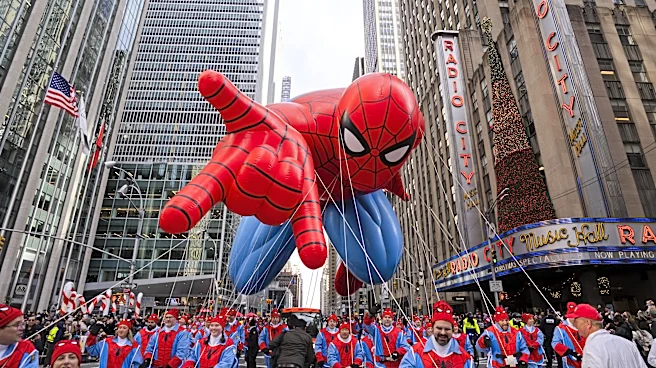
It's followed by its signature soaring balloons, shimmering floats and jolly characters that have made this parade a dazzling national spectacle for a century. It has withstood historical trials. It has seen pivotal advancements in production and technology. And it has served as an important cultural time capsule.
"It is a really interesting record of American entertainment and consumer experiences that is then framed into art through these really interesting floats and balloons, that then have this layer of design and interpretation that are also of their time," said Emily Pazar, assistant
curator of Decorative Arts and Material Culture at The New York Historical.
The Macy's Thanksgiving Day Parade is what defines the holiday for Vienne Peters, who grew up in the Jersey Shore community of Forked River.
Her father, Donald Zabroski Jr., has attended nearly every parade since he got his driver's license. He took her to her first parade when she was 5 years old, and seeing it in person has been a beloved tradition ever since.
"I looked forward to going every year; I couldn't wait to get up at like 3 a.m. to get on the road," she said. "That's just what Thanksgiving was to us."
She looks back fondly on years of braving the rain and the snow, and the building anticipation in the crowd as time ticked closer to the start of the parade. The family has met people from all over the world — many of whom didn't know of Thanksgiving, Zabroski said.
"I used to get up on a ladder — back when you could do that — and explain to them what Thanksgiving was all about, thank God for what we have and then I would get everyone to sing 'God Bless America,'" he said. "It's a good way to unite people. It's Thanksgiving, a day to be thankful for what we have. And especially seeing the happiness and the excitement on people's faces, the tradition of going to the parade is an important thing to carry on."
The parade debuted in 1924, and took a two-year break during World War II. This year, it celebrates its 100th edition.
"It’s a privilege to carry forward a tradition that has become part of how generations of families kick off the holiday season. The Parade began more than a century ago as a gift from Macy’s colleagues to America, with the simple goal of bringing people together in shared celebration," said Sharon Otterman, Macy’s chief marketing officer. "That same spirit is still at the heart of the Parade today. It’s more than a spectacle. It’s a shared experience that people return to year after year, and we never take for granted the role we play in creating those unforgettable moments and memories."
How the Macy's Thanksgiving Day parade started
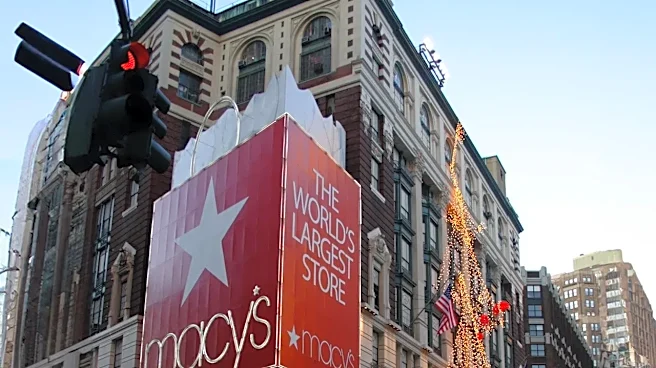
Macy's first opened in 1858, when founder Rowland Hussy Macy established a store in Manhattan on Sixth Avenue, between 13th and 14th Streets. The store quickly expanded with innovative industry practices, including fixed pricing, cash-only sales, aggressive advertising and first-to-market products.
It also pioneered early holiday traditions, like introducing the first in-store retail Santa in 1861.
The store also began incorporating elaborate holiday window displays in 1874, with the first scene featuring porcelain dolls arranged in scenes from "Uncle Tom's Cabin." And in 1899, the displays upgraded to animated, moving figures and hand-built sets.
After years of rapid growth, Macy's moved its flagship store to Herald Square in 1902. It had outgrown its old site, and the new location offered a more modern space — with escalators, a mechanical package delivery system and dedicated employee amenities — that was well-connected to public transportation.
By the 1920s, the store needed to expand. And with that expansion came enthusiasm about how the store could further be promoted for the holiday season while also offering something to the community.
The Macy's Thanksgiving Day Parade was born.
The Macy's Christmas Parade in 1924 was an idea conceived by Macy's employees, many of which were first-generation European immigrants who wanted to create the grandeur of old-world European festivals and street parades in New York City. It drew inspiration from the Philadelphia Thanksgiving Day Parade, which started in 1920.
The inaugural procession stretched six miles, running from 145th Street and Covenant Avenue in Harlem to Herald Square on 34th Street.
Employees marched in colorful, vibrant costumes of traditional festival figures like clowns, knights and princesses; and live animals from the Central Park Zoo — those long considered "beasts of burden" in traditional European festivals like elephants, bears, camels and lions — were guided down the street.
Floats depicting famous European fairytales and nursery rhymes, like "Little Red Riding Hood" and "The Old Woman Who Lived in a Shoe," also glided along the route. They matched a store window display designed by artist and puppeteer Tony Sarg titled "The Fairyfolk Frolics of Wonderland," featuring an animated fairy city with hundreds of moving marionette figures and nursery rhyme scenes.
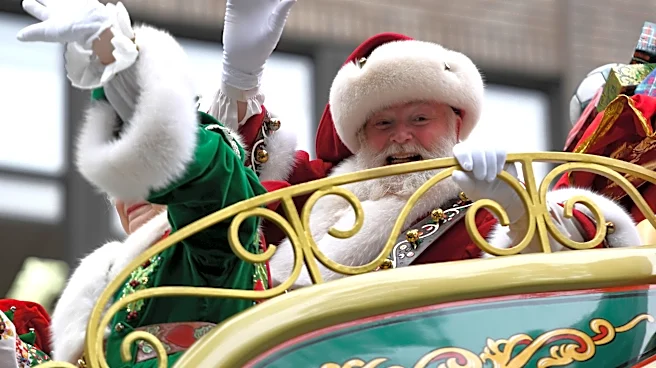
Santa Claus wrapped up the parade, crowned as "King of the Kiddies" at the Herald Square store.
The event was an instant success: It drew more than 250,000 spectators in its first year, and Macy's executives immediately decided to make it an annual tradition.
Introducing the parade's signature balloons
Macy's debuted its signature giant balloons in 1927 — the same year it officially changed its name to the Macy's Thanksgiving Day Parade — to replace the live animals that had been featured during the parade's first few years.
"I think there first was a lot of thrill at the spectacle of how big and impressive the parade was. But then reports started coming in that kids were actually scared of being that close to the animals," Pazar said. "So just a few years later, they transitioned away from the animals because of the feedback, but also because they had this great idea."
And that idea was "upside-down marionettes" guided by handlers walking along the street. Sarg was hired to design the event's earliest inflatables, stitched together out of rubberized silk by the Goodyear Tire and Rubber Company, who produced most of the parade's giant balloons until 1980.
Felix the Cat was the event's first-ever character balloon, designed to look simple, stiff and comically charming. It was filled with air, not helium, so it couldn't float on its own. Felix the Cat was carried by handlers using large wooden rods and stilts.
Macy's switched to helium in 1928, making it easier to guide these massive inflatables along the parade route. The transition also brought a new temporary tradition: letting the balloons float off into the sky at the end of the parade.
"They were tagged with a return address for Macy's, and there was a finder's fee for those who returned them. But ultimately, it created a big conflict," Pazar said. "Sometimes people were racing to get these balloons and that finder's fee, and also there were some encounters in the air where pilots were flying a bit too close to these balloons for comfort. So after some dangerous scenarios, they realized it was just not a good idea."
The parade continued to grow throughout the 1930s. Local radio stations began broadcasting the festivities live in 1932, allowing millions of listeners to experience it from home; and by 1933, over 1 million people were watching in person.
It was also during this time that Macy's started outfitting certain balloons with built-in sound effects, creating inflatable barking dachshunds and crying babies. The iconic Mickey Mouse balloon also debuted in 1934, joining other early Disney characters like Pluto and the Big Bad Wolf, in collaboration with Walt Disney; marking a shift toward famous commercial and cartoon characters.
World War II, and the rise to national recognition
Macy's canceled its Thanksgiving Day Parade for the first and only times from 1942 to 1944 due to World War II, as rubber and helium — both used for the parade's iconic balloons — were desperately needed for war efforts.
Store president Jack Strauss and New York Mayor Fiorello LaGuardia publicly deflated the balloons, and donated 650 pounds of scrap rubber to help produce items like military life vests and lifeboats.
The parade resumed in 1945 with record-breaking crowds. And the next year, the parade route was shortened to accommodate fixed camera equipment and new recording sets brought on by its first ever local TV broadcast.
In 1947, it garnered national attention with the release of "Miracle on 34th Street," which opens with scenes filmed during the actual 1946 parade and centers around Macy's during the holiday season.
The movie's production company, 20th Century Fox, filmed the parade without advance permission from Macy's. Studio executives screened the movie for store's top leaders to see if they would sue, or demand any changes, but they ultimately loved it and gave enthusiastic approval for its release.
"I think this was kind of the beginning of the second era," Pazar said. "There's this golden beginning of innovation in the parade starting after this break. It really becomes a more modern event."
National broadcasting, and the parade as we know it today
The parade had aired nationally for the first time in 1947, and began its long-standing national broadcast on NBC in 1953. This shifted the scale of the event's production from a localized street event to a television-first spectacle.
The 1950s also saw the debut of The Giant Spaceman, a character balloon reflecting the nation's post-war fascination with outer space; and Popeye, who flipped backward during the parade when his sailor hat filled with water during a heavy rainstorm in 1957.
"When we think about the parade, we really do think about it as a national event. It's something people are putting on their TVs on Thanksgiving. They're watching is across the country and now even across the world," Pazar said. "The 1950s brought us elements of the parade that are really key to our idea today of what the parade is."
It's also during this time, and onward, that the parade expands from only being an event that celebrates Macy's. From brands sponsoring floats to character balloons reflecting current pop culture, Pazar said this is when the parade develops a broader commercial aspect to it.
The 100th parade
In honor of Macy's 100th milestone, the 2026 parade will feature a record-breaking lineup of 100 inflatable elements, the return of historic favorites and special celebratory tributes.
Expect to see new giant character balloons, including the debut of Joe Cool & Woodstock by Peanuts Worldwide and Sorcerer's Apprentice Mickey by Disney; and new novelty balloons like Billie Brightpaw and Blueprint Macy's Stars, which includes original star balloon drawings from the 1970s.
There will also be several returning favorites. This includes Underdog, appearing for the first time since 1984; Felix the Cat, the parade's first character balloon; and a recreated novelty version of the Blue Hippopotamus, which was never recovered after it was released into the sky at the end of the 1931 parade.
The Macy's All-Stars Float will also highlight classic inflatables from past parades, like Popeye, Sonic the Hedgehog and Bullwinkle J. Moose.
Plus, the Tony Sarg's Amazing Marionettes float will honor the legendary artist and puppeteer who pioneered the idea of the parade's giant balloons. It will showcase a scene of Sarg puppeteering a miniature parade, surrounded by some of his iconic characters.
And as always, there will be dazzling performances by high school and college marching bands, beloved Broadway shows, iconic celebrities and more.
The parade is the result of a year-long collaboration between NBC and Macy's, said Jen Neal, Executive Vice President of Live Events and Specials for NBC & Peacock.
"Planning for this year's parade started as soon as last year's wrapped, with teams on both sides working closely together. There are countless moving pieces behind the scenes," she said.
"NBC and Macy's have been working together for decades to bring this beloved holiday tradition to audiences nationwide, and this year is particularly meaningful as both the parade and NBC celebrate their 100th anniversaries."
The New York Historical will also have a special installation in honor of the 100th parade, Pazar said.
It will highlight Macy's retail history in New York City, and feature photos by Elizabeth Kahane, who has spent more than 25 years documenting the parade. There will also be paintings of the Macy's Mickey Mouse balloon, inspired by a famous 1934 photo, by artist Bruce Hollander; an archive of items from the parade's former executive producer Amy Kule; and more.
"It's become a national and global tradition, and it's very personal. Whether you're at the parade with family and friends seeing it in person, or it's on your TV at home while you're starting to cook Thanksgiving dinner, that's a very personal and familial experience," Pazar said. "There's something comforting about this beloved tradition continuing, even when things feel very difficult in the world."
Maddie McGay is the real estate reporter for NorthJersey.com and The Record, covering all things worth celebrating about living in North Jersey. Find her on Instagram @maddiemcgay and on X @maddiemcgayy. Do you have a tip, trend or terrific house she should know about? Email her at MMcGay@gannett.com.
This article originally appeared on USA TODAY: These traditions built Macy's Thanksgiving Day Parade over 100 marches