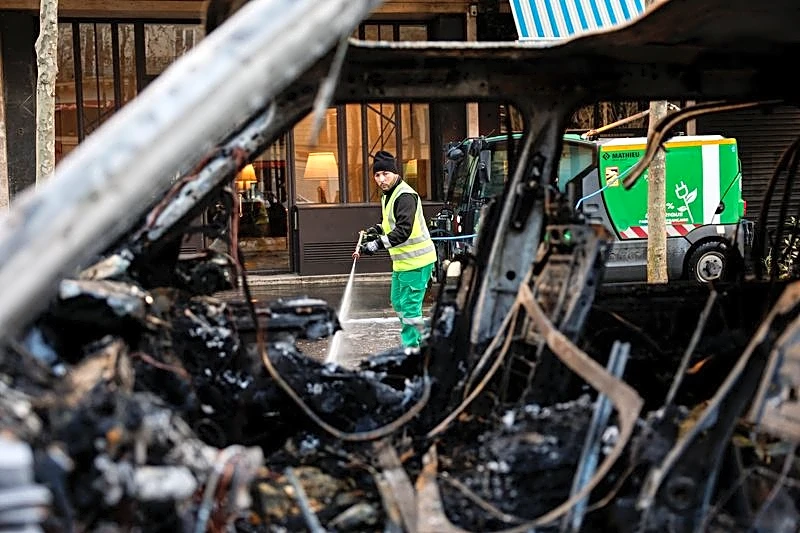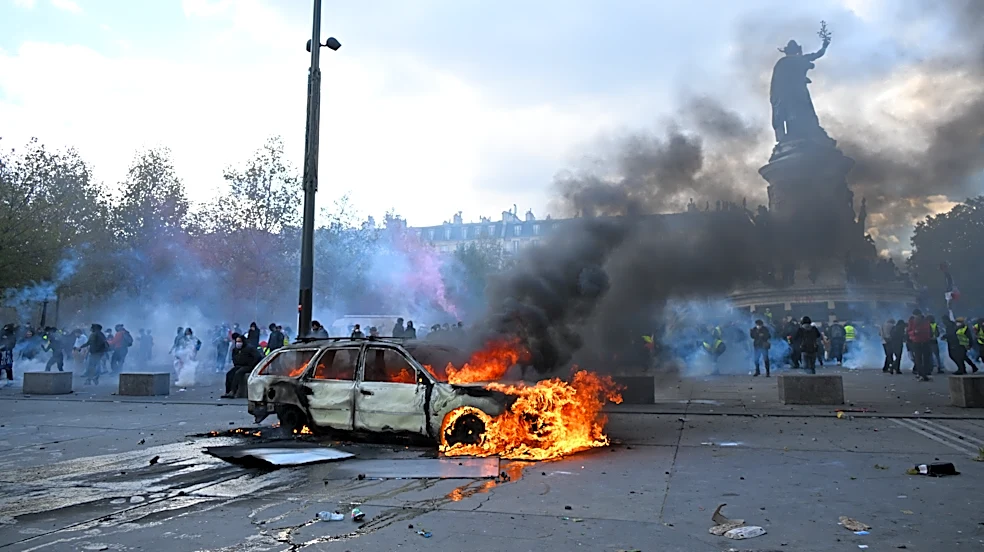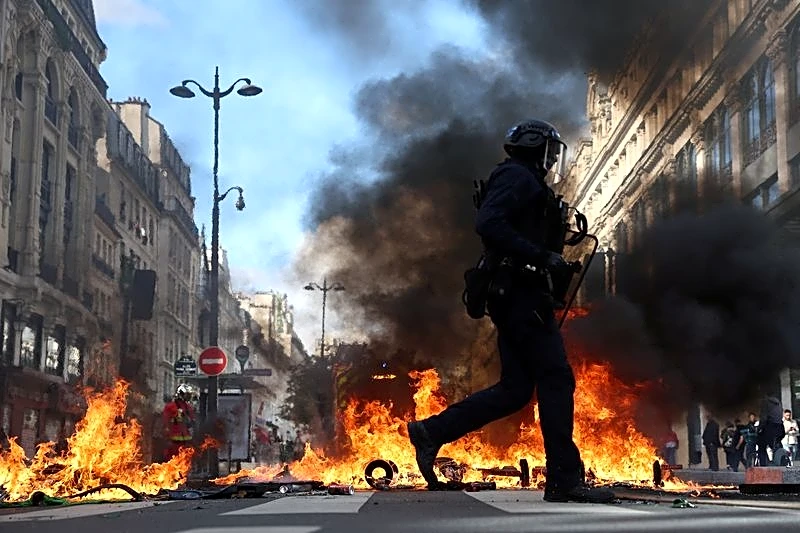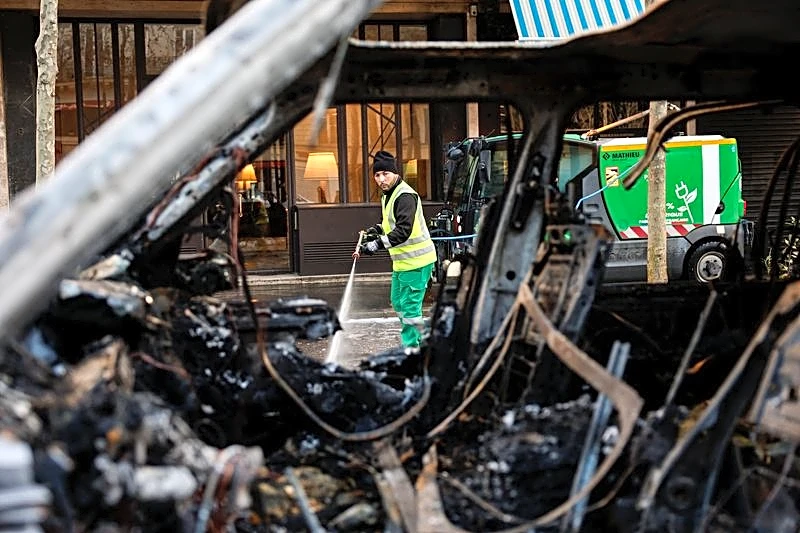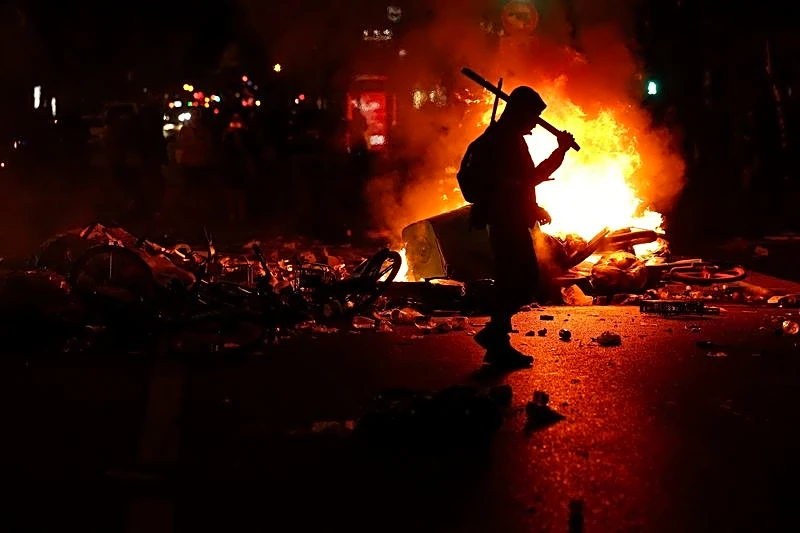


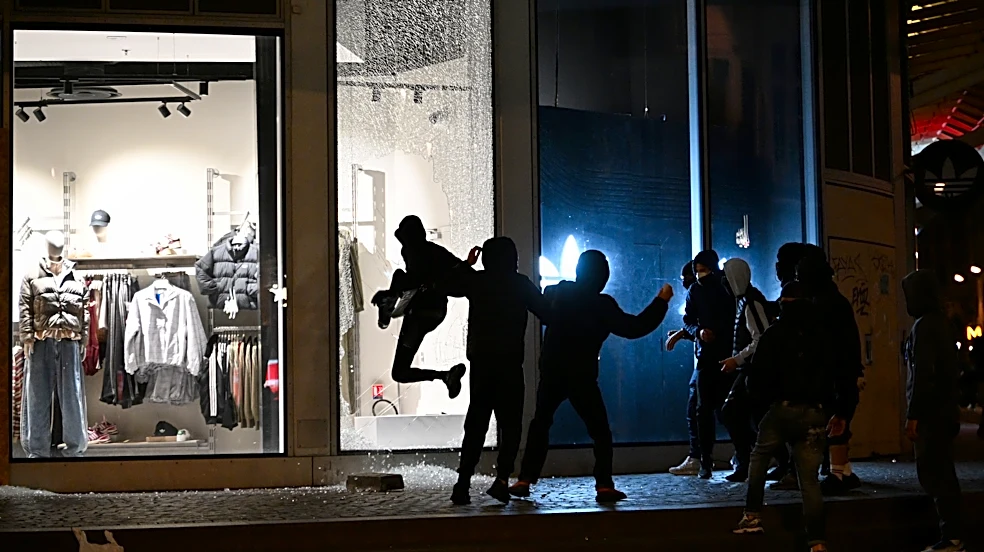
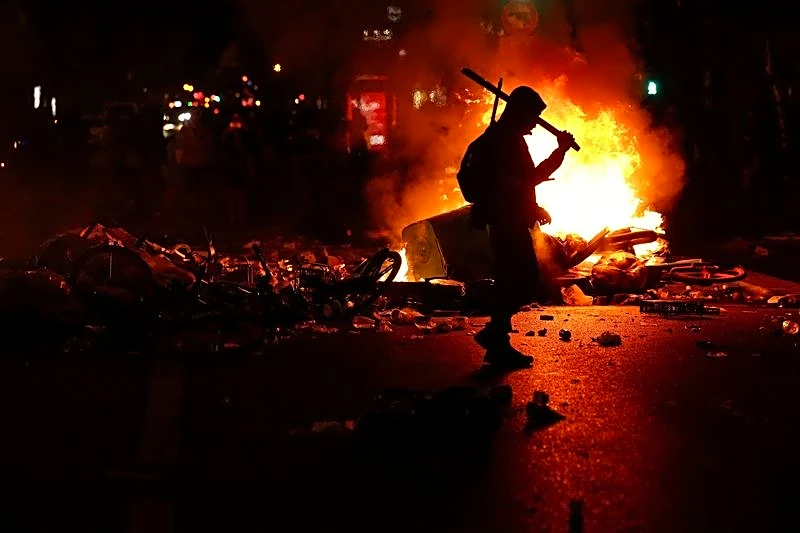
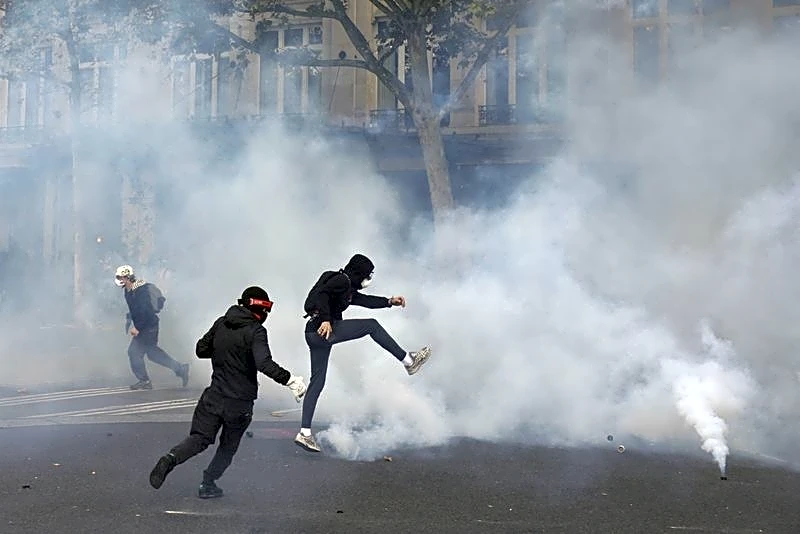

PARIS – Large-scale anti-government protests across France spiraled into violent riots and looting over the weekend, stunning citizens who woke up to smashed storefronts, burned cars and cities littered with debris.
More than half a million people in France participated in mass protests throughout the country on Oct. 17 over the surging cost of living, before rioters used the gatherings as a guise for looting. More than 2,000 people were arrested for participating in the violence, which marked some of France’s worst unrest in years.
The protests in France started late last month as high school and university students demanded more government funding for education and better conditions in schools. Labor unions, farmers and other workers’ groups
later took to the streets as well, turning the protests into a broader anti-government movement.

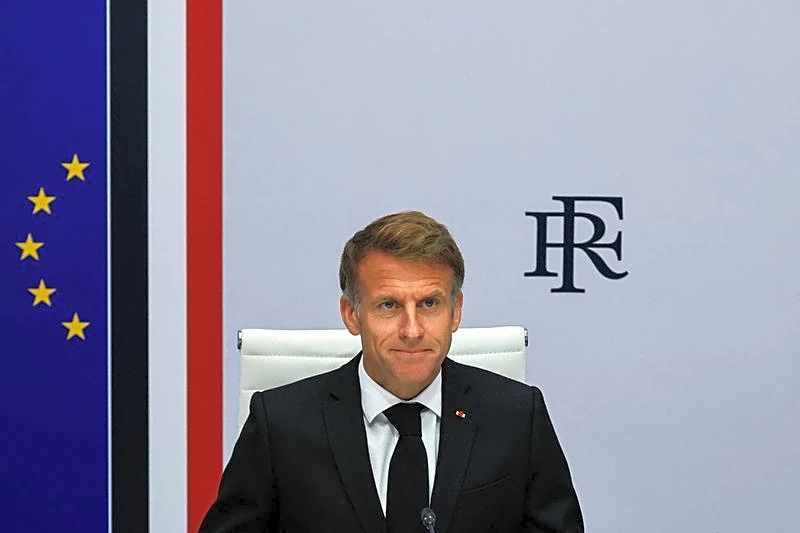
The protesters have focused their anger on French President Emmanuel Macron, who they blame for the rising cost of living and record-high oil prices. Macron’s 10-year tenure as president of France will end in May, and the presidential candidates vying to succeed him have sought to capitalize on the public discontent.
Demonstrations in France continued on Oct. 19 as university students in Paris blocked access to the Louvre Museum and French Prime Minister Sébastien Lecornu announced that he asked regional authorities to enforce partial curfews in the evening.
“The French people, from their television, would think that there is chaos everywhere,” Lecornu said. “Thankfully, that is not the case. We have chaos that is very much localized in certain urban areas.”
How did the protests start?
The current wave of anti-government protests started with high school and university students, who walked out of class and blockaded schools with dumpsters over France’s budget plan, which proposed cuts to education.
The students took to the streets to express their anger at unfilled teaching positions, run-down school buildings and systemic inequalities in the educational system.
The initial protests, which were largely peaceful, featured some clashes with riot police.
French authorities faced backlash for deploying tear gas, rubber bullets and batons against the students. One 15-year-old boy had his hand blown off by a police stun grenade that was deployed
Many of the student demonstrations adopted anti-police messages in response to outrage at the French authorities for deploying significant force against the protesters.
More than a hundred people participated in one protest outside the Paris-Panthéon-Assas University in Paris, where the entrance to the building was barricaded with dumpsters and students chanted “ACAB,” the acronym for a derogatory anti-police slogan.
Adrien Amielet, 22, a university student from Paris, said in an interview with USA TODAY that he joined the protests to support the high schoolers and show his anger at the government’s education policies.
“The French are revolting because we are sick of this government that we’ve had for 10 years, and the only way our voices can be heard is if we participate in protests that get noticed,” Amielet said. “We want to be heard by our institutions and install a new regime that will be more egalitarian.”
Why did the protests become violent?
High school students in France are now on a two-week vacation, but the anti-government protests have escalated as labor unions and others join in. Social media accounts affiliated with the “yellow vest” protest movement promoted the protests over the weekend and announced that an “Act II” will follow on Oct. 24.
The U.S.-Israeli war against Iran has driven up fuel prices around the world. Europe has been hit particularly hard by the energy crisis.
Macron said in a televised address on Oct. 18 that some of the protesters have “legitimate” complaints about rising energy costs that stem from the Iran war, which “France was not part of.”
The protests, which started off as peaceful, turned violent as rioters seized an opportunity to destroy property, including storefronts and government buildings.

One of the most shocking scenes was an arson attack that destroyed a historic town hall in Limoges. Videos circulated on social media of the building’s spire toppling to the ground as flames consumed the building.
Macron and other French politicians have condemned the rioting and pledged to prosecute the perpetrators of the violence.
“Peaceful demonstrations have their rightful place in our Republic,” Lecornu wrote in a post on social media. “Arson, looting, and attacks have none.”
President Donald Trump alleged in a social media post on Oct. 19 that immigrants are responsible for the looting in France, but French politicians have cast blame on criminals and far-left groups.
“Ultraleft groups organized the violence in several French cities,” Lecornu wrote. “Delinquents joined in to pillage and destroy.”
What are the political consequences?
France has a long history of civil protest, where strikes and marches occur relatively frequently, but the intense violence over the weekend has gripped the country.
The mass protests stand to benefit Jean-Luc Mélenchon’s left-wing France Unbowed party and Marine Le Pen’s far-right National Rally party as they seek to capitalize on broad discontent in France with the political mainstream.
French voters will elect a new president next spring as Macron, who is limited to two terms, will depart the Élysée in May. Le Pen has led recent polls and Mélenchon has begun to pick up steam. Both candidates are running for the presidency for a fourth time.
Mélenchon expressed support for the non-violent student protests, and some members of his party participated in some of the demonstrations. Le Pen and some members of the French government have accused Mélenchon and his party of stoking unrest in France.

Le Pen said that legitimate demands expressed by protesters have been “hijacked by the far left and the rhetoric of Jean-Luc Mélenchon.”
Lecornu, who has said he is not running for president in 2027, also sparred with Mélenchon over the protesters, criticizing the left-wing politician for blaming French police for the violence.
“You call on those who share your movement not to take part in the looting. Start then by clearly identifying the culprits – that is, those who loot and vandalize,” Lecornu wrote on X.
Mélenchon has defended his comments, saying that he is in solidarity with the thousands of peaceful protesters who have been tear-gassed and assaulted by the police. He said the protests are the result of “a disastrous 10 years” of Macron’s government.
“Our youth deserves a good end to this sequence,” Mélenchon said in an interview on Oct. 18. “Their demands must be heard.”
This article originally appeared on USA TODAY: Rioting and arson attacks: Why protests are boiling over in France