




I'm all for people having friendships with those they disagree with. It's vital for the future of our country, as civility continues to go by the wayside.
Good friends, however, hold themselves accountable – especially those in positions of wide influence.
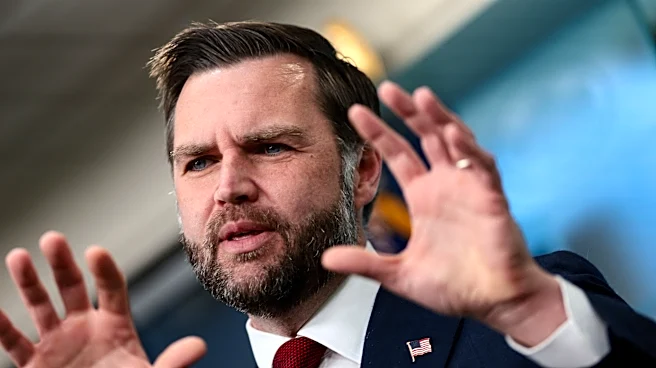
That’s not what’s happening between Vice President JD Vance and podcaster Tucker Carlson, who are reportedly friends. Carlson has spent recent months making headlines and creating an uproar in the conservative community – suggesting President Donald Trump could be the “antichrist,” opposing the war in Iran and consistently attacking Israel. Even algebra is suspect, in Carlson’s worldview. Not so long ago, Carlson was one of Trump's biggest boosters.
Despite all this, at a recent White House press
briefing, Vance firmly defended his friendship with the podcast host.

At the Sept. 3 briefing, a reporter asked him how he defends his "close relationship" with Carlson.
Vance’s answer?
“Tucker is a friend, despite the fact that we disagree on a number of things. And I’m not going to play the game where I throw friends under the bus because I have political disagreements with them. I think that is a terrible place for the United States to go. And if you have a disagreement with somebody politically, even over a deeply held issue, you should still be friends with that person, because the whole republic depends on people of different perspectives being able to talk to one another.”
I’m all for the gist of what Vance is saying. But it doesn't hold up given his position in the White House and Trump administration – and given other things Vance has said about his political opponents.
'Why are you guys friends again?' is a good question

National Review writer Noah Rothman put it well, posting on social media after the briefing:
"Okay, but at a certain point, the volume of anti-Semitic remarks, actions, conversations, and the many, many headlines about them raises a pretty big question: Why are you guys friends again?”
It’s a good question.
One example: Carlson's recent de facto endorsement of Michigan U.S. Senate candidate Abdul El-Sayed – a raging progressive who has said plenty of antisemitic things, not to mention insulted Vance's wife, Usha Vance.
On his Sept. 2 podcast, Carlson said he wouldn't vote for Republican Senate candidate and former congressman Mike Rogers “at gunpoint,” called him a "tool of Israel," and agreed with his guest that El-Sayed was more "America First" than Rogers.
Rogers, remember, is the same candidate who could help determine control of the Senate come November – the one Trump and Vance are actively campaigning for. He spoke at this week's Republican midterm convention (aka "Trumpapalooza").
At the White House press briefing, Vance acknowledged he thinks “El-Sayed is a crazy person” and that he'd "like to have a non-crazy person like Mike Rogers representing Michigan in the United States Senate."
OK, fine. But why not call out your buddy, too?
Vance slams El-Sayed for his friends. He should hold himself to same standard.
No one likes a hypocrite. And Vance edges into that territory by refusing to distance himself from Carlson over some of the very problematic things he's said.
Because at the same time, Vance has no problem shouting about El-Sayed’s buddies, including Marxist Twitch streamer Hasan Piker, who has campaigned with El-Sayed and has a history of antisemitic and anti-American remarks.
In response, Vance has called El-Sayed “very evil.”
"My message to Abdul El-Sayed is: You can pal around with terrorist sympathizers, and you can say that America deserved 9/11, or you could empathize not with the children who were targeted at Temple Israel, but with the attacker,” the vice president said to the Michigan crowd, referring in part to things Piker has said.
El-Sayed has recently tried to make amends with Michigan’s Jewish community, apologizing for things he’s said that offended the state’s Jews.
What he won’t do? Apologize for palling around with Piker on the campaign trail.
While campaigning with Piker during the primary, El-Sayed defended doing so despite the controversial things Piker has said, paraphrasing at one point questions he gets from the media about their relationship:
“Here’s this one thing that Hasan said. Do you now condemn him and everything he stands for? And I’m like, in what f---ing world does the world work this way?”
El-Sayed's defensiveness about Piker isn't all that different from Vance's about Carlson. Both men, when pressed, reach for the same excuse: friendship shouldn't require answering for your friends.
Regardless of party, who you call a friend still says something about you. And so does what you're willing to overlook to keep them.
Ingrid Jacques is a columnist at USA TODAY. Contact her at ijacques@usatoday.com or on X: @Ingrid_Jacques.
This article originally appeared on USA TODAY: I don't care if they're friends, Vance should call out Carlson | Opinion