






The stories of loss and survival still resonate 100 years after the ferocious storm hit.
As hurricane-fueled floodwaters inundated the town of Moore Hayes, Florida, on Sept. 18, 1926, one woman tied herself to her three children and ventured into the surging waters.
When two of the children drowned in the waves, she cut them loose and held the third child to her shoulder until they were rescued, according to an account of the storm in Weatherwise magazine.
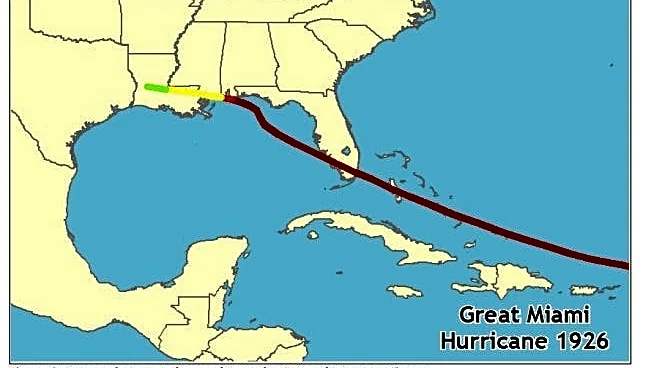
Tragically, such stories were not uncommon during the Great Miami Hurricane of 1926, when a practically unpredicted Category 4 hurricane smashed into South Florida with winds estimated at up to 150 mph and storm surge of up to 15 feet.
The storm killed hundreds of people, causing widespread devastation
and essentially ending the Florida land boom of the 1920s. It was one of the first major hurricanes to impact a heavily populated area of the U.S. and highlighted the vulnerability of coastal development.
If the same storm hit the same spot today it would likely be the nation's costliest hurricane of all time, with one estimate at half a trillion dollars in damages.
A classic storm, almost undetected
The Great Miami Hurricane of 1926 was of classic Cape Verde origin, first known to the Weather Bureau (precursor to the National Weather Service) from ship reports in the central tropical Atlantic on Sept. 11, 1926, the weather service said in an online report about the storm.
It passed north of the Leeward Islands and Puerto Rico on the 14th, 15th, and 16th, avoiding normal channels of Caribbean information.
Therefore, in those days before satellite pictures and reconnaissance aircraft, the hurricane remained somewhat of a mystery, with only a few ship reports to tell of its existence.
How unprepared were people for the storm? Did they have any warning?
The weather bureau did not begin issuing warnings for Miami until noon on the 17th – just over 12 hours before the storm began lashing the shore with tropical-storm force winds and 18 hours prior to landfall, weather historian and meteorologist Sean Potter told USA TODAY. Initially, special Storm Warning flags – indicating that a storm “of marked violence” was expected – were hoisted, but at 11 p.m. these were changed to Hurricane Warning flags – announcing the expected approach of a hurricane.
"By that time, however, many Miamians were asleep or unaware of the imminent danger the storm presented. In addition, many people living in Miami at that time were new to the area and had never experienced a hurricane before," Potter said.Richard Gray, the official in charge of the Miami Weather Bureau office, later claimed in a narrative published as part of a report on the storm in the journal Monthly Weather Review that Miamians had been adequately warned. Potter said the Monthly Meteorological Notes for the Miami Weather Bureau office, however, tell a different story. “The hurricane came with great suddenness,” according to the entry for Sept. 18, 1926. “Except for a moderate but steady fall of the barometer after 10 a.m. of the 17th, there were no unusual meteorological conditions to herald the approach of the storm.”To make matters worse, the Miami Herald — in a front-page, above-the-fold article in its Sept. 16, 1926, morning edition— noted there were three tropical disturbances off the East Coast of the United States at the time, including the one that would devastate South Florida two days later, but suggested that “the Florida coast is not thought to be in active danger from any of the three hurricanes.”

How was the science of meteorology different 100 years ago? Were there hurricane warnings back then?
The science of meteorology was vastly different 100 years ago, Potter told USA TODAY. "Without the aid of satellites, radar, numerical weather models, and other modern forecasting tools, forecasters were forced to rely mainly on a relatively sparse network of surface observations – and an even sparser set of reports from ships at sea – to monitor tropical storms and hurricanes."Potter said that whereas the National Hurricane Center today averages approximately 55 hours of lead time for Hurricane Watches and about 40 hours of lead time for Hurricane Warnings – allowing ample time for preparations and, if necessary, evacuation – warnings issued 100 years ago often came too late for any meaningful preparation to take place.

What made the storm so devastating?
"It was really a combination of extreme wind speeds and record storm surge that led to the devastation across Miami and surrounding areas," Potter told USA TODAY. "The hurricane officially made landfall as a Category 4 storm, with maximum sustained winds estimated at 143 to 150 mph and a minimum central pressure of 930 mb.
This resulted in storm surges of 8 to 10 feet, with an estimated peak storm surge of 14 to 15 feet, Potter said.
When the storm surge spread across Lake Okeechobee, it overwhelmed dikes meant to protect nearby communities from flooding.
According to the article in Weatherwise magazine, the shallow freshwater lake burst its dikes, flooding the town of Moore Haven with hurricane-tossed waters 12 to 15 feet deep. Some houses were swept two miles from theirfoundations. Nearly every house in the town was destroyed, save for a block of brick buildings in the commercial district. Twenty-three people were killed when a two-story house collapsed.
In addition to Moore Haven, the town of Clewiston was also completely inundated, leaving some 250 people dead — about two-thirds of all the deaths attributed to the hurricane, according to Potter.

The deadly eye
The greatest penalty paid by an unprepared public came when the eye of the storm passed over Miami shortly after 6 a.m. Saturday morning, according to the Weatherwise magazine article.
Unfortunately, many people had no idea what the sudden lull meant. After two hours of winds averaging above 100 mph, dazed Miamians emerged from shelter thinking the storm was over and unwittingly placed themselves in harm’s way. Hundreds headed for the beaches for an early morning swim; others combed through the wreckage trying to findfood or salvage belongings.
"Hundreds of bathers were caught out on the beach when the eastern eyewall arrived, and many of them drowned. The renewed storm surge and peak winds of 138 mph also killed perhaps a hundred more who were walking along the causeways," the Weatherwise article said.

Did the storm end Florida’s land boom of the early '20s?
It may have been the final blow, but the stage had already been set for economic collapse before the 1926 Miami Hurricane even formed.
Blessed with phenomenal growth and seemingly perfect weather, residents couldn’t resist calling Miami “The Magic City.” But the magic would vanish in 1926; the boom would turn to bust, and a great hurricane would teach a grim lesson to people dreaming of eternal sunshine and easy money, the Weatherwise article said.
According to Potter, in 1925, Miami was the fastest-growing city in the country. Land was being purchased and developed at such a rapid pace that construction could not keep up with demand and buyers often had to live in makeshift camps temporarily while their new homes were completed. This led to a frenzy of speculation. By the fall of 1925, prices rose to such astronomically high amounts that the market became unsustainable.
Other factors – such as a railway freight embargo and a spate of negative press from newspapers in the North – only added to the situation and, by early 1926, the bubble began to burst. When the hurricane hit in September, it dealt the final blow to the already beleaguered Florida real estate market.
With the onset of the Great Depression three years later, followed closely by the economic strains of World War II, it would take nearly two decades for the market to recover fully, Potter told USA TODAY.

What would happen if a similar storm hit the same area today?
So much has changed over the past century that would affect the outcome – both positively and negatively – if a similar storm were to hit the same area today. "On the one hand, advances in technology, forecasting techniques, and communications allow for earlier detection, better monitoring, and more accurate and timely warnings of hurricanes. On the other hand, the population and infrastructure growth in South Florida has increased to the point that, despite such advancements, the effects could still be devastating," Potter said.
Several analyses of the cost of the hurricane in today's dollars have been conducted over the years:In 1976, the Associated Press reviewed the devastation caused by the Great Miami Hurricane of 1926 and reported on what a similar storm might do to the area 50 years later. It concluded that such a storm could result in more than $1 billion (1976 dollars—about $5.87 billion today) in damage and create a situation where as many as 5,000 people (those who don’t evacuate) “literally might be swimming for their lives.”In 2008, a team of researchers led by Roger A. Pielke Jr. of the University of Colorado published a paper suggesting “that a storm like the 1926 Great Miami hurricane could result in perhaps $500 billion in damage as soon as the 2020s.”In 2011, hurricane researcher Chris Landsea concluded that the $100 million of damage caused by the 1926 Miami Hurricane, when normalized for 2011 population, infrastructure, and inflation, would result in about $165 billion in damage – making it more devastating than Hurricane Katrina.
The most recent estimate of damage costs was undertaken earlier this week by Swiss Re, a global reinsurance firm based in Zurich. "A repeat of the 1926 Great Miami Hurricane, a Category 4 storm, could cause around $200 billion in insured losses today."
According to the Swiss Re report, "a century of population and property growth has transformed the potential impact of a hurricane striking Miami-Dade County. Just over 100,000 residents lived there when the Great Miami Hurricane arrived in 1926, compared with around 2.8 million in Miami-Dade today. More than two million homes in the Miami metropolitan area, with a combined reconstruction cost exceeding USD 600 billion, are now at moderate or greater risk of hurricane wind damage," Swiss Re said.
Doyle Rice is a national correspondent for USA TODAY, with a focus on weather and climate.
This article originally appeared on USA TODAY: The true story of the 'Great Miami Hurricane' echoes 100 years later