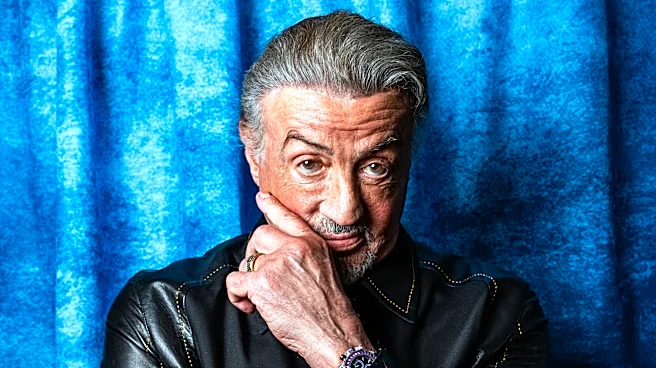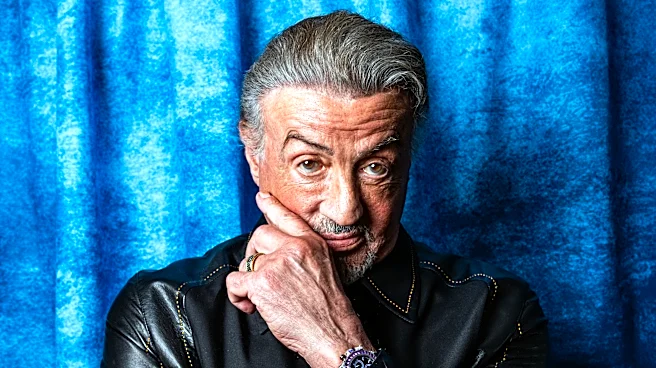







The last thing I was expecting when watching Sylvester Stallone, a man whose body in movies like “Rocky” had made him the ultimate image of masculinity, was to hear him say in his New York Times interview about his recently released memoir "The Steps" that he had struggled with bulimia.
His confession took me back to something that happened last spring when I did an author event at a middle school to speak about body image issues.
One of the school administrators pulled me aside.
"Could you make sure to talk about boys as well as girls?" she asked. "We have a boy at school that’s struggling with an eating disorder.”
“Of course,” I said, trying not to show my surprise.
I knew boys also had this mental health issue. But even I, who’d lived with bulimia,
and had researched and written about eating disorders in numerous publications, still thought it was mostly a female issue.
Body dissatisfaction looks different in boys. It can be just as damaging
National Institute of Mental Health data has found that out of kids ages 13 to 18, 1.5% of boys had experienced an eating disorder. Even though the percentage is not as high as the 3.8% of girls, it shows an important statistic, that boys are also struggling with this complex mental illness that can be just as severe and life threatening.

Stallone's story is especially meaningful because his eating disorder didn't come from wanting to look like the stereotypical image we associate with anorexia or bulimia. He said that while making “Rocky III,” he became obsessed with having a lean muscular physique.
That matters because body dissatisfaction can look different in boys and men. While girls are bombarded with the message to become smaller, guys receive a different message: to get bigger, leaner, more muscular.
Even though the goal is different for boys and girls, the messages are as dangerous.
I kept my bulimia a secret. It lasted 30 years
My mother had spent years trying to get me to lose weight. She believed thinness meant beauty and power. She threatened, pleaded and bargained. I was also growing up in the 1980s, surrounded by low-fat food, SlimFast and Jane Fonda workout tapes. Thinness wasn't just fashionable; it was everything.

A few days into my first year of high school, a popular girl asked how much I weighed. I told her about 130 pounds. She reacted with horror and said she would kill herself if she ever weighed that much. Her words confirmed what I already feared, that there was something wrong with my body.
Soon after, at 15, I walked into a bathroom, locked the door and pushed my fingers down my throat for the first time. I sat on the cold bathroom floor, my throat burning and my face wet with tears. I felt disgusted, embarrassed, ashamed, but I also felt a kind of relief.
That moment began a secret life that lasted for 30 years, bingeing and purging, locking bathroom doors, turning on showers so people wouldn't hear me vomit.
For me, the eating disorder was tied to my relationship with my mother. Eating felt like freedom. I thought I was fighting her when I ate the foods she didn't want me to eat. But I wasn't winning. I was hurting myself. It took me a long time to understand that my mother's fixation didn't begin with me.
She’d grown up in a culture and era where she believed a woman's beauty got her respect and opportunities. She loved me, but she had strong beliefs about what my body needed to look like.
Nearly 25% of those with eating disorders are men
For years, I thought of eating disorders as an issue between mothers and daughters, and of girls and women striving for beauty and thinness. Then I started doing author talks about body image and disordered eating, and I saw boys raise their hands with trepidation, and share stories about their bodies, and the fraught relationships with parents because of their weight.
I realized how important it was for me to make sure they were included and felt seen when talking about this mental health struggle. And how our societal assumptions help keep boys and men invisible.
Men represent about a quarter of people with eating disorders. But they get diagnosed much later than women, with possible factors being shame, misunderstood symptoms, marginalization and later onset of disorders.
They don't usually recognize what's happening to them because of the societal stereotype of eating disorders as a woman's issue.
Now, every time I speak at schools I think about that boy, and remind myself that I’m there to help every young person, and that even though the boys’ stories might not be the same as mine, their shame and struggle are.
For decades, my eating disorder continued because I kept it a secret. I was ashamed, so I hid it. It was only when I talked about it in my mid-40s with my husband that I was able to begin working on my recovery.
That's why there is something so powerful about an 80-year-old man whose body once represented a superhuman version of manliness telling the world he struggled with bulimia.
When someone in the public eye like Stallone shares their eating disorder, it brings into the light the secret shame so many people live with. And it helps lots of people, especially men and boys, know that they’re not alone and that asking for help doesn't make them less strong.
Rebecca Morrison is the author of “The Blue Dress,” a National Education Association pick for Read Across America 2026-27. Her novel is a coming-of-age story based on her childhood struggle with body image and a strained mother-daughter relationship. You can find her at rebeccakmorrison.com.
This article originally appeared on USA TODAY: Why Stallone's honesty about bulimia is so important | Opinion