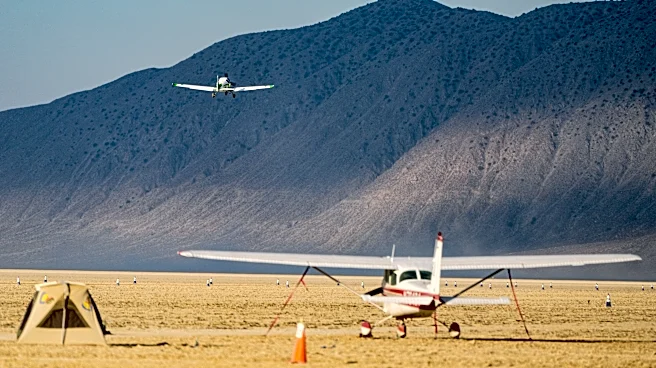

BLACK ROCK CITY, Nev. — There's no security screening, no baggage claim and no Uber rides, but for a week each year, a dusty patch of the Nevada desert claims it becomes one of the busiest airports in the United
States.
Here at the Black Rock City Municipal Airport at Burning Man, jester-hatted pilots mingle with women in sparkly leotards. Dust storms obscure the departure gate. Air traffic controllers in cowboy hats work out of a shipping container sitting on wooden stilts.
While the flying remains serious business, whimsy surrounds the entire volunteer-run operation. Burning Man has formally recognized the airport since about 2003, but pilots have been landing planes on the dry lakebed for the event since 1991. The runways themselves are packed-down sections of the dusty lakebed, and pilots have been known to simply land elsewhere on occasion.
"As far as we know, we’re the busiest temporary airport anywhere, the only airport of its size run by volunteers, and the dustiest airport in the world," airport managers said in welcoming Burners to the site.
The airport serves multiple purposes: People with enough money can skip driving to Burning Man and take a charter flight in, usually from California or Reno, either by small plane or helicopter. Small private jets can also land at the airport, which has two mile-long runways. The airport also serves as a medical flight evacuation point.
But the majority of flights during the week of Burning Man, the annual event in the Nevada desert focused on community, arts and self reliance, are free scenic flights "gifted" by pilots to people who began queuing up well before dawn.
In past years, pilots flying small planes like Cessnas and Beechcraft have flown more than 1,000 scenic flights during Burning Man.
On Tuesday, Sept. 1, several pilots, including one Australian known as "Sky Doggie," carried aloft dozens of passengers, letting them see the dusty temporary city below. More than 100 people were waiting for scenic flights, sitting on dusty yoga mats and wooden benches in front of signs reminding them that flights are gifts, not guarantees.
As they walked back from their scenic flight, Mickey and Elizabeth Sattler said it was the first time they’ve ever seen the city from above.

“It changes your perspective on the scale of things," said Mickey Sattler, 62, who's at his 22nd burn. "When you’re in the ground, two RVs can block your view. When you’re hundreds of feet up, you can see how it all fits.”
His wife Elizabeth, attending her fifth burn, said she got emotional seeing the curving entrance road leading into the city. Many attendees have spent five or more hours waiting in line to enter over the years.
“I teared up a little,” Elizabeth Sattler, 52, said. “It’s the first time I’ve looked at Gate Road and thought it was beautiful.”
For pilots, air traffic controllers, 'serious business' at Burning Man
Airport managers caution both attendees and pilots that while Burning Man may be a place with relatively few rules, the airport itself still operates like any other flight base. Pilots brief passengers on emergency evacuation procedures, and professional air traffic controllers watch over it all as people cross the safety fence surrounding the Burning Man site to access the apron.
"Once you're outside the fence, take off the Burning Man 'hat' and put on your pilot hat," airport mangers caution pilots. "Tell your (passengers) to do the same. This is serious business and people can get hurt."
By Tuesday afternoon, pilots had to halt their rides: Too dusty.
This article originally appeared on USA TODAY: For one week a year, Burning Man's airport is among nation's busiest