




Around the globe, Amelia Earhart enthusiasts are anxiously awaiting the results of an expedition that could locate the famed aviator's missing plane and help solve one of the 20th century's most enduring mysteries.
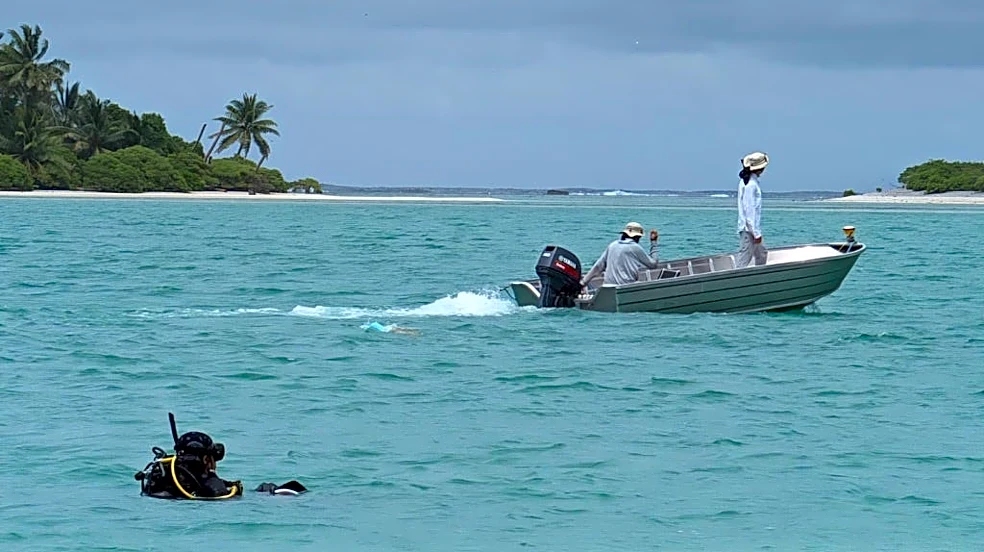
In early October, a group of researchers set out for a remote Pacific island in hopes of finding the aircraft Earhart used in her attempt to complete a historic around-the-world flight
nearly 90 years ago.The ongoing expedition, which Purdue University has described as the best chance yet to locate the missing Lockheed Electra 10E, is expected to conclude by the end of the month. Researchers believe it could provide new clues about what happened to Earhart and her navigator, Fred Noonan, in 1937.
In an Oct. 15 update, Purdue said researchers
expect to identify a mysterious object under investigation within 48 hours, heightening anticipation among Earhart admirers worldwide.

In the Northern Ireland city of Derry, Nicole McElhinney is closely monitoring the researchers’ social media pages, waiting for news.
“I am so excited,” she told USA TODAY.
McElhinney, 52, is chair of the Amelia Earhart Legacy Association, a group that raises awareness about Earhart and her connection to the city. In 1932, Earhart made an emergency landing on a cow pasture in Derry after a 14-hour flight from Canada, a journey that made her the first woman to fly solo across the Atlantic.
“We’re watching it around the clock,” she said. “It’s like we’re sitting at the edge of the phone just waiting to see what’s going to happen.”

In San Antonio, Texas, Jennifer Borchelt is similarly glued to her phone, hoping to see the decades-long mystery finally get solved.
"It would be amazing if they found it," she said.
New expedition brings experts to remote island
Earhart and Noonan disappeared on July 2, 1937, as they flew from Lae, Papua New Guinea, toward Howland Island, where the U.S. Coast Guard cutter Itasca was waiting with refueling supplies. The pair were nearing the end of what would have been the first around-the-world flight along the equator.
Coast Guard authorities received voice messages from Earhart in which she warned she was running low on fuel. Neither Earhart nor Noonan knew Morse code, preventing two-way communication, according to the Smithsonian Institution's analysis of government records.
After their disappearance, the U.S. government launched what was then its largest search for a lost aircraft. Two weeks later, the search ended without finding Earhart, Noonan or their plane. On Jan. 5, 1939, they were declared legally dead.
In the decades since, millions of dollars have been spent on expeditions that have taken researchers from remote islands to the depths of the Pacific Ocean in search of the missing plane.
The latest expedition, which is a joint effort between Purdue University’s Research Foundation and the Archaeological Legacy Institute, has brought a team of researchers to Nikumaroro, a small Pacific island between Australia and Hawaii.
There, researchers will assess the "Taraia Object," a visual anomaly in the island's lagoon identified through satellite imagery that some believe could be Earhart's long-lost plane.

The 17-person crew departed Los Angeles on Oct. 2 and arrived on the island more than a week later.
“We understand the tremendous interest in what we’re doing at Nikumaroro, and we appreciate everyone’s patience,” said lead archaeologist Rick Pettigrew in a recent statement. “This is a complex scientific process. You don’t simply arrive at a site and immediately identify what’s there. We have to carefully collect the data, analyze it and reach sound conclusions.”
Some are optimistic. Others not so much.
The prospect of a breakthrough has generated both excitement and skepticism among Earhart enthusiasts.
“I’m not convinced that it is the plane,” said McElhinney, referring to satellite images of the “Taraia Object.”
She said she supports the most widely accepted explanation, which posits that Earhart and Noonan ran out of fuel and crashed into the Pacific Ocean in the vicinity of Howland Island. Other theories suggest Earhart was captured by a foreign government or that she and Noonan survived and assumed new identities.
“We hope that it is the plane,” she added, “but we don’t know.”
Randy Adcox, of Rocky Mount, North Carolina, said he’s “optimistic they’ll find something.”
“I do think there are several possibilities, and this is just one of many,” said Adcox, 67. “I think there’s a real possibility that what they are looking at could be part of the plane.”
For McElhinney, however, the cycle of hope and disappointment that accompanies such expeditions can be exhausting.
"It's very difficult not to become emotionally invested," she said. "We love Amelia, we love everything about her, and we're so inspired by her. So when we hear of an expedition, we think, 'Please let this be the one. Let them find her.' And if it doesn't happen, we feel quite disappointed."
Amelia Earhart still inspires, captivates
Earhart’s life, legacy and mysterious disappearance have fascinated people around the world for decades.
Borchelt, 43, said she first learned about Earhart’s trailblazing career as a schoolgirl in northern Indiana.
“I was always interested in mysteries,” she said. “Then I learned about how important she was to women in aviation. And I’m still learning things, like that she was a clothing designer.”
Borchelt’s husband attended Purdue University, where Earhart was once a visiting adviser and counselor. Some of her friends lived in a student housing building named after the famous aviator, and she’s taken photos in front of a bronze 8-foot-tall statue of Earhart on campus.

In Ireland, McElhinney didn’t know who Earhart was until an acquaintance approached her about starting a group to raise awareness about the pilot’s ties to Derry. After some research, McElhinney gained an admiration for Earhart that led her to join the local group and eventually become its chairperson.
“She set the bar very high and we have our trans-Atlantic travel today as a result of her efforts,” McElhinney said, noting that Earhart was flying a plane at a time when few women drove cars.
McElhinney's organization raised a plaque commemorating Earhart's emergency landing in 1932. Its efforts also led to the creation of a mural, believed to be the largest in Northern Ireland, on the facade of a college building in the city.

McElhinney, who has traveled to Earhart’s hometown at least four times, said her family shares her passion. Her two young daughters dress up as Earhart for school photographs and Halloween.
“We all think she’s just amazing,” she said.
What happens if the plane is discovered?
Purdue officials have said that if the object is confirmed to be Earhart's plane, future expeditions would focus on recovering it and bringing it to the university for display.
Borchelt said she’d travel with her family from San Antonio to see the wreckage if it’s recovered and brought to her home state of Indiana.
“I would absolutely go see that,” she said. “I would definitely make a trip out there.”
Until then, Borchelt and other Earhart enthusiasts will be checking their phones for what could finally provide an answer to one of the world's most captivating mysteries.
“To me, it's a fascinating story, and who knows, maybe this will be the time that they find something,” Adcox said. “I’d love to see it.”
Christopher Cann is a national reporter for USA TODAY. Reach him by email at ccann@usatoday.com.
This article originally appeared on USA TODAY: Amelia Earhart fans anxiously watch expedition for long-lost plane