
“Shop still open?”
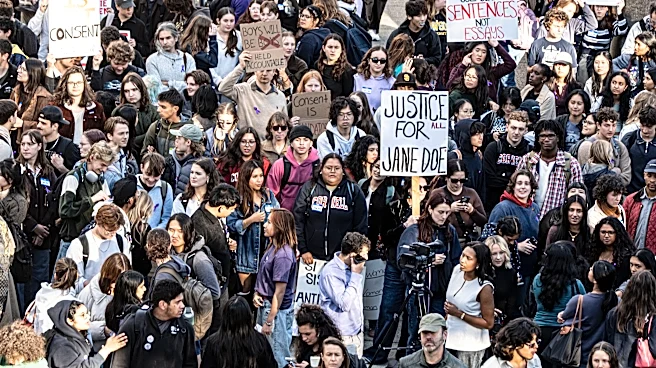
Of all the evidence I’ve seen from the rape investigation happening at Cornell University, the alleged messages among members of the Chi Phi fraternity on Snapchat have stuck with me the most.
The one quoted above isn’t the worst of the batch, but it speaks to the degradation of "Jane Doe" by members of the organization who seemed to see her as nothing more than a body.
At the time of the alleged gang rape in October 2024, Chi Phi had 57 members at Cornell, according to the New York Post. The reactions in the group chat vary. One member replied directly to a message advertising “free (expletive), saying “this is crazy work.” Another response read, “I (expletive) love Chi Phi.”
From what we know, many of the men in the chat stayed silent. Seven men might be named in the lawsuit filed by Jane Doe on Sept. 16, but how many others knew what was happening and did nothing?
I recently spoke with Lauren Mahoney, an adjunct assistant professor of psychology in the City University of New York School of Professional Studies, about the men in the group chat.
“I firmly believe that the presence of 57 people shouldn’t mean that the responsibility is divided 57 different ways,” Mahoney said. “It should mean that there are 57 different opportunities for somebody to act on that.”
The Chi Phi men who were in that group chat failed Jane Doe. While the university punished only a few people in the aftermath, there are many more who saw her in need and did nothing.
The bystander effect was on full display in the Cornell case

It is difficult to stomach that so many men could ignore those chats, but it’s also not necessarily surprising. Psychologists have called the cultural phenomenon that keeps people from taking action the “bystander effect.” According to Bibb Latané and John Darley, the psychologists who popularized the phrase, the bystander effect happens due to diffusion of responsibility and social influence.
But the bystander effect is not impermeable. People can become “active bystanders” and intervene in situations in which someone else is being harmed or otherwise needs help. That is what should have happened in this instance.
“Bystanders don’t necessarily need to be investigators,” Mahoney said. “Coming in like ‘I’m going to save the day.’ It could just be someone who came in and interrupted it, or quietly and anonymously called campus security.”
Yet research has also shown that college men are less likely to be active bystanders because of sexism and substance use. In fraternal organizations, these factors coincide with social hierarchies among group members.
In the Cornell instance, up to 57 members chose to be loyal to the fraternity instead of helping someone who was heavily intoxicated and needed help in the face of graphic messages.
“When you have this collective identity, your individual morals recede, and you take on the morals of the group,” Mahoney said.
They were certainly operating as a group in the days following the incident: Texts recently uncovered by NBC News show the fraternity brothers discussing how to react to Jane Doe’s report to the university.
Chi Phi was suspended during the 2024 Title IX investigation and ultimately kicked off Cornell’s campus. Had one of its members been brave enough to step in, the outcome of all of this could have been different.
What does this say about the state of things in America?
The lack of action is also a product of the online and real-life environments in which these young men came of age. Social media depictions of misogynists disguised as “alpha males” have certainly done their damage, as have violent acts presented to them through the algorithm.
The success of President Donald Trump has shown that saying horrific things about women is not career-ending. While patriarchy and violent images are nothing new, the desensitization is becoming a growing concern among psychologists, including Mahoney.
“We’re seeing a huge shift in apathy among people,” she told me. “They’re just kind of paying attention to their own thing and not getting involved in other people’s business.”
Colleges and universities, the institutions that shepherd young people from adolescence to adulthood, can help with this. There must be a change in prevention education and response to fit evolving societal norms.
Mandatory sexual misconduct trainings taught through online lessons are not enough – some would argue they never were. There must be a combination of comprehensive, in-person training for scenarios like this at orientations and severe consequences when these incidents happen. Young people must see the older adults in the room take these instances seriously.
I’ll be honest: I don’t necessarily believe a world without sexual violence is possible. What I do believe is that stronger actions can be taken by all of us to help people. All of us could be active bystanders.
Follow USA TODAY columnist Sara Pequeño on Bluesky: @sarapequeno.bsky.social
This article originally appeared on USA TODAY: What's the bystander effect? We saw it in the Cornell texts | Opinion