



If there’s a move that we can learn from the viral breakdancer Raygun, it’s how to move on.
Being pelted on the world’s stage with the modern equivalent of rotten tomatoes – memes and scathing online posts – hasn't kept the dancer, born Rachael Gunn, from laughing. She erupts into a warm guffaw several times throughout a conversation about her globe-circulating performance at the last Summer Olympics and a new documentary about the experience and resulting backlash. “Untold Raygun: Breaking Badly” is now streaming on Netflix.
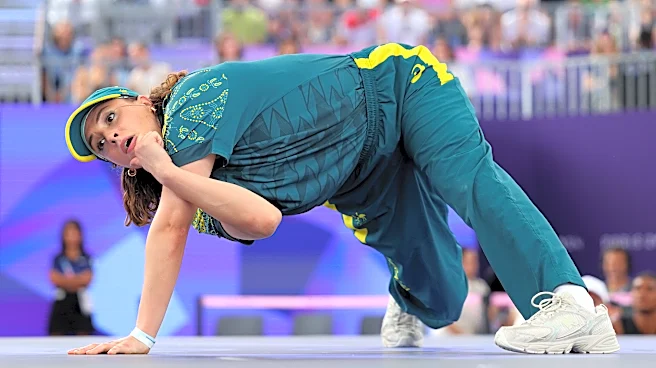
On Aug. 9, 2024, Gunn stepped to the stage at Paris’ Place de la Concorde representing her home country Australia in emerald and yellow. After battling competitors from America, France and Lithuania, Gunn didn’t earn a single
vote from judges.
“I was so nervous all the way through and so petrified that I was almost liberated a little bit on the day, because it was like all the prep, it's done,” Gunn, who turns 39 in September, tells USA TODAY in an interview. “Today's it. You kind of leave it all on the table.”
If only it were that simple. Gunn went viral. Her performance became the earthquake that spurred a tsunami of criticism and even allegations that her husband, fellow breakdancer Samuel Free, helped her qualify for the Games. In actuality, a panel of international judges evaluated the Olympic qualifier.
“When I was the topic of so many conversations around the world, there was bullying, there was misinformation, there was harassment,” Gunn says. “My whole credibility, mine and my partner Sammy's, was thrown into the mix. There were some really tough times in there, but it's been really nice that in the documentary we get to address a lot of those things that people misunderstood.”
Below, Gunn reveals how the experience has made her “more unapologetically” herself, why she left her job at an Australian university, and if she plans on entering the Olympics again.

Question: In the documentary, you recall how you experienced a panic attack and imposter syndrome while walking through the Olympic Village. If you think about the source of the anxiety, was there any criticism factoring in?
Rachael “Raygun” Gunn: “What am I doing there? You don't belong here.” That imposter syndrome was so big. I hadn't grown up in an elite sports environment, and now to be in the ultimate elite sport environment was a really difficult [thing]. How that feels physically, emotionally, psychologically, it really impacts you on multiple levels. So it all kind of coalesced, and that's why I did seek help. I was seeing a psychologist. I did go on antidepressants, and that's something that I've continued throughout the process, since the Olympics. It takes work. Mental health is work.
Ahead of your performance, how were you feeling? Did you think you might medal?
No [laughing]. I thought it was going to be very lucky, fortuitous, maybe, if I'd won a battle… I wasn't going to get anywhere close to the podium. It kind of became clear to me leading up to the games, after I'd been competing overseas, that I was only making it through the first or second round, and the people I was going to be competing against [were] in the semifinals and the finals. I was like, “I'm not going to get a vote.”

In the documentary, you mention the backlash is not personal. How did you come to have such a healthy attitude?
Thank you. It's taken me a long time. I'd understand that and then I'd forget it. So it's a constant battle with myself, reminding myself that it's not personal and this is a whole symptom of viral media. I think it's going to be really sad if one of the outcomes of this is that people are more scared to put themselves out there or more scared because they're worried that they could end up on the internet. You can't be scared to live your life. You just can’t.

You haven't stopped breakdancing. What was it like returning to the sport?
It was hard to dance again. My whole body just felt like lead. I couldn't feel properly, I couldn’t move properly. It took a long time, but I've got the most supportive husband in the world, and he just constantly was like, "Why don't we just try this? Or why don't we just try this?"
But competing was definitely difficult. I'd lost my battle resilience… I just totally freaked out, and I was like, "They're all going to laugh at me again. The world's going to explode," which, saying that sounds ridiculous. But it happened last time, so it kind of shows the absurdity of the entire situation, really.
If breakdancing returns to the Olympics, would you want to compete again?
No, I think those days are past me, but if it does end up in the Olympics again, then by all means, I will be happy to support the athletes and next generation in whatever way that I can.

How have you changed in the last two years from this experience? What has it taught you?
I really think it's made me stronger, this whole experience, and I feel like I'm more confident in myself… And I think this whole experience has made me feel more unapologetically me. You like me or you don't, but no doubt you've got an opinion about me.
Many people have a fear of judgment. Do you feel a sense of freedom, now that you've experienced "the worst" that could happen?
It is freeing! The world's already laughed at me. What are they going to do now? Laugh at me? Been there, done that! Come at me. I don't care anymore, really, I don't. So it is certainly liberating and freeing, for sure.
Do you have anything to say to the people who thought of you as just a meme and said critical things without considering you as a person?
I'd prefer to talk more generally. If someone is in a video, or if they've been turned into a meme, do remember that this is a person with a life, with a job, with a family, with friends, with people who care about them. Don't forget that when you're sharing it… I think we need to all take a step back a little bit and rethink how we engage with memes and videos on the internet of real people. But in terms of the people who have rubbished me, I don't really listen to them now. So I'm not really going to send a message out to them. They can do what they want in their spare time.
You left your position as a lecturer at Macquarie University. What do you want to do for work in the future?
My academic career was a huge part of my life, and it was something that I was still working towards and had plans [to return to] post-Paris. But everything changed. I became a different person overnight. My position in the world changed. How people saw me changed.
I decided to leave my university job and just see where this path takes me… I'm hoping [for] something fun, something creative, something a little left of kilter.
This interview has been edited and condensed for clarity and length.
This article originally appeared on USA TODAY: Raygun gets last laugh after viral Olympic breakdancing – 'I don't care anymore'