





At least 19 police and sheriff’s office employees in five states were arrested, fired, put on administrative leave or placed under investigation over the last two months for using Flock Safety's vast network of license plate reader cameras to track cars’ locations for potentially improper or illegal purposes.
But it wasn't their police supervisors who spotted their irregular search activity. It was USA TODAY reporters.
In Dallas, Georgia, state investigators arrested a 911 director who searched more than 2,500 times for cars belonging to her estranged husband and his new girlfriend.
In Sarasota, Florida, an officer who tracked an ex-girlfriend’s car at least 335 times over two months was fired and arrested.
The Lufkin Police Department in Texas
suspended all Flock use after Rangers arrested an officer who had repeatedly tracked seven license plates, one more than 3,400 times. He is charged with at least 100 felonies.
In each of those cases and more than a dozen others, USA TODAY flagged their patterns of questionable searches before their own agencies did. Only after reporters contacted their employers did the agencies spring into action.
Their cases illustrate a dynamic that is playing out in communities across the country. As Flock and other brands of automated license plate readers become ubiquitous in nearly every state, many law enforcement agencies have done little to monitor how their own employees use them.
Some of that work instead has fallen on journalists, activists and others concerned that anyone with access to the company’s private camera networks can follow virtually any driver's movements with a query as effortless as a Google search.
If you cannot see the Flock Safety records search tool below, click here.
Yet in direct response to increasing public scrutiny over abuse of its technology, Flock in December 2025 changed its systems to make officers' misuse exponentially more difficult for the public to unearth.
To reveal the officers' surveillance, USA TODAY analyzed more than 75 million searches of Flock license plate reader data spanning three-and-a-half years and more than 6,300 agencies – a fraction of the total number of searches by Flock users during that period.
The analysis identified hundreds of examples of law enforcement personnel searching single license plates hundreds or even thousands of times over prolonged periods, while justifying many of their searches with vague or nonsensical reasons, such as “SUS,” “TRAFFIC,” “INQUIRY,” “INVESTIGATION,” “TEST,” or a single letter of the alphabet, like “A,” “B” or “Z.” Where reporters could determine the targeted cars’ owners, they found several registered to the searching officers’ ex-partners, co-workers, family members and other people they knew personally.
Altogether, USA TODAY’s analysis surfaced 240 Flock users whose frequent and persistent searches stood out from more casual users. Reporters contacted the police agencies that employed 67 of them. In about half those cases, the agencies confirmed or launched investigations for potential misuse. The agencies did not respond in a quarter of the cases. For the other quarter, the agencies said they lacked sufficient information or the uses appeared legitimate.
Flock blacks out key data
USA TODAY’s analysis was possible because until December, Flock customers could access monthly usage audits that showed the initials of each person who searched the company’s camera data, the tags they had searched and their stated reasons for searching. In many states, those audits are public records that provide transparency into how officers use the system.
But Flock changed its software in December to black out most officer initials, license plate numbers and reasons from those logs, which will make large-scale analyses like USA TODAY’s virtually impossible in the future.
Flock declined to answer detailed questions from USA TODAY, providing only an emailed statement.
“Any officer abuse of our system is completely unacceptable, and the people that abuse our system should absolutely be held accountable,” said the statement from Paris Lewbell, Flock’s public relations manager. “We are committed to setting a baseline for where safeguards and transparency for our industry should be, and welcome further conversations and regulations from local communities about the rules of the road that they want to set for public safety technology.”
Lewbell said that Flock began redacting key details from audit logs because of a “pattern of people using publicly released audit data to identify undercover officers by name – publishing their contact information alongside details of active investigations.” When pressed by USA TODAY for specific examples, Flock did not provide any.
Amid a spate of headlines and police-officer arrests over abuse of its technology, Flock in January rolled out a new tool that helps their customers – thousands of police agencies, homeowners associations and private companies – flag people who abuse the system.
The company says the feature will detect officers’ abnormal search activity and shut off their access until an agency administrator can review it. In addition, Flock started requiring users to enter specific case numbers and offense types associated with each search.
That tool, however, allows agencies to audit their officers' search activity only dating back to January 2026. And Flock won’t require agencies to adopt it until next year.
Those limitations were on display in a case in Covington, Georgia, where police in July fired a detective after discovering with the help of Flock's tool that he had tracked a female co-worker 41 times since January, an internal affairs report shows. The woman was shocked to learn from a USA TODAY reporter weeks later, however, the full extent of the detective’s surveillance of her car: 2,890 searches over more than two years.
Asked why the public should trust internal auditing as an adequate replacement for public oversight, given that many agencies allowed their own officers’ conduct to go unchecked for years, Flock did not respond.
Flock's redactions are "catastrophic" both for transparency and agencies' ability to spot improper searches by outside officers, said Dave Maass, director of investigations at the Electronic Frontier Foundation, a nonprofit whose mission is to ensure that technology supports freedom, justice and civil liberties.
"Flock encourages agencies to share their data nationwide, and now it's making it impossible for agencies to audit their data when it comes from an external entity," he said. "Flock is doing it solely to cover its butt. It wants to cut down on the reporting about abusive searches."
The change reflects the stance that Flock chief communications officer Joshua Thomas took one year ago in response to concerns about officers abusing its technology.
“It is not Flock’s job,” he said, “to police the police.”
'It’s an invasion of privacy’
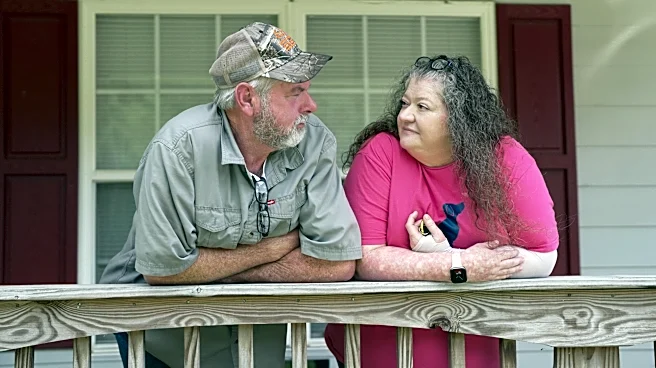
Flock’s recent reforms offered little solace to Billy Taylor and Leandra Higgenbottom, whose cars Heidi Taylor is accused of improperly tracking for months while she was the 911 director for the police department in Dallas, Georgia.
Billy and Heidi Taylor separated around November 2024 after 27 years together, Billy Taylor, an electrician his friends call “Sparky,” told USA TODAY. He and Higgenbottom started dating soon after, when he fixed the wiring in her home.

In the months after, they said Heidi Taylor repeatedly showed up unannounced at the restaurants where they ate, the hospital where Higgenbottom works and even at the rural, 100-acre Alabama property they regularly visit.
“Sometimes she would just sit there, and as we would walk out to her, then she'd haul buggy and be gone,” Higgenbottom said. “I think she wanted us to know she was there.”
Heidi Taylor did not respond to calls or emails seeking comment. Billy Taylor said they had a brief discussion when she called him from jail to ask for her son’s phone number. According to him, when he asked her why she tracked him and Higgenbottom, she replied: “You know why.”
USA TODAY’s analysis shows that Heidi Taylor used Flock to look up Billy Taylor’s and Higgenbottom’s license plates almost every day from July 2024 to May 2025 – as many as 39 times in one day, sometimes just seconds apart. More than half her searches of those cars occurred between 7 p.m. and 3 a.m.
USA TODAY contacted the Dallas Police Department about Heidi Taylor’s Flock activity on July 6. A subsequent press release shows the department asked the Georgia Bureau of Investigation to investigate her the next day.
If you cannot see a graphic below, click here.
Arrested on Aug. 12 on two misdemeanor counts of misusing a license plate reader, Heidi Taylor has not been charged in court. A 14-year department veteran who no longer works for the agency, she had garnered praise in performance evaluations, her personnel file shows, for running background checks without being asked.
Billy Taylor and Higgenbottom dislike Flock, they told USA TODAY, and the enormous power it places in the hands of people like Heidi Taylor, who is not a sworn officer. They live quiet lives and don’t want to be tracked wherever they go.
Higgenbottom said she fears for her safety. She filed a petition for a restraining order against Heidi Taylor on Aug. 20, court records show, citing her frequent Flock searches.
“It’s an invasion of privacy,” Billy Taylor said. “Who gave y'all permission to look for me while I was going down the road? I'm not a wanted fugitive. I'm not a child molester. I'm not a thief.
“Why were y'all looking at me?"

Flurry of arrests, firings and investigations
Almost immediately after USA TODAY reporters asked about their officers’ irregular Flock usage, at least a dozen law enforcement agencies launched internal investigations.
Although some agencies said the officers’ Flock searches appeared to be connected to legitimate narcotics investigations or training exercises, many took swift disciplinary action. Over the next few days, police officers, sheriff’s deputies and law enforcement personnel across the country were arrested, referred to outside agencies for criminal investigations, placed on leave or fired.
In Georgia, officer Sierra Carroll used Flock to look up a single license plate more than 4,000 times over a 16-month span while employed by the Perry Police Department, USA TODAY’s analysis found. That was one of six license plates she repeatedly searched: Two of them were registered to cars owned by her co-workers; another belonged to her daughter’s father.

“Prior to your inquiry, Perry Police Department was not aware of the frequency with which Sierra Carroll was using Flock to search the specific license plates identified in your email,” Chief Alan Everidge told USA TODAY in an Aug. 19 email, five days after a reporter contacted him. “After receiving your inquiry, we immediately began reviewing Carroll's Flock activity.”
Carroll left the Perry Police Department in April 2025 to work for Georgia’s Houston County Sheriff’s Office as a school resource officer at a local high school. She continued making searches from her Perry police-issued Flock account for at least four months after she left, audit logs show.
The Houston County Sheriff’s Office suspended her without pay on Aug. 17, Sheriff Matt Moulton told USA TODAY. She was arrested two days later on charges of misusing a license plate reader system.
Carroll declined to comment when reached by USA TODAY. A plea has not been entered in her case.
In Texas, officer Zachary Klein of the Lufkin Police Department used Flock to repeatedly search seven license plates, USA TODAY’s analysis found, including one more than 3,400 times over 10 months. His stated reason for each search was simply, “INVESTIGATION.”
On Aug. 20, six days after USA TODAY asked Lufkin police about Klein’s Flock use, Texas Rangers arrested Klein, an 11-year veteran of the department, on felony charges of abuse of official capacity and tampering with a government record. Lufkin police also launched a department-wide audit, suspended the use of Flock cameras across the department and placed a second officer on administrative leave.
“The department recently became aware of potential issues and immediately began an audit into the use of the technology,” public information officer Jackie Zimmerman said in an Aug. 20 press release. She added in an email to USA TODAY, “we appreciate you bringing your concerns to our attention.”
Klein, who faces at least 100 felony charges, according to court records, did not respond to calls or emails from USA TODAY. He has not entered a plea.
The Sarasota Police Department in Florida fired officer Cory Waiters and arrested him on two felony counts and one misdemeanor count of misusing computer systems and official misconduct on Aug. 19 – two weeks after a reporter asked the agency about his 335 Flock searches of his ex-partner's car. Waiters, who did not respond to calls or emails from USA TODAY, has not entered a plea.

The Cherokee County Sheriff’s Office in Georgia on Aug. 19 fired and arrested deputy Jerry Shellhouse, who searched one tag at least 840 times. The office had previously arrested and fired three deputies for abusing Flock but missed Shellhouse until contacted on Aug. 14 by a USA TODAY reporter. Shellhouse, who has not entered a plea in his court case, did not respond to messages from USA TODAY.
The St. Charles County Police Department in Missouri suspended an employee and discontinued the department’s Flock usage, and the Harris County Sheriff’s Office in Texas suspended three deputies’ Flock access pending an internal investigation – all in response to questions from USA TODAY.
At least six more agencies – including the Houston Police Department in Texas, Eastpointe Police Department in Michigan and Georgia’s Butts County Sheriff’s Office, LaGrange Police Department, Milton Police Department and Richmond County Sheriff's Office – launched criminal or administrative investigations into officers because of USA TODAY’s reporting.
Their investigations continue.
Public scrutiny prompts Flock to clamp down
Flock began as three college friends’ pipe dream to “eliminate crime.”
But after cops were increasingly publicly exposed for using Flock to commit crimes, the company mobilized, instituting consequential changes that inhibit the public's ability to hold rogue officers accountable.
As told by company CEO Garrett Langley in a series of newspaper and podcast interviews and public speeches, he became frustrated by Atlanta police’s failure to solve most murders and property crimes.
So he and fellow Georgia Tech alumni Paige Todd and Matt Feury in 2017 put an Android phone in a waterproof box and deployed it in their neighborhood. It took pictures of passing cars and uploaded details about them – license plate number, make, model, color and other characteristics like body damage and bumper stickers – to an online database.
License plate readers had existed for years. But Langley and his friends soon developed a product more affordable than its competitors, he told The Atlanta Business Chronicle’s On Leadership podcast in 2023, and marketed it aggressively to police.

Backed by at least $650 million in venture capital funding, Flock now captures and analyzes more than a billion photos, sounds and videos a day with more than 100,000 cameras installed across the U.S. The company says it helps solve a million crimes a year.
Law enforcement officials nationally praised Flock as a game changer for helping crack stolen-vehicle, missing-person and homicide cases. But as officers were outed for tapping into local Flock camera networks to stalk exes, track a woman her husband suspected of getting an abortion and enforce federal immigration laws, activists started harnessing Flock’s power against it.
Several anti-Flock websites and muckrakers used open records laws to collect and publish hundreds of police agencies’ audit logs – internal records detailing each time an officer searched Flock for a specific tag. HaveIBeenFlocked.com created a public, searchable database that enabled anyone to enter their own license plate and check if a cop had used Flock to track their whereabouts.
That was when Flock – which achieved a $7.5 billion valuation on the premise that taking photos in public places is fair game – obscured its data to block it from public view.
As first reported in a post on HaveIBeenFlocked.com’s blog, Flock vice president Chris Colwell in a series of December 2025 emails informed customers the company was taking action to permanently hide police officers’ search activity.
“Recently, a third-party website began aggregating search information that appears to have been released through these public-records processes,” read the emails. “We recognize that seeing investigative search activity displayed publicly can raise understandable concerns about officer safety, investigative integrity, community perception and compliance with state law.”
Colwell on Dec. 9 announced Flock’s solution: The audit logs that HaveIBeenFlocked.com and so many other news outlets and civilians had obtained would no longer include most officers’ initials, the tags they searched, and their stated reasons.
Flock would begin redacting those details so that agencies could see only the identities of their own officers. Details of statewide or national searches run by outside officers on their networks – the bulk of all searches – would be concealed, Colwell’s Dec. 9 email said, “to protect active investigations and ensure officer safety.”
From that point forward, agencies themselves could not see which outside officers were accessing their data, and for what reasons. When members of the public requested those logs, most officers’ initials and the plates they searched were replaced with “REDACTED” or simply “***.”
Retracing officers’ steps
Flock’s changes make it much harder for the public to root out future abuse. But it was too late to cover up what was already out.
Before the changes took effect, many news organizations and civilians had uploaded agencies’ audit logs to Muckrock.com, a nonprofit newsroom and resource hub where journalists and others frequently share government documents and data obtained through public records requests.
From there, a USA TODAY reporter downloaded audit logs released by more than 120 police agencies in 24 states and obtained even more logs through additional records requests. Together, the logs contain records of more than 75 million license plate searches conducted from January 2023 to July 2026 by officers from 6,300 agencies – about a third of all law enforcement agencies in the U.S.
Because so many officers who looked up license plates ran their searches across not only their own agencies’ camera networks, but hundreds or thousands of others’, their searches still showed up in the data even when their own agencies refused to release it. That allowed USA TODAY to create a picture of at least 208,000 officers’ Flock usage.
USA TODAY’s analysis resulted in a list of many of the nation’s most prolific Flock users, many of whom had used the service to repeatedly search single tags. In many cases, they entered nebulous and implausible reasons for their searches, including “PLATE,” “TAG,” “POLICE” or “BOB.” Many of their searches spiked in the wee hours of the night.
Those users represent only the ones USA TODAY knows about. Of the 75 million individual search records USA TODAY obtained, just 14 million were fully unredacted.
Because most of the unredacted logs listed only the officers’ initials, reporters spent weeks scouring agencies’ websites, city staff directories, statewide badge registries and news articles to reveal the officers’ identities.
In some cases, USA TODAY identified the specific people officers had monitored by matching their license plates to parking or speeding tickets. When contacted by reporters, several of those people said they had been entirely unaware that officers had used Flock to track them.
Many of the agencies the officers worked for said they, too, were unaware.
Recent Flock reforms go only so far
The more agencies USA TODAY reporters contacted, the more apparent it became that many were not conducting routine audits of their officers’ Flock use.
USA TODAY submitted public records requests to 30 police agencies that employed prolific Flock users for any internal audits, investigations or reviews they had conducted of their officers’ Flock activities since January 2023.
Of the 14 that responded, four – the Eastpointe Police Department in Michigan, Albany County Sheriff’s Office in New York, Gurnee Police Department in Illinois and Mentor Police Department in Ohio – said they had no responsive records. Five denied the requests, saying that the records were part of pending investigations or disciplinary cases, that the request was too broad or that any such audits are exempt under laws governing the disclosure of license plate reader data.
The other five agencies – the Newton County Sheriff’s Office in Indiana, Braintree Police Department in Massachusetts, Lufkin Police Department in Texas and Georgia’s Braselton and Norcross police departments – provided records indicating that they had begun conducting audits only this year, when Flock introduced its “Audit Assistance” feature, which the company says is intended to help agencies detect unusual search activity.
Flock made that feature optional. About a third of agencies that use Flock had turned it on voluntarily as of early August, April Sigona, a Flock strategic communications consultant, told USA TODAY. But amid an onslaught of officer arrests and negative press coverage over misuse, Flock in August said it will make the feature mandatory for all law-enforcement customers by the end of 2026.
In an interview with USA TODAY, Flock CEO Langley declined to say what specific criteria meet Flock’s internal threshold for unusual activity. He said that the feature generally is designed to flag repeated searches of a single plate and late-night queries.
Chief Garrett Fiveash of the LaGrange Police Department sent USA TODAY several screenshots of the internal audit features Flock offers, which the department started using in January. One shows an officer who searched one plate 11 times, next to the words “Needs Review.”
Because the feature doesn’t examine searches before 2026, however, Fiveash said that Flock did not alert him to the irregular activity of Sergeant Joseph Randazzo, who searched one license plate 781 times over two-and-a-half months in 2025 – an average of 10 times a day. Fiveash said he first learned about Randazzo’s searches from USA TODAY.
The department placed Randazzo on administrative leave three days later for what Fiveash called an “egregious violation.” Randazzo, who has not been charged with a crime, did not respond to messages from USA TODAY.
“Suffice to say it was a very, very serious problem,” Fiveash told USA TODAY. “We feel sure that it’s going to wind up, more than likely, with him being terminated and prosecuted when it’s all said and done.”

The LaGrange Police Department is one of several agencies that recently implemented new safeguards to address how its officers use Flock. Officers must now enter a case number associated with each search, Fiveash said, to ensure each is connected to an actual criminal case. The agency will also conduct a historical audit of its officers' Flock activity.
The Richmond County Sheriff’s Office in Georgia as of a July 2026 policy change now requires deputies to submit search requests through its Intelligence Unit, which runs the searches on their behalf. The requesting deputies are required to provide their computer number, case number and an offense type.
Flock’s Audit Assistance feature helped several Georgia police agencies identify rogue employees, whom they referred to the Georgia Bureau of Investigation for criminal probes in recent weeks. Since July 6, the bureau announced arrests of 14 of them. Several additional cases remain ongoing, bureau spokesperson Sara Lue told USA TODAY.
Was it 41 searches, or nearly 3,000?
For the Covington Police Department, Flock's audit feature presented only a small fraction of the full picture.
Michael Canty, a now-former Covington detective, is one of the first Georgia officers Flock’s Audit Assistance feature helped net.
It flagged his excessive Flock activity in July, prompting Covington police to launch an internal review, copies of which USA TODAY obtained through a public records request.
The review shows that Canty used Flock to search the license plate of a woman he used to date, who also works for Covington police, 41 times since January 2026. Canty, it shows, also searched the tags of that woman’s new boyfriend – another Covington detective – and a second ex-dating partner.
The department fired Canty soon after, referring him to the Georgia Bureau of Investigation for an independent criminal investigation. Canty, who did not respond to calls or emails from USA TODAY, was charged on Aug. 27 with five counts of violation of oath by a public officer and other offenses. He has not entered a plea.
In fact, Canty’s surveillance was far more extensive.

USA TODAY’s analysis of publicly released audit logs found that Canty searched the first ex-dating partner’s license plate 2,890 times from June 2023 to October 2025. He looked up her plate nearly every day for 14 months straight, the logs show – as many as 41 times in one day, usually between 9 p.m. and 4 a.m.
That came as news to the woman he was searching.
The woman, who declined to use her name for this story, told USA TODAY that she suspected Canty had planted a tracking device on her vehicle. He repeatedly showed up unannounced, she said, and seemed to know every place she had been, frequently bringing it up in conversations. Once, she noticed him parked outside of a Waffle House in his police cruiser while she ate late at night with friends.
The woman, a Covington police employee, said she has seen the value Flock adds when it comes to solving crimes. But she said there need to be far more guardrails around when and which officers can use it.
When a USA TODAY reporter called her in early August and told her the true number of times Canty had searched her plate, she said she was in shock.
“I’m really scared,” she told the reporter. “I’m going to call the police right now.”
Jeanine Santucci contributed reporting.
Kenny Jacoby is an investigative reporter for USA TODAY. Contact him at kjacoby@usatoday.com.
Austin Fast is an investigative data reporter at USA TODAY. Contact him at afast@usatoday.com.
Jack Lemnus is a TCPalm enterprise reporter. Contact him at jack.lemnus@tcpalm.com, 772-409-1345, or follow him on X @JackLemnus.
This article originally appeared on USA TODAY: Frequent Flockers. Repeat searches prompt officer firings, arrests