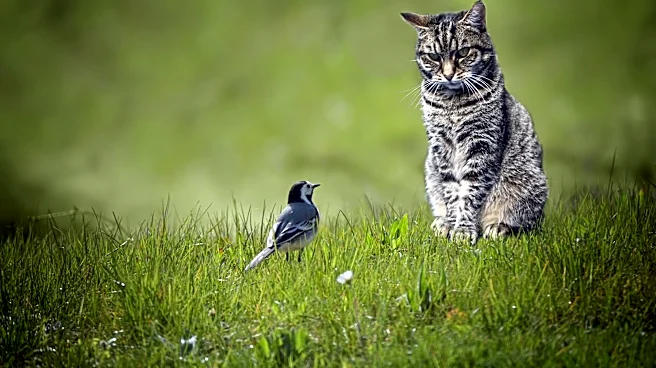





There are many reasons to keep your domestic cat indoors, but there’s one big reason you may not have considered. It isn’t your sweet pet’s safety, but rather the opposite: the devastating impact your feline can have on local wildlife. The same hunting skills they use to chase a toy mouse or dangling feather can directly harm local bird and small animal populations.
A catastrophic problem
Domestic cats that roam freely outdoors, hunt, and reproduce within natural ecosystems are functioning as ecologically invasive predators. However, Dr. Deby Cassill, an associate professor in the Department of Integrative Biology at the University of South Florida, said they can still disrupt the established pecking order.
“Domestic cats are not villains. They are highly effective
predators doing exactly what thousands of years of evolution prepared them to do," she said. "A cat may look like a cuddly companion indoors, but outdoors it becomes a small tiger with neighborhood access.”
Your adorable tiny tiger isn’t a problem when it’s relaxing on the couch, but an ecological problem arises when people release that predator into environments containing native birds that haven’t adapted. Your cat isn’t part of the natural food chain.
The impact cat owners don’t see
According to Cassill, there are approximately 76 million pet cats living in U.S. households, in addition to an estimated 30 to 40 million unowned or community cats. Domesticated cats (Felis catus) first appeared in the U.S. about 500 years ago, and today there are around 100 million domestic cats in the country.
The problem is, for every bird or mouse a cat brings home, there are many more it kills that you never see. Losing a few birds in your yard may not seem like a big deal, but repeated across millions of pet cats, the impact on wildlife is enormous.
“A widely cited national analysis estimated that free-ranging domestic cats kill approximately 1.3 to 4 billion birds annually in the contiguous United States,” said Cassill.
On top of the outright deaths that are attributable to roaming outdoor cats, there also are an unknown number of what are categorized as sub-lethal effects, said Robert Mulvihill, an ornithologist at the National Aviary in Pittsburgh.
“These include such things as nest abandonment, chick starvation, and decreased pairing success, all of which affect the productivity needed to counterbalance the combined annual sources of mortality that a population of birds faces," he said.
Birds are valuable contributors to nature’s harmony, providing essential ecological services such as eating insects, dispersing seeds, and pollinating plants.
Beyond birds
Cats left free to roam face more issues than just decimating the local bird population.
Being outside, without supervision, “Can lead to exposure to diseases, illnesses, and toxics, cruelty from humans and outside dangers like cars, and other predators,” said animal behaviorist Michelle Bernstein from the food equity nonprofit Switch4Good.
All of these things can hurt or kill your kitty, so to keep them around longer, keep them inside.
Bernstein added that there are safe ways for cats to go outside, such as training your cat to use a secure and fitted body harness, providing a fully enclosed outdoor patio or putting them in a mesh stroller or cat carrier that is designed for pets.
Being a responsible cat owner means following the same rules that apply to dogs: Don’t let them roam unsupervised.
This article originally appeared on USA TODAY: Why keeping your cat indoors saves birds