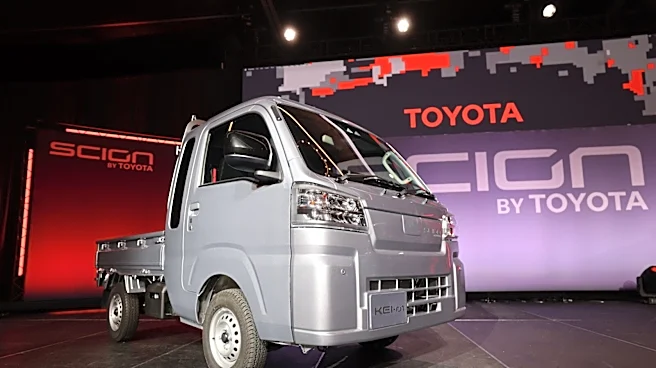






President Donald Trump has argued that Kei trucks, like the oneToyota is planning to introduce soon in the United States could be a fix for the affordability crunch that has gripped the American auto industry in recent years.
"If you go to Japan, where I just left, and if you go to South Korea and Malaysia and other countries, they have a very small car, sort of like the Beetle used to be with the Volkswagen," Trump said during a December 2025 event announcing a rollback of federal fuel economy rules. "They're very small. They're really cute. And I said, 'How would that do in this country?'"
"They're really nice and less expensive, and it really gives people a chance to have a car. You know?" Trump continued.
The average price of new cars in the
United States was $52,369 in October 2026, according to market data compiled by Cloud Theory's MotoMiner platform and USA TODAY Co.'s LocaliQ Automotive. The average new-car price in October rose from $52,326 in September and $49,861 in October 2025.
The average price of a full-sized pickup truck was $67,912 in October, according to Cox Automotive.
The USA TODAY Cars team took a look at what Kei cars and trucks are, why Trump thinks they'll do well in the United States and how Toyota is introducing now.
What is a Kei car or truck?
A Kei is an ultra-compact car that until recently was unique to the Japanese market.
Kei cars are the smallest segment of cars allowed on Japanese highways.
Toyota said its Scion kei truck for the American market would have the following features:
- A 660 cc three-cylinder engine
- Automatic transmission
- Four-wheel drive
- Length of just over 11 feet (approximately 3.35 m)
- Width under 5 feet (approximately 1.52 m)
- Payload of up to 600 pounds (approximately 272 kg)

Why does Trump think Kei trucks will do well in the US?
Trump argued a year ago that Kei cars could be a solution for shoppers who cannot afford to pay that much for a new car.
Trump said Kei cars could allow shoppers to "have a brand-new car, as opposed to a car that maybe isn't so great. And so, you car companies start thinking about that."
"Some of them are really beautiful, actually, if you take a look," Trump added then. "Honda, some of the Japanese companies do a beautiful job, but we're not allowed to make them in this country. And I think you're going to do very well with those cars, so we're going to approve those cars. I think it's going to be a tremendous market."
Trump said then he "authorized the (Transportation) Secretary to immediately approve the production of those cars so you'll be able to buy (them)."
Transportation Secretary Sean Duffy said in response to Trump's December 2025 comments: "If Toyota or any other company wants to make smaller, more affordable cars, fuel-efficient, we have cleared the deck so they can make them in America and sell them in America."
Americans love pickup trucks, but they generally opt for full-sized models. Pickups trucks accounted for 19.1% of U.S. new vehicle registrations so far in 2026, up from 15.9% in 2017, according to data compiled by Mobility Global and USA TODAY Co.'s LocaliQ Automotive. About 50 million pickup trucks are registered in the United States annually, according to the U.S. Department of Transportation's Bureau of Transportation Statistics.
"For decades, the full-size pickup defined the American truck market," Chris Wood, vice president of automotive client strategy for LocaliQ Automotive, said. "But our registration data shows that the growth is increasingly coming from compact and midsize pickups."
"Consumers aren't necessarily moving away from trucks," Wood added. "They're embracing a broader range of vehicles that deliver pickup utility without requiring a traditional full-size truck."
Why is Toyota bring its kei trucks to the US?
Toyota said in an Nov. 9 announcement that it is reviving its former Scion brand to produce a new vehicle inspired by the Kei trucks popular in Japan.
Toyota said the new Scion Kei truck will be built in Indiana, and its assembly will result in a $34 million investment in the local economy, creating 50 jobs.
"Kei trucks have long been valued in Japan for their maneuverability and practicality, they are still relatively uncommon in the United States, where full-sized pickup trucks dominate the landscape," Toyota said.
"Let's talk about a small truck with some big possibilities," said David Christ, group vice president and general manager of the Toyota Division. "The love for Kei trucks has really taken off and it got us thinking... what could our take on this segment look like?"
Christ added the new Scion vehicle represents Toyota answer to the question "what if we go beyond the automotive mainstream?
"Well, you're looking at our first answer," he said, adding that the American Kei cars would be "affordable, capable, and adaptable to a variety of lifestyles and applications."
Despite Trump and Duffy's earlier statements, the U.S. Department of Transportation has not yet amended the Federal Motor Vehicle Safety Standards to allow Kei cars to build in the United States like they are in Japan. Many older Kei cars in Japan didn't have air bags, but newer models do.
Absent any changes to federal car rules, any tiny cars built in the United States would have to meet domestic safety standards.
Keith Laing is an automotive reporter on the National Trending Desk at USA TODAY. Contact Keith at klaing@usatodayco.com.
This article originally appeared on USA TODAY: Why Trump thinks tiny trucks could solve car affordability crisis