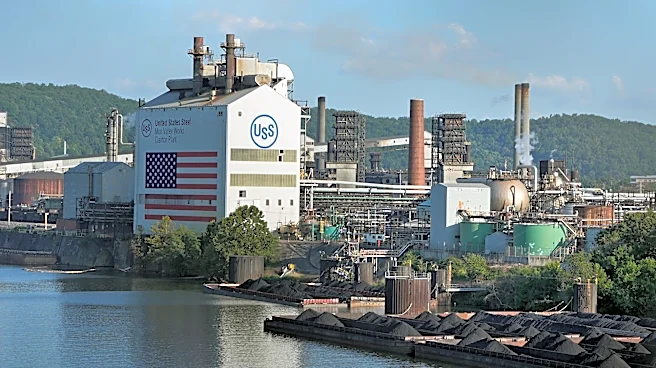

There's a rotten odor filling the air in Pittsburgh, but in spite of how it smells, it isn't bad eggs or a sewage spill. It's actually gas from a U.S. Steel plant, and it might be making you sick.
If you
step outside and smell something sulfuric, it's probably hydrogen sulfide. The gas, which gives off a bad smell even at very low levels, comes from U.S. Steel's Clairton Coke Works Plant about 10 miles south of Pittsburgh, according to a 2022 study by Allegheny County Health Department.
Here's why you're smelling it and what you can do about it.
Why does the air smell bad in Pittsburgh?
Allegheny County Health Department tracks hydrogen sulfide levels online. It doesn't take much gas for its smell to become noticeable. The rotten eggs odor can become bothersome to most people when a low level of the gas — about 0.3 ppm — is emitted, though a 24-hour average level of just 0.005 ppm may be detectible, according to the county health department.
Readings from the past year can be viewed online through Western Pennsylvania Regional Data Center's website, where the health department records daily hydrogen sulfide levels. Group Against Smog & Pollution, a southwestern-based organization advocating for better air quality, also tracks the data on its website and across social media pages. The group estimated that based on data gathered between Jan. 1 of this year and Nov. 23, the Liberty monitor had detected a 24-hour average hydrogen sulfide level over Pennsylvania's standard 103 times.
What is hydrogen sulfide? Is it dangerous?
Hydrogen sulfide is a flammable, colorless gas that commonly comes from industrial processes and facilities like oil and natural gas refineries, craft paper production, coke ovens and tanneries, according to Allegheny County Health Department. The gas is also released at sewage treatment facilities and landfills, as well as when bacteria break down waste from humans and animals.
While extremely high levels of hydrogen sulfide can be fatal, exposure to lower levels long term may cause more minor symptoms symptoms like headache, fatigue and irritation to the eyes, nose and throat, according to the Agency for Toxic Substances and Disease Registry. People who are asthmatic may have more serious symptoms like difficulty breathing, nausea and vomiting.
People can lose their ability to smell the gas when they are exposed for several minutes to levels at about 100 ppm. If they are exposed to moderate or high levels (over 100 ppm) of the gas for more than a week or two, they may have more severe symptoms, such as loss of consciousness.
The effects of the gas typically wear off when people are no longer exposed to it, though long-term or permanent effects are possible.
The gas has not been shown to cause cancer in people, and its potential ability to cause cancer in animals has not been thoroughly studied.
Where is the bad smell in Pittsburgh coming from?
The main source of hydrogen sulfide in the Pittsburgh area is the U.S. Steel Mon Valley Works Clairton Plant, according to a study conducted in 2022 by the county health department.
Allegheny County Health Department examined emissions and air quality data from Jan. 1, 2020 through March 1, 2022 from multiple sites around the county under different meteorological conditions to find any potential sources of hydrogen sulfide that were causing levels to exceed the ambient air quality standard laid out by the Pennsylvania Department of Environmental Protection. The department also installed gas sensors at a nearby wastewater treatment plant to determine if it was contributing to the gas exceedances.
The department found that the U.S. Steel Clairton Coke Works Plant was the single source causing hydrogen sulfide levels to exceed the standard at the county's Liberty monitoring site. They found no evidence of additional sources contributing to the excessive levels of hydrogen sulfide.

Because of its hydrogen sulfide exceedances, U.S. Steel was issued a notice of violation in early 2021, with the health department issuing an enforcement action the following year that resulted in a civil penalty of more than $1.8 million.
In 2023, the health department issued an enforcement order, noting that from March 2, 2022 through Nov. 30, 2023, the U.S. Steel Clairton Coke Works Plant violated the standard levels of hydrogen sulfide in a 24-hour period on 159 calendar days, violations that resulted in a civil penalty of more than $2.2 million. The department ordered U.S. Steel to take action to prevent further exceedances and provide Allegheny County Health Department with a plan to be complaint with Pennsylvania's hydrogen sulfide standard.
Does winter weather make air pollution worse?
Colder weather itself doesn't make air pollution worse. But when air near the ground cools overnight while air at higher levels in the atmosphere remains warmer, or warm air moves through a region at a higher level while the air at ground level remains cool, temperature inversions can develop, causing warm air to stack on top of cool air, according to the National Weather Service. Conditions like long nights, clear skies and calm winds can lead to inversions.
The warm air at a higher altitude acts like a lid to the cooler ground-level air, trapping it close to the surface. This means that pollution is also trapped at ground level and can't move out of the lowest levels of the atmosphere. That's why the air quality can be worse on days where Pittsburgh is experiencing a temperature inversion.
Are hydrogen sulfide levels regulated?
In Pennsylvania, yes. While the U.S. Environmental Protection Agency doesn't have federal air quality standards for hydrogen sulfide, Pennsylvania regulates it, with the Allegheny County Health Department incorporating the Pennsylvania Department of Environmental Protection's regulations into the county's air quality rules and regulations. Allegheny's Air Quality Program enforces the regulations.
The Pennsylvania 24-hour standard for hydrogen sulfide is 0.005 ppm, with the one hour standard set at 0.1 ppm. This standard was created based on nuisance caused by the gas' smell and not by a health standard, according to ACHD.
How to report hydrogen sulfide smell in Pittsburgh region, find more information
If you smell something with the scent of rotten eggs or sulfur, you can report it to the Allegheny County Health Department online through the department's self-service portal, which is reviewed daily.
The health department also sends out air quality alerts, which residents can sign up online to receive. Those who have concerns can also attend the department's air advisory committee meetings, or check the department's air quality dashboard, which is updated hourly. There, you'll find a daily air quality forecast and dispersion outlook report for all of Allegheny County.
You can also check Allegheny's hydrogen sulfide levels online, where local readings are updated multiple times a day. And, if you want to see what areas of Allegheny County are most impacted by the smell, you can check Smell Pittsburgh, a mobile app developed by CMU CREATE Lab. User-submitted reports populate a map of Allegheny County, showing where the smell is the worst. These reports are made available each day to the health department.
Finch Walker is the Pittsburgh Connect Reporter for the USA TODAY Network. Contact Walker at FWalker@usatodayco.com. Instagram: @finchwalker_. X: @_finchwalker.
This article originally appeared on USA TODAY: This gas is stinking up Pittsburgh region and may be making you sick