







The Centers for Disease Control and Prevention has officially recorded its first measles death of the year after a contentious back-and-forth between the federal agency and the state of Pennsylvania.
Four "measles-associated" deaths have been reported by the Pennsylvania Department of Health since August as part of a growing outbreak in the state. County coroners confirmed that the deaths occurred in two infants too young to be vaccinated; an unvaccinated 18-year-old; and an unvaccinated 40-year-old.
Only one of the deaths was added to the CDC's official count in an update on Sept. 23, however. The rest of the information on the CDC's measles tracking page, including nationwide case counts and states with infections, did not appear to be updated
at the same time and still showed numbers from Sept. 17.
But the remaining deaths have yet to be reflected in the CDC's official count due to questions from Health and Human Services Secretary Robert F. Kennedy Jr. and changes in reporting made by President Donald Trump's administration.
Why four deaths recorded in Pennsylvania aren't in CDC count
Last month, Kennedy, a known vaccine skeptic, asked for two measles-related deaths reported by Pennsylvania’s health department to be removed from the CDC’s national tally of measles, questioning whether the virus was the cause, Reuters reported. CDC staffers had already accepted the state’s characterization of the deaths as linked to measles before Kennedy's request.
In a terse back-and-forth that played out over social media and speeches, Kennedy accused Pennsylvania Gov. Josh Shapiro of "fabricating" the deaths, while Shapiro said Kennedy was "downplaying the severity of measles."
The administration then announced that it would change where it gets its information about measles illness and deaths. Previously, the CDC generally relied on state and local health departments' surveillance reports through the National Notifiable Diseases Surveillance System (NNDSS) when counting measles-related deaths. Under the new approach, the agency says it will count deaths only when the National Center for Health Statistics (NCHS) identifies measles as the underlying cause of death from official death records, a move experts called "puzzling" and an "extraordinary political interference."
See map of states with measles cases
As of Sept. 17, the CDC reported 3,471 confirmed cases in 45 states plus Washington, DC.
Measles cases hit three-decade high
Measles, one of the most contagious infectious diseases, was previously eliminated from the United States in 2000, something the CDC called a "historic public health achievement."
Cases have since hit their highest level in more than three decades under the Trump administration, which has attempted to change the childhood vaccine schedule and promoted the idea that vaccines, including the combined measles, mumps and rubella (MMR) shot, are more dangerous than the diseases they prevent, despite decades of scientific evidence saying otherwise.
As of Sept. 17, the CDC reported 3,471 confirmed cases in 45 states plus Washington, DC, well surpassing last year's total with three months still left in the year.
Cases previously reached a 30-year high in 2025, with 2,289 confirmed infections across 43 states plus Washington, DC, for the entire year. The majority, 93%, of infections were contracted by unvaccinated people or those with unknown vaccination statuses. Three people, including two children, died as a result of the outbreaks, marking the first pediatric deaths from measles in a decade.
About 90% of unvaccinated people who are exposed to measles end up contracting it. Additionally, 1 in 5 of those people end up hospitalized, according to the CDC. It is especially dangerous for young children.
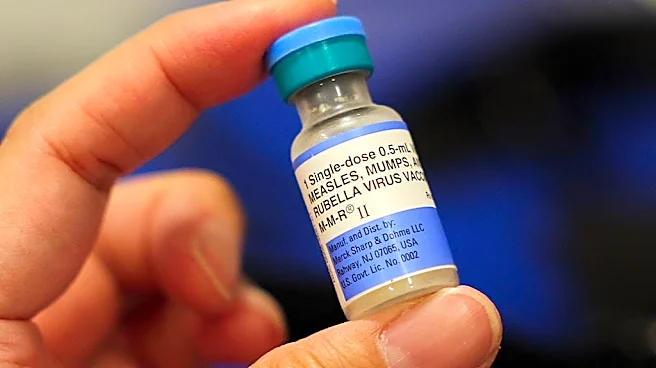
The MMR vaccine (measles, mumps and rubella), which protects against measles with 97% efficacy, is typically administered to children as part of the regular vaccine course at ages 12 to 15 months for the first dose and ages 4 to 6 years for the second. MMR vaccination uptake has declined in recent years, resulting in a growing number of states no longer reporting rates consistent with herd immunity.
This article originally appeared on USA TODAY: Why CDC counts only 1 measles death while Pennsylvania reports 4