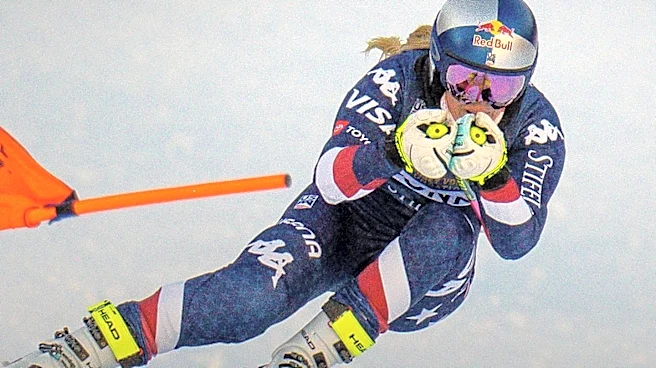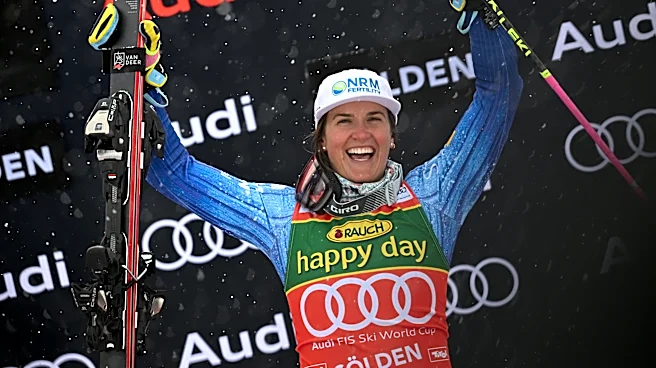



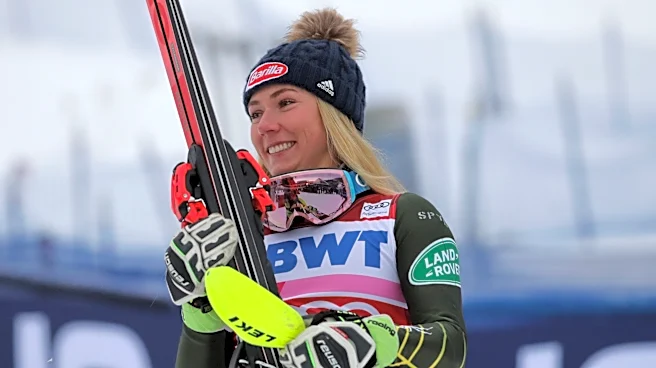
It is fitting Paula Moltzan’s first time wearing the red bib awarded to the leader in the standings will be at this weekend’s World Cup in Killington, Vermont.
Vermont is Moltzan’s adopted home state, where she went to college and spends her offseasons. Killington is where she kickstarted her comeback in elite ski racing, rebuilding a career that continues to challenge norms — on and off the slopes.
“It was close to never happening, never coming back to World Cup,” Moltzan said. “When I was in college, I was loving school and I was loving my college ski racing. But I never let go of that dream or the itch to be the best in the world. So I owe a lot to (Killington) … for reigniting my career.”
Dropped by the U.S. Ski team in 2016, Moltzan competed
for the University of Vermont and won the 2017 NCAA title. She was able to keep racing at Killington because of extra spots given to the host country, and her 17th place finish in 2018 gave her a path back to the World Cup circuit.
Since her return to the circuit full-time in the 2020-21 season, Moltzan has made 11 World Cup podium appearances and won the bronze medal in the team combined at the Milano Cortina Olympics. Her win in the season-opening giant slalom made Moltzan, 32, the oldest woman to get her first World Cup victory.
“It gives (younger athletes) inspiration they can make a career out of this. It’s not like they have one shot and then they’re out,” Anouk Patty, chief of sport for U.S. Ski and Snowboard, said.
“We recognize it’s a journey. It takes time to develop a World Cup athlete. Knowing that we, the U.S. Ski team are committed to supporting those athletes, it gives them a little more comfort to know they will be supported.”
Planning for when to have a family
Moltzan initially thought she would retire after Milano Cortina, her second Olympics. She and husband Ryan Mooney, who is also her ski technician, know they want children, and it is not lost on her that the prime of her career is overlapping with her prime child-bearing years.
It’s a familiar challenge to women in many sports. As women are extending their athletic careers into their mid- to late-30s, some even into their 40s, they have to make choices about when, or whether, to have a family.
It can be a daunting decision — one Moltzan is trying to make less so.
She speaks openly about her decision to freeze her eggs after Milano Cortina, allowing her to retire when she wants to rather than when she believes she has to. She’s in her second season with Northeastern Reproductive Medicine, a fertility clinic in Vermont, as her helmet sponsor.
“I wanted to make a plan so that I could have babies in the future,” Moltzan said. “I’ve always wanted to have a family, so (it was good) to be able to partner with someone that was going to make that process a lot more seamless and really break it down.
“And then to be able to carry it forward and show other women what’s available. Even if they’re much younger, to know that there’s options out there and they can keep going on their career much longer.”
Moltzan: Ask about the fertility clinic on my helmet
Moltzan is doing more than putting a sticker and an (artistic) drawing of a uterus on her helmet. She's having conversations with U.S. Ski and Snowboard and the U.S. Olympic and Paralympic Committee about the options and financial help available to athletes.
Moltzan's willingness to share her story is so powerful because it gives other women the freedom to ask questions, said Dr. Jenny Brown, the medical director of Northeastern Reproductive Medicine.
"People are becoming so much more comfortable talking about it just knowing someone else already is," Brown said. "It just starts the conversation."
At last year’s World Cup in Copper Mountain, Colorado, Moltzan organized an informational session with Brown on fertility options. The rest of the U.S. women came, as did some members of Norway’s team.
Even some male skiers came, wanting information for their partners.
“And they were asking questions. They were so engaged. We never would have had that conversation in the past, if not for Paula and what she’s doing,” Patty said.
“The questions they’re asking, they’re all asking it. She’s just normalized it. I think it’s had a really big impact on a lot of those women.”
More women are competing in ski racing later in life, pushing the boundaries of career longevity. Lindsey Vonn won two downhill World Cups at 41 last season. Italy’s Federica Brignone became the oldest Alpine Olympic champion, male or female, with two gold medals in Milano Cortina at 35.
On the U.S. Skiing’s A team this season, five of the 12 women are 30 or older.
But women of all ages, and in all careers, can benefit from talking about fertility options and everything associated with it, Moltzan said.
“Most people, especially when it comes to healthcare, are pretty scared by the process of insurance and billing. Like, `What’s going to be covered? Am I going to get approved?’” Moltzan said.
“How I see that I can (have an) impact is to get out there and show people exactly what the steps are to make it happen,” she said. “… Explaining how to do it to take the scariness and the unknowns away.”
Simply normalizing these conversations makes an impact, Brown said.
"It’s all about education ... so they don’t feel regrets later," she said. "The No. 1 thing I hear in my office is, `I wish I had known.'"
The overlap between having a career and having a family has always existed but, for too long, women felt they had to choose one or the other. Knowing they can take steps to give themselves options is good for them personally and professionally, Patty said.
"It’s pretty easy for athletes to get pretty myopic and focus on their sport. This is encouraging them to think about life beyond," Patty said. "We're trying to help them so when they do leave the sport, they're in a much better place, a lot happier and much more secure. It gives them a little more security when they’re in it."
Look at Moltzan.
She does not think it's a coincidence that her first World Cup win came after she froze her eggs. The decision gave her peace of mind, she wrote in an Instagram post, turning off the clock that had been ticking in her head. As she returns to Killington, she still wants to be the best in the world and she's given herself the time to do it.
"I still have some pretty good goals set," Moltzan said. "I don't think winning one World Cup is going to fill my cup."
This article originally appeared on USA TODAY: Paula Moltzan isn’t choosing between ski racing and motherhood. She’s giving herself options