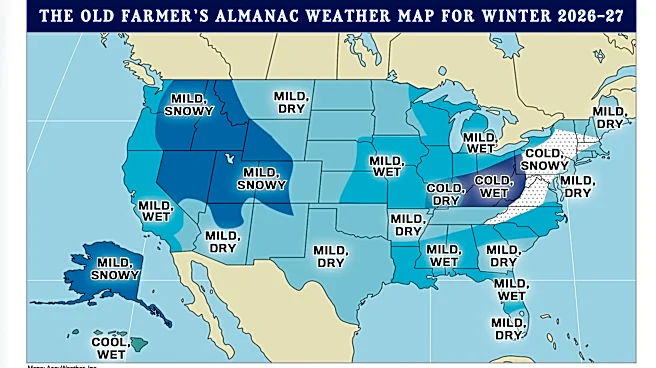






The Old Farmer's Almanac's winter weather forecast predicts a mild, near-normal winter for much of the United States. But regions hit months ago by January's massive winter storm may need to brace for some colder-than-usual temperatures.
The Almanac's just-released full winter forecast – the print publication becomes available Tuesday, Sept. 1 – predicts a wetter-than-normal winter for much of the West and in parts of the South, Midwest and Florida. A drier winter is forecast for parts of the East, Plains and Southwest. A snowier-than-normal winter is forecast for parts of the Northeast and Appalachians, parts of the West and Alaska.
Meteorologists generally pay little attention to annual forecasts produced by almanacs. "I don't know what voodoo
magic they use to get their forecasts," meteorologist Don Day at Wyoming's Cowboy State Daily newspaper said earlier in August. "I don't think we should be talking about any detailed winter forecast till maybe mid to late September. Until then, it’s not helpful for anybody."

Still, the Old Farmer's Almanac forecast has some commonalities with the National Weather Service Climate Prediction Center's December 2026-February 2027 outlook, which forecasts above-normal to near-normal temperatures for much of the United States.
Much of the northern U.S. is forecast to have normal or below normal precipitation, according to the weather service. Above-average precipitation is forecast for much of the Southwest, Central, South, Mid-Atlantic and Northeast.
The competing Farmers' Almanac also predicts a wetter winter for much of the United States. The North will encounter quick bursts of snow and cold, while the Northeast may face a mix of rain, sleet, ice and heavy wet snow.
El Niño and winter weather forecasts
Last winter brought extreme conditions, including a polar vortex and massive winter storm in January that battered more than 30 states and claimed more than 120 lives. The Carolinas were hit with blizzard conditions, with even Florida getting snow. Then, a March megastorm brought blizzard conditions to the Great Lakes, high winds and thunderstorms to the East and a heatwave to the West.
The forecast for the upcoming winter is particularly tough to pin down because of the strengthening El Niño, a natural warming of seawater in the Pacific Ocean, and its interactions with the polar vortex. If El Niño disrupts the polar vortex, it can lead to extreme cold in the eastern U.S., experts say.
For instance, AccuWeather won't release its long-range winter forecast until October, when more is known about how El Niño, "the marine heat waves and the polar vortex could influence rain, snow and temperatures across the country," according to the weather site.
The almanac accounts for El Niño and the polar vortex. The Old Farmer's Almanac notes that El Niño and other factors could cause the polar vortex "to displace southward this winter, sending cold air from across Canada south into the U.S." The Farmers' Almanac expects El Niño to lead to "wetter-than-normal conditions across much of the southern United States."

How accurate is the Old Farmer's Almanac?
The almanac boasts a traditional average accuracy of 80% on temperatures and precipitation. It uses a secret formula devised in 1792 by founder Robert B. Thomas that has been updated by "state-of-the-art technology and modern scientific calculations," it says, adding, "We predict weather trends and events by comparing solar patterns and historical weather conditions with solar activity."
Did the Old Farmer's Almanac get its winter weather prediction right last year?
The publication exceeded its 80% mark last year, it says. "Our forecast for below average snowfall across much of the country was correct, and above average snowfall in the eastern Ohio Valley also verified," the almanac says. "We underestimated snowfall in the northern Atlantic Corridor from Boston through New York, as well as from the eastern Upper Midwest through the Lower Lakes."
Here's the Old Farmer's Almanac winter forecast for regions across the U.S.
Old Farmer's Almanac winter weather forecast
Northeast (Maine, New Hampshire and parts of Massachusetts, Vermont, Rhode Island and Connecticut)
The winter forecast for this region calls for warmer-than-normal in the north and colder in the south, with the coldest periods in early and mid-January. Below normal precipitation, but snowfall above normal in the south and below normal in the north.
Atlantic Corridor (Massachusetts, Rhode Island, New Jersey, New York, Pennsylvania, Maryland, the District of Columbia and Virginia)
Winter in this region is forecast to have above-normal temperatures and below-normal precipitation, with snowfall slightly below normal. The coldest temperatures are expected in early to mid-December, early to mid-January, and early and late February. The snowiest periods are expected in late November, early to mid-January, and early and late February and late March.
Appalachians (Parts of North Carolina, Virginia, Maryland, Pennsylvania and New York)
This winter's coldest and snowiest conditions will be in mid-January and early and late February. Overall temperatures and precipitation will be below normal, but snowfall will be above normal, especially in the north.
Southeast (Georgia, South Carolina and parts of North Carolina and Virginia)
This region is forecast to have winter temperatures above normal, while precipitation will be above normal in the north and below normal in the south.
Florida
The state can expect a warmer winter than usual, with the coldest temperatures in early and mid-December and early January. Rainfall will be above normal in the north and below normal in the south.
Lower Lakes (Michigan and parts of Wisconsin, Illinois, Indiana, Ohio, Pennsylvania and New York)
The region is forecast to have winter temperatures above normal, with the coldest periods in early January and early February. Precipitation will be above normal with near- to below-normal snowfall.
Ohio Valley (Kentucky and parts of Illinois, Ohio, Pennsylvania and West Virginia)
In this region, winter will be colder than normal with the coldest periods in mid- and late January. Precipitation will be above normal in the east and below normal in the west. Snowfall will be slightly below normal.
Deep South (Louisiana, Mississippi, Alabama and parts of Arkansas, Florida and Tennessee)
This region is forecast for winter to be warmer than normal. Precipitation will be below normal in the north and above normal in the south. Snowfall will also be below normal.
Upper Midwest (parts of Minnesota, North Dakota, South Dakota and Wisconsin)
Winter in this region will be warmer than normal. Precipitation will be above normal in the east and below normal in the west. The coldest period will be in mid- to late January. Snowfall will also be near to below normal.
Heartland (Iowa and parts of Kansas, Missouri, Nebraska, South Dakota, Minnesota, Illinois and Wisconsin)
For this region, a warmer-than-normal winter is forecast with the coldest periods in early and late January and early March. Overall precipitation will be above normal, but snowfall will be near to below normal.
Texas-Oklahoma
Winter will be warmer than normal, with below-normal precipitation but near-normal snowfall. The coldest periods and best chances for snow in the north will be in early and late January and early February.
High Plains (parts of Montana, Colorado, North Dakota, South Dakota, Nebraska, Colorado, New Mexico, Texas, Oklahoma and Kansas)
Winter here is forecast to have above-normal temperatures, with the coldest temperatures expected in early and late January and early and late February. Precipitation and snowfall will be below normal.
Intermountain (parts of Washington, Oregon, Nevada, Colorado, Idaho, Arizona, Montana and New Mexico)
This region is forecast to have a warmer-than-normal winter. Precipitation and snowfall will be above normal, with the snowiest periods in late November, late December and early February.
Desert Southwest (parts of California, Arizona and New Mexico)
This region is forecast to have a winter warmer than normal, with the coldest periods in early and late January and early February. Precipitation will be below normal with below-normal snowfall in areas that usually receive snow. The snowiest periods will be in early January and late February.
Pacific Northwest (western Washington, Oregon and northern California)
The region is forecast to have warmer-than-normal winter temperatures. Precipitation and snowfall will be above normal, with the snowiest periods in late December, mid-January and mid-February.
Pacific Southwest (most of California)
A warmer and wetter-than-normal winter is forecast here with near- to above-normal mountain snowfall. The coldest temperatures are expected in late December, mid- to late January, early February and late March. The stormiest periods will be in late December, mid-January, early and late February and early and late March.
Alaska
A milder winter than normal is forecast with the coldest periods in late December, mid-January and mid-February. Precipitation will be above normal in the north and below in the south. Snowfall will be above normal, with the snowiest periods in mid-November, early and late January, mid-February and late March.
Hawaii
Winter will be cooler than normal, while rainfall will be above normal with the stormiest periods in mid-December and mid-January. Late February and much of March will be stormy in the east.
Contributing: Brandi D. Addison, Antonia Noori Farzan, Dinah Voyles Pulver and Doyle Rice.
Mike Snider is a national trending news reporter for USA TODAY. You can follow him on Threads, Bluesky, X and email him at mikegsnider & @mikegsnider.bsky.social & @mikesnider & msnider@usatoday.com.
This article originally appeared on USA TODAY: Old Farmer's Almanac 2026 forecasts 'mostly mild' winter