
The Hog Trail Killer's approach was devious.
He'd target young white men who needed some cash. He'd offer them a couple hundred bucks to pose nude in bondage photos. And once he got them where he wanted
them − isolated and tied up in the woods − he would put them through living hell before killing them.
Prosecutors called it "a dark fantasy" come to life along Florida's Gulf Coast in the 1990s.
Now 30 years later, Florida is set to execute the man identified as the Hog Trail Killer, Daniel Conahan, Jr. He is scheduled to be executed by lethal injection on Thursday, Sept. 10, for the murder of 21-year-old Richard Allen Montgomery's nude body was found tied to a tree, covered in rope burns, and strangled on April 16, 1996. Montgomery's genitalia had been cut off.
"It was a death which occurred solely for the pleasure of the defendant," prosecutor Bob Lee told jurors in 1999, according to an archived story in The News-Press, part of the USA TODAY Network.
Jurors also heard from a man who testified that Conahan had tied him naked to a tree, performed a sex act on him and tried to strangle him but ultimately gave up on killing him. Though Conahan was only tried for Montgomery's murder, investigators suspect he's responsible for at least 12 more killings, perhaps more.
Conahan, now 72, acknowledged having a bondage fetish in court but has always denied killing anyone. His attorneys have been fighting for a reprieve from execution, arguing that Conahan was convicted largely based on circumstantial evidence, that the purported attack survivor lied on the stand and that further DNA testing would prove Conahan's innocence.
"Just because I have been found guilty in a court of law doesn't mean I am guilty," Conahan told the judge at his sentencing hearing in 1999, according to the Sarasota Herald-Tribune, part of the USA TODAY Network.
Here's what to know about Conahan's execution, his arguments for DNA testing, and the Hog Trail Killings.
At least 13 murders tied to the Hog Trail Killer
On Feb. 1, 1994, two hunters following buzzards came upon a man's naked, partially decomposed body in the woods of Port Charlotte, an unincorporated area halfway between Sarasota and Naples on Florida's Gulf Coast. The body, which wasn't identified until 2021, was that of a drifter from Lowell, Massachusetts, named Gerald "Jerry" Lombard.
Though no one knew it at the time, Lombard's body was the first discovery of many that would be connected to the Hog Trail Killer, named for the game trails in the area.
The next development didn't come until two years later in January 1996, when a dog found a human skull in North Port, about 5 miles northwest of where Lombard was killed. Police responding to the scene found more human remains.
As detectives worked the case, utility workers came across a human skull in a remote, heavily wooded area of Port Charlotte on April 17, 1996. Police then found even more human remains, including one body that had been killed so recently, authorities checked for a pulse, according to archived news reports.
Montgomery's body was among the five victims. All of them were naked, mutilated and left in desolate spots.
More than a decade later in March 2007, long after Conahan's dramatic trial for Montgomery's murder, an ecologist surveyor came across some remains in a wooded area of Fort Myers, about 30 miles southeast of where the earlier bodies were discovered.
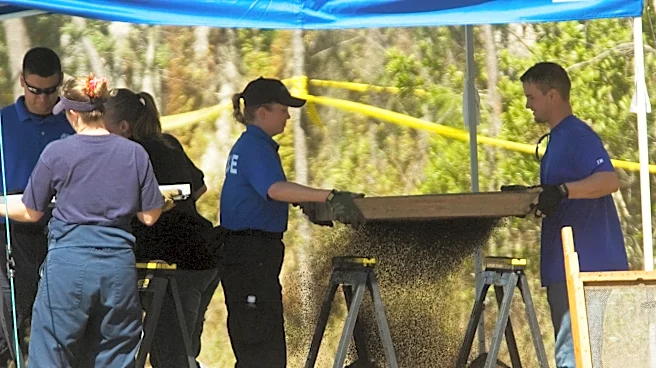
The find turned into what Florida authorities say is among the state's largest ever excavations of human remains. Crime scene units from across the state came together to eventually uncover the bodies of eight men, all within a 200-yard radius, according to reporting at the time by the News-Press.

Police struggled to identify the remains, which were all skeletal, and they still don't know who they all are. No clothes were found at the site, indicating they had all been naked, and there was no evidence they had been stabbed or shot, indicating they could have been strangled. Several of those whose identities had been determined were known to have transient lifestyles.
Police later identified Conahan as a "person of interest" in the so-called "Fort Myers 8" killings, and have named no other suspects. Authorities have identified four of the eight bodies through DNA technology:
- Robert Ronald “Bobbie” Soden, who was 30 when his family last heard from him in 1996.
- Jonathan Tihay, 25 or 26, a drifter without a solid job.
- Johnathan Blevins, 26, lived a transient lifestyle before he went missing in 1995.
- Eric Kohler, 21, lived with his grandparents when he disappeared in 1995.

Attack survivor led police to Daniel Conahan
A man claiming to be an attack survivor led police to Conahan, who at the time was a 42-year-old out-of-work nurse.
On Aug. 15, 1994, Stanley Burden told police that he had agreed to go to a wooded spot with Conahan after Conahan offered him up to $150 to pose for nude bondage photos.
Burden told investigators that Conahan took several photos of him before pulling out a rope and tying him to a tree. While Burden was tied up, he said Conahan tried to sexually assault him and then began strangling him with rope.
After a half hour, Burden said Conahan gave up on strangling him and left him tied to the tree. Burden said he then freed himself and reported the attack to police.
Police then found the crime scene, including a tree with markings that corroborated Burden’s injuries and story, according to court records.
Police then began an undercover investigation of Conahan and later arrested him on murder charges for Montgomery’s killing.
Burden testified about what happened to him in Conahan’s murder trial. At one point, he pulled down his shirt collar to show jurors scars that he had on his neck that he said were from the attack.

Defense attorneys question Burden's motives, push for DNA testing
Conahan's defense attorneys have been arguing for a stay of execution, saying that no DNA has ever tied him to Montgomery's crime scene and that further testing on hair, cigarette butts and fingernail clippings would prove his innocence.
"Law enforcement wanted Mr. Conahan to be the true killer, and made him so," Conahan's attorneys argued in a recent filing in the Florida Supreme Court. "A reasonable probability exists that DNA testing using current technology, which can detect minute traces of DNA, would reveal the true perpetrator."
They also said that Burden has since admitted to testifying against Conahan in order to get a chance at parole on his own prison sentence for raping a 12-year-old boy in Ohio. (Burden pleaded guilty to the rape.) They also say that Burden lied on the stand about his motivations to testify.
"Burden and Montgomery sustained different injuries and there is no credible evidence to suggest their cases are connected," defense attorneys wrote.
The Florida Supreme Court denied Conahan's stay of execution on Sept. 3, ruling that it was known at trial that Conahan's DNA was not found on any evidence and that even if new testing turned up someone else's DNA, it wouldn't have much impact.
"This is true because the cigarette butts Conahan seeks to have tested again were found in an open field known for being a trash site and thus a repository for others’ DNA," the court wrote.
Conahan's attorneys have taken the fight to the Supreme Court, where they are continuing to press for DNA testing. If they don't succeed there, nothing stands in the way of Conahan's execution at 6 p.m. ET on Sept. 10.
"Unfortunately, our system gets it wrong sometimes," defense attorneys wrote in a Sept. 7 Supreme Court filing. "Mr. Conahan does not ask to be declared innocent at this posture. Nor does he ask to be released from prison. All he asks is for this Court to stay his imminent execution so that this Court can review his meritorious claims."
The Florida Attorney General's Office is arguing that Conahan's arguments don't present "a compelling reason why a last-minute stay outweighs Florida’s interest in enforcing its laws."
"Conahan did not meet his burden that additional testing would either exonerate him or lessen his sentence," they wrote on Sept. 9. "Indeed, Conahan’s conviction and sentence were based on evidence and testimony that conclusively connected him to Montgomery’s killing."

Florida continues execution push amid busy September
Conahan's execution is the first of eight scheduled in the U.S. in September, the most in a single month since 2010, according to a USA TODAY analysis of data tracked by the nonprofit Death Penalty Information Center. That year, five states carried out nine executions in the month of May.
This month's spate of executions comes amid an overall uptick in the death penalty in the U.S. in the last two years. In 2025, 11 states executed 47 inmates, the most in any single year since 2009. So far this year, 24 inmates have been executed, with another 14 on the calendar through December, though more are expected to be added.
Experts attribute the increase to a friendlier death penalty climate under President Donald Trump and Florida's particularly aggressive execution push in the last two years.
Of the 71 executions carried out in the U.S. since 2025, Florida accounts for 33 of them. That's 46%, and that figure is increasing. Of this year's 24 executions, Florida has carried out 14. That's 58%.
Gov. Ron DeSantis, who decides which inmates are executed and when, has been drawing increasing criticism from death penalty opponents and observers who say the Republican is being motivated by political ambition ahead of the 2028 presidential election and is "increasingly treating executions as routine instruments of political power," according to a recent statement from Floridians for Alternatives to the Death Penalty.
DeSantis has said he wants to give closure to families who have waited for justice, sometimes for over four decades.
It's unclear whether Florida will continue its execution pace come January, when DeSantis' second term as governor ends. DeSantis has endorsed Republican U.S. Rep. Byron Donalds to succeed him. Donalds will face off against Democrat David Jolly.
Contributing: Kim Luciani, USA TODAY NETWORK - Florida
Amanda Lee Myers is a senior crime and courts reporter who covers the death penalty, cold case investigations, and breaking news for USA TODAY. Follow her on X at @amandaleeusat.
This article originally appeared on USA TODAY: 'Hog Trail Killer' may have killed as many as 13. Florida is about to execute him