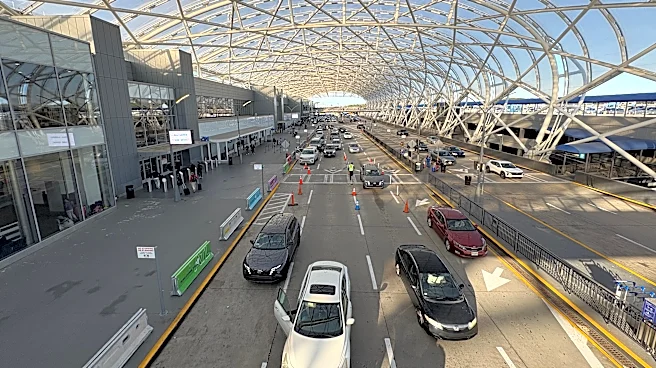

After a government shutdown left airport security workers without pay and passengers snaking through the Hartsfield-Jackson Atlanta International Airport this spring, no changes are expected to the security process.
On Monday, Atlanta City Councilmember Byron Amos announced the conclusion of a TSA privatization feasibility study conducted at the airport after calls for changes in May.
Transportation employees were left unpaid for more than a month after the federal government shut down in the middle of February. The employees started to call out of work or simply not show up by the second week, and passengers still hoping to reach their destination spent hours in line for security stations run with skeleton crews.
Eventually in some airports, like Hartsfield-Jackson, Immigration and Customs Enforcement agents were called in to man the security lines and to get the process moving at a quicker pace. The government reopened at the end of March, and TSA employees received back pay before returning to work.
But, the shutdown sparked a national conversation about the privatization of airport security, and Atlanta was no different.
City Council 'fully supports' study findings
In May, the Atlanta City Council voted 11-1 to request the Department of Aviation commission a feasibility study of privatized security at Hartsfield-Jackson through the existing Screening Partnership Program, already in place in other American airports.
The request gave a third party 90 days to evaluate how private TSA could actually work in Atlanta, and occurred at the same time the city was hosting thousands of travelers for the FIFA 2026 World Cup when air traffic was high.
Hartsfield-Jackson, while part of both Clayton and Fulton Counties, is operated by the city. Officials estimate that the cost of TSA screening operations annually is between $140 million to $240 million.
The study asked if a private partnership could lower these costs, while also offering more stability in the current political climate.
According to councilmember Amos, the Department of Aviation recommended "no change to security operations" at the presentation of the study to the council.
“I fully support the Department of Aviation’s findings,” Amos said in a statement on Nov. 9. “When I introduced the legislation requesting the feasibility study, I did so with the intention of leaving the work in the hands of the experts, including general manager of Hartsfield-Jackson Atlanta International Airport and his team, that ensure we have the world’s busiest and most efficient airport. I commend General Manager Smith and the entire Department of Aviation for their exceptional work in thoroughly evaluating every aspect of this complex issue. Now we call on Congress to listen to the cries of the people that Washington D.C. is hurting air transportation and do the work to ensure that our TSA workers are treated fairly.”
What is the Screening Partnership Program?
There are at least 20 airports in the United States that already use private security, though they are predominantly smaller and regional airports.
"The Screening Partnership Program contracts security screening services at commercial airports to qualified private companies," according to the TSA. "These companies run screening operations under federal oversight and much comply with all TSA security screening procedures."
San Francisco International Airport and Kansas City International Airport are the largest to jump on the private train so far, but other airports in the northeast, west and southern states haven't transitioned to the program.
If Atlanta chose to go to privatized security, it would be the largest and busiest to make the change, as well as being a security hotspot due to the high number of international flights.
Atlanta maintains title of world's busiest airport by passenger travel
Airports Council International's annual report was released in April analyzing total passengers, international passengers, air cargo and aircraft movements to identify the busiest airports in the world.
Atlanta took the top spot for total passengers, followed by Dubai International Airport and Tokyo Haneda Airport.
"We congratulate the world’s busiest airports for managing growing air travel demand amid increasing operational complexity. These hubs keep people and goods moving, supporting global trade, tourism, and economic growth in their communities and regions," ACI World Director General Justin Erbacci said in an April 14 release. "To help keep pace with rising demand, governments must prioritize sustained investment in airports and the broader aviation ecosystem.”
A total of 106.3 million passengers traveled through the Atlanta airport in 2025, a slight decrease from 2024, but enough to keep the Peach State in the top spot.
Irene Wright covers Hartsfield-Jackson Atlanta International Airport as the Atlanta Connect reporter with USA TODAY's Deep South Connect Team. Find her on X @IreneEWright or email her at ismith@usatodayco.com.
This article originally appeared on USA TODAY: TSA likely here to stay at ATL airport after studying privatization