







On Oct. 20 (Japan local time), Japan launched the Martian Moons eXploration (MMX) spacecraft, beginning an ambitious journey to Mars' moons, Phobos and Deimos.
In partnership with other space agencies, including NASA, Japan's JAXA (Japan Aerospace Exploration Agency) aims for MMX to become the first mission to land on Phobos and return samples to Earth, shedding light on the origin of Mars' moons and the history of the early solar system.
The spacecraft is expected to return samples from Phobos, the larger of Mars' two moons, to Earth within five years. Scientists hope the material will help explain how Phobos and its smaller companion, Deimos, formed while providing new insights into Mars' history.
"Despite their potential importance, Martian
moons have never been fully investigated," JAXA planetary scientist and MMX project manager Yasuhiro Kawakatsu told the Associated Press. "They are known as the most important unclimbed mountains in the solar system."
Here's a overview of Japan's MMX mission:
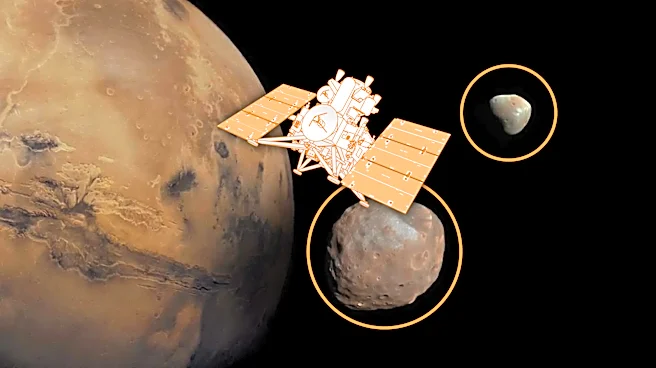
Mars' moons present a tiny target for the MMX mission
Mars' moons, Phobos and Deimos, are thought to be captured asteroids or remnants of material left over from the early solar system, according to NASA.
Phobos, the larger of the two, circles Mars about three times each day and orbits so close to the planet that it is not always visible from the Martian surface. Deimos, the smaller and more distant moon, completes an orbit around Mars about every 30 hours.
Scientists believe that if Phobos formed from material ejected from Mars, it may hold clues from an era when the planet was better suited to support life, according to a JAXA statement.
Unable to view our graphics? Click here.
How long will it take to get to Mars' orbit?
According to JAXA, MMX's five-year mission includes about two years of travel to and from Mars and roughly three years orbiting Phobos while conducting scientific observations and collecting surface samples.
MMX spacecraft journey to Mars: Countdown
MMX: One spacecraft, three modules
The MMX spacecraft consists of three main modules: the propulsion module, exploration module and return module, according to JAXA. Together, they will support a five-year mission to explore Mars' moons, gather material from Phobos and return it to Earth.
To obtain those samples, MMX will use two collection systems. One will gather surface material by firing bursts of nitrogen gas to lift dust and soil before vacuuming it into a container. The other will collect material from several inches below the surface.
Dealing with Phobos low gravity
Phobos isn't an easy place to explore. Its gravity is less than one-thousandth of Earth's and temperatures can swing by more than 360 degrees Fahrenheit in just seven hours.
The 55-pound Idefix rover "has two main tasks: Providing information to prepare for the landing of the main spacecraft to collect samples, and analyzing the composition and texture of Phobos' surface," according to the European Space Agency's MMX mission description.
"The gravity on Phobos is so low that Idefix will only weigh the equivalent of 15 grams on its surface!" the agency added.
How MMX will bring Mars moon samples back to Earth
After several years studying Mars' moons, the spacecraft will depart the Martian system and begin the journey back to Earth. The samples are expected to reach Earth about five years after launch.
Here's how: As the spacecraft approaches Earth, it will release a sample return capsule that will plunge through the atmosphere and land for recovery. Scientists will then analyze the Phobos material to better understand how Mars' moons formed and whether it contains clues about the Red Planet's early history.
According to Kawakatsu: "The Martian moon Phobos remains an unexplored frontier for humankind. By bringing home samples from Phobos, we hope to explore how the Martian moons were formed, how the Mars sphere evolved."
SOURCES Japan Aerospace Exploration Agency, NASA, European Space Agency, Space.com and USA TODAY research
CONTRIBUTING Eric Lagatta/USA TODAY
This article originally appeared on USA TODAY: Japan Launches Mars Mission. Here's What Happens Next