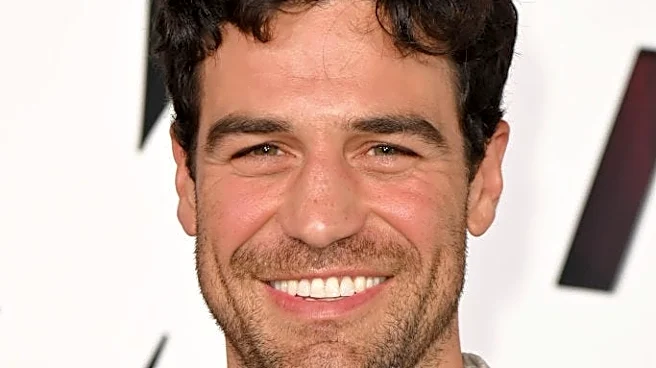







Joe Amabile is about to run his third marathon. But unlike his last two races, where the "Bachelor" franchise star pushed himself to the point of dehydration, this time the 40-year-old is just hoping to finish the race. That's because he recently underwent brain surgery after full-body MRI scan revealed he had a malignant brain tumor.
Amabile has detailed his health journey after revealing in July he had a low-grade astrocytoma, found during a Prenuvo scan. Doctors were ultimately able to remove the "blueberry-sized" lesion. Amabile will receive follow-up MRIs every three months for a year, then he'll switch to twice a year and then once a year after that. He's also taking a daily IDH inhibitor, a drug that targets proteins responsible for tumor
development and progression.
But did he need any of this in the first place, much like celebrity Busy Philipps?
You've probably seen countless celebrities sharing photos in sleek pajamas with the bright, booming Prenuvo technology in the background. Why wouldn't you want to find out if something was wrong with you? Humans crave reassurance. And when social media algorithms feed that reassurance, it's easy to see why these tests seem smart to try.
More than 87% of influencer posts on social media about tests including full-body MRI, multi-cancer early detection tests and more offered a positive spin, according to a JAMA study published in February 2025; about 84% were overt promotions and 68% involved financial interests like advertisements or paid partnerships.
You may be asking yourself whether such a scan is worth it. Research shows these tests often find something, but much less often find actual disease. One study in 2020 found that 95% of asymptomatic patients had some type of "abnormal" finding, but just 1.8% of these findings were indeed cancer. Research has varied on just how many incidental findings occur from these tests.
"I don't know if I want to give advice on the full body MRIs yet," Amabile says. "I've heard so many conflicting things from doctors. I think in my case it was beneficial, and I am somebody that wants to be proactive on (my) health." Even his doctors told him, "this is why you don't get a full-body scan." Amabile's neurosurgeon said he would have most likely had a seizure within five to 10 years, and his oncologist said there's there's a chance that this wouldn't have presented itself for 30 years.
In general, "whole body MRI is in its clinical infancy," Dr. Manjiri Dighe, professor of radiology at the University of Washington School of Medicine, previously told USA TODAY. "While it is noninvasive and highly sensitive, it lacks the large-scale longitudinal data needed to prove that it saves more lives than it complicates through overdiagnosis." With low availability and high cost, for the average person, it remains a luxury item not an "evidence-based medical necessity," Dighe says. The tests range from several hundred to several thousand dollars, depending on which sections of the body are scanned, and are not covered by insurance.
In clinical practice, "I don't personally see a lot of incidental lesions that are found on whole body MRI that I end up intervening on," Dr. Anthony DiGiorgio, associate professor of neurological surgery at UCSF, previously told USA TODAY. "But I probably have colleagues that do, and so I don't want to say it doesn't happen ever, but I think it's incredibly rare."
This article originally appeared on USA TODAY: 'Bachelorette' star talks controversial full-body MRI after brain tumor