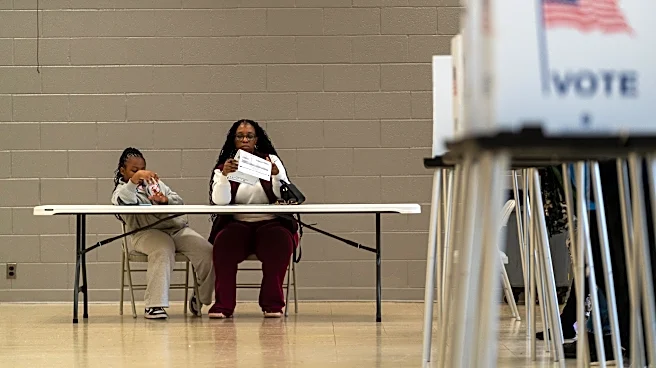




If “didn’t vote” had been a candidate in the 2024 presidential election, they would’ve beaten Donald Trump (77.3 million votes) and Kamala Harris (75 million votes) by a long shot. That’s because 89 million eligible voters did not show up to the polls.
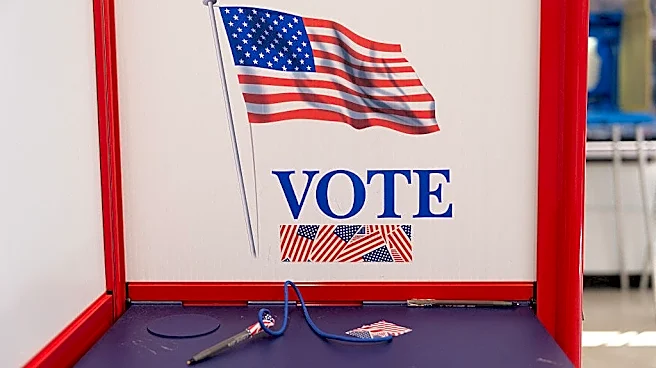
I’m a 17-year-old high school senior five months shy of voting age and no political scientist, but it’s clear even to me that America’s longstanding problem with low voter turnout is a gaping issue in a participatory democracy. I was delighted that Nov. 3’s midterms had huge voter turnout relative to other recent elections. But I take issue with the popular notion that voters who showed up represented America “delivering a verdict.”
Let’s be clear, less than 50% of eligible voters actually cast
ballots in the midterms – the rest stayed home. That’s not America as a whole delivering anything; it’s a verdict determined by a narrow majority. To me, that’s an unfulfilled democratic promise.
Even in the best of times, America has an alarmingly low turnout rate compared with democracies like Belgium and Australia, where recent rates have been close to 90%.
This participation gap poses a problem for my generation especially: Just over a quarter of eligible young voters showed up at the midterms. This was the second-highest youth turnout during midterms in three decades, but that’s not saying much. As a percentage of all voters, the participation of 18- to 29-year-olds was 12%, the lowest of all age groups.
US should make voting mandatory – and fine nonvoters
But I’m a solutions-oriented guy, and after speaking with experts, I see a way to fix this. It may sound crazy, but hear me out and judge me later: Voting should be mandatory, not voluntary, in America, so that our republican government actually represents what all Americans want.
A voluntary system lets voters tune out and allows politicians to get lazy. Candidates build their campaigns around the voters they expect to show up and ignore those who will likely stay home, according to Miles Rapoport, executive director of 100% Democracy, an organization dedicated to universal voting.

A former politician, Rapoport explained that high-propensity voters are more likely to get their legislative wish list addressed. Many political experts consider Medicare to be untouchable because it impacts seniors who vote often, whereas funding for programs like Head Start that serve poor kids (who can’t vote) are frequently on the chopping block.
That’s where universal voting comes in. It’s “the only policy which makes the actual voting electorate fully reflective of the population as a whole,” Rapoport told me.
He favors an approach where the legal requirement to vote would be enforced with a small fine – say, $20. I’d like to introduce a carrot – a payment or small tax break for being civically active. My idea isn’t unprecedented: In Ancient Athens, they paid for people to attend the Assembly and take part in the political process.
Anthony Fowler, an expert on political representation and professor at the University of Chicago’s Harris School of Public Policy, told me that theoretically, the carrot and the stick have the same incentive power. I prefer the carrot because voting and civic engagement take actual time that should be compensated – like jury duty.
Mandatory voting isn’t some pipedream. After Costa Rica implemented mandatory voting without a punishment, it saw a 16 percentage point increase in turnout rate from 65% in 1958 to 81% in 1962.
It worked in Australia, too, which charges first-time nonvoters a $50 penalty, and more for recurring offenders. Fowler, who studied the electoral and policy consequences of the Aussies implementing the rule in the early 20th century, told me, “The evidence suggests that, at least in Australia, compulsory voting policies are really effective at getting a much more representative set of people voting.”
Tax breaks could pave way for more engaged electorate

I have to admit, comparing early 20th century Australia to modern America isn’t apples-to-apples. Still, Australia provides a noteworthy precedent – one that still works for Aussies today.
There is one undeniable hitch in the universal voting concept: It does not ensure that previous nonvoters will suddenly become informed voters. Here’s where incentives come in. Small tax breaks should be offered for attending civic events such as city hall meetings, town halls and party caucuses – the classic things that your civics teacher forced you to do. These are experiences that make politics concrete, build community engagement and shape our value systems.
Tax breaks for voting haven’t yet been tried in a modern democracy, but 250 years into the American experiment, a system that requires and rewards voting could save us money, make us smarter, strengthen our communities and boost civic pride. At worst, we’d have higher voter rates.
Fowler and Rapoport both think national mandatory voting is constitutional, but very unlikely. Instead, they think it would be best implemented state-by-state – like rank-choice voting. Now is the time for a bold state to take the lead, passing legislation that authorizes its cities or counties to pilot universal voting with an added incentive to mobilize engagement – especially among my generation – before the next election.

Still think it sounds outlandish? Many good things seem outlandish until they happen. In 2006, same-day voter registration was in seven states. Now it's in 24 states and Washington, DC.
For the next two years, I’ll be lamenting that I couldn’t vote in the 2026 midterms. But here’s hoping I’ll smile in 2028 while I cast my first mandated ballot.
Ben Aviles is the co-editor-in-chief at The Spectrum, the student newspaper of The Blake School in Minneapolis. His work has been published in MinnPost, The Star Tribune and Best of SNO. He is also an avid sports fan and has a small black cavapoo named Taters. This opinion column was produced in partnership with the Students United News Network (SUNN), which connects student newsrooms across the country and publishes the first nationwide student newspaper, the SUNN Post.
This article originally appeared on USA TODAY: I can't vote yet. We should pay those who do | Opinion