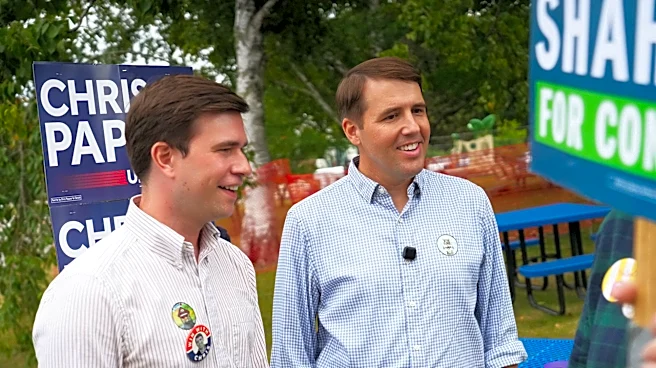







Rep. Chris Pappas, D-New Hampshire, is living a life that he didn’t think was possible growing up in the 1990s. A four-term member of Congress, he is now his home state's Democratic nominee for U.S. Senate. If he wins, he will become the first openly gay man elected to serve in that body.
Pappas holds a single-digit polling lead against former Republican Sen. John E. Sununu, in New Hampshire's race to replace retiring Democratic Sen. Jeanne Shaheen. Holding the seat is crucial to Democratic hopes of flipping the Senate, which is controlled by Republicans 53-47.
One could be forgiven for ignorance about the history making potential of the race: It’s not something that the Pappas campaign highlights often, and some people in the state don’t even
know the Manchester, New Hampshire, native's sexuality.
Pappas says that he’s not running to make history, but he acknowledged that being at this point shows how far the United States has come on gay rights. LGBTQ+ politicians and advocates in the state said his win could provide greater representation for LGBTQ+ kids. At the same time, the lack of discussion of Pappas' sexuality demonstrates progress, they say, because it's no longer seen as important − at least, not in the "Live Free or Die" state.
"My campaign and my time in public service is always focused on what I can do for New Hampshire, how I can make people's lives better," Pappas said in an interview with USA TODAY. "So I'm not running to make history, but, you know, it's a sign that our nation has come a long distance."
Does anyone even care any more about a politician's sexuality?
Over the course of a 50-minute candidate forum in Salem, New Hampshire, in mid-October, sexuality came up exactly once and it was from Sununu, who said in his opening statement that he voted against a ban on gay marriage when he served as senator in 2004 − part of the Republican's effort to demonstrate his socially moderate bona fides.
Pappas’ sexuality is no secret: in 2018 he became the first openly gay congressman to be elected from New Hampshire. His husband, Vann Bentley, accompanies him on campaign stops.
But it’s not something he or his campaign brings up much on the campaign trail, nor is it something Republicans have used directly as attack fodder. The biggest mention is in a Republican attack ad accusing him of not properly disclosing his relationship with his now-husband, who was an Amazon lobbyist, which Pappas has denied. Sununu has instead focused on ideology and policy issues, frequently accusing Pappas of being too closely aligned with the Democratic Party and voting for higher taxes.
Pappas was named one of the most bipartisan members of Congress by the Lugar Center in 2023, but has campaigned with many national surrogates in recent months, and has voted to raise taxes a few times as a state legislator.
Sununu did not return a request for comment.

“All this time hearing about him and what he's doing, it rarely comes up,” said Dave Breault, 81, who was volunteering at a standout ahead of the debate and called Pappas’s sexuality a “non-issue.” “I’ve been, in fact, a little surprised to have heard so little about that. People are aware of it, but it’s not ever brought up that that makes him a bad congressman.”
For some people, it doesn’t register at all: Rachel Teague, VP of Operations & Incoming President at LGBTQ+ center Manchester True, said her 18-year-old daughter didn’t even know he was gay until recently - an experience echoed by others.
Pappas said that he talks a lot about his background and that he’s always felt it was a “net-plus” for him to be open and honest with voters about who he is.
“It means that we're building a level of trust and honesty that I think is really important in public service,” Pappas said in the interview with USA TODAY.

Andrew Smith, director of the University of New Hampshire Survey Center, said that Pappas’s sexuality has never come up significantly in his previous races.
If it was a big advantage, he said, Pappas’ campaign would likely be talking about it more. But Smith also thinks it's not a major liability and that Republicans would “probably suffer more from the blowback against it” if they tried to make it an issue.
“It probably just doesn’t matter,” Smith said.
New Hampshire has historically been a leader in gay rights. It was one of the first states to legalize gay marriage through the then-Democratic-controlled legislature in 2009. A UNH poll at the time found that 55% of New Hampshire residents favored same-sex marriage, while 39% opposed it, compared with 40% support and 57% opposition nationally. Repeal efforts failed even after Republicans gained a veto-proof majority in 2010.
While the current Republican-controlled state government banned transgender girls from competing on girls' school sports teams in 2024, Pappas and Teague described it as a generally open-minded state that values individual rights.
Teague said the fact that a candidate’s sexual orientation might not be the defining issue in the race is, in many ways, “a sign of some progress.”
“It suggests that more people who vote are evaluating the candidates based on their ideas and their experience and their ability to serve, rather than just on their identity, which is definitely towards progress in my mind,” Teague said.
Win would provide crucial representation for LGBTQ+ kids
Growing up, long-time New Hampshire politician Jim Splaine, who led the fight for marriage equality in New Hampshire, said that he looked up to Harvey Milk, the first openly gay man to be elected to public office in California.
“I met him only for two and a half minutes or so, briefly, with a friend of mine on Castro Street,” Splaine said, referring to the street at the heart of a largely gay neighborhood in San Francisco. “But I was fascinated by this man who was saying as loudly as he could that he's gay and that's okay. At the time I had been city councilman in Portsmouth. I had been a state legislator. I was about to run for state Senate, and that gave me the feeling that I could do that, just like he did it.”

Splaine ended up becoming the first openly gay man to serve in the New Hampshire state Senate. He said that a win by Pappas would provide crucial representation for LGBTQ+ kids in New Hampshire and all over the country.
Teague helps run Manchester True, which is the first and only LGBTQIA+ community center in New Hampshire. The center offers a variety of different programs each month, from transgender support groups to a queer homecoming. They do not endorse candidates, but she said that representation matters for the kids she works with because it “expands what’s possible.”
“There's plenty of people and communities across the country who haven't seen themselves represented in positions of power,” Teague said. “So having this historic milestone can help remind people, especially young people, that there is room for them in public life.”
Representation is also about accurately reflecting the population, Kelley Robinson, the president of the Human Rights Campaign (HRC), said. Gay people represent about 12% of the U.S. population, according to the HRC, but there is currently only one openly gay member of the 100-person Senate (Sen. Tammy Baldwin, D-Wisconsin). Pappas would double that number and bring the percentage up to 2%.

What is the impact of sexuality on electability?
Pappas’s first election to the U.S. House in 2018 was part of the four-year, so-called “rainbow wave” that culminated in a record 436 openly LGBTQ+ candidates winning races for elected office in 2022. If all LGBTQ+ candidates running for office this year win their elections, it would set a new record for LGBTQ+ representation in Congress, with 17 members.
And while Pappas will be the first openly gay man to be elected to the body, Baldwin was the first openly gay senator when she was elected in 2012. Since then, former Arizona Sen. Kyrsten Sinema, who identifies as bisexual, and former California Sen. Laphonza Butler, who is gay, have both entered and left the chamber. (Former Sen. Harris Wofford, D-Pennsylvania, was married to a woman when he served in the U.S. Senate from 1991-1994, but in 2016 married a man - although he never identified as gay.)
Still, an electoral penalty persists. A study from Northwestern University published in May found identifying as gay dropped a candidate’s probability of support by 7% nationally, and that a gender nonconforming appearance dropped the gay candidate by another 7%. Vice President JD Vance recently mocked Texas Senate candidate James Talarico at a rally in support of his Republican opponent Ken Paxton by falsely suggesting Talarico is gay. And sexuality still comes up in conversations about other races, like former Transportation Secretary Pete Buttigieg’s potential run for president. Breault, the Pappas volunteer who said that Pappas’ identity was a non-issue in New Hampshire, said that Buttigieg’s identity could be a liability in the presidential race.
Buttigieg, who has campaigned for Pappasin New Hampshire several times this year, has not yet said whether he will run again for president in 2028, and it’s unclear if the potential U.S. Senate milestone would mean anything about his chances.
“I think we should get past just all the ways that we've traditionally looked at candidates for president through a demographic lens,” Pappas said. “I don't know that that's relevant anymore because people are most interested in who's going to stand up and take on big fights.”
In a statement, Buttigieg said that he is proud to support Pappas.
"Not only because of what his victory will represent, but because he's the kind of leader we need more of in Washington,” he said.
While Pappas has maintained a slight lead in many polls, national Republican groups, including the Senate Leadership Fund, have invested more than $40 million in ads, according to ad-tracking firm AdImpact, hoping to pull off an upset in a state Vice President Kamala Harris carried by less than 3 percentage points in 2024. The most recent UNH poll from Sept. 24 found Pappas ahead by 8 points after being statistically tied in August. Sununu is from a popular political family in the state, but Pappas is a strong candidate in his own right, having won four terms in a swing district.

“To be able to do that as an LGBTQ candidate might have been unprecedented a few years ago, but now it seems like no big deal to a lot of folks, and I think that's a sign of progress itself,” Pappas said. “So I'm just grateful for the support that I have in New Hampshire, and how the community and state that I grew up in has embraced and supported me along the way.”
This article originally appeared on USA TODAY: New Hampshire could make Chris Pappas first openly gay man in Senate