
WASHINGTON – Ezadullah pushed his hands deeper into his pockets against the morning chill, but his thoughts had drifted nearly 7,000 miles east, to Afghanistan, where his wife has remained since Kabul
fell in 2021. Five years have passed since he last held her.
For years, Ezadullah interpreted for Americans and helped run youth programs alongside the U.S. mission, trusting the United States would stand by those who stood with it. When the government collapsed, he was evacuated, and she was left behind. He, like others, asked to be identified only by his first name because he fears the Taliban could retaliate against his relatives.
Now Ezadullah feels both of their lives are on hold. Hers because she can't get out and his because he can't be sure he will be allowed to stay as the Trump administration sweeps up Afghans in its push for mass deportations.
"I cannot go back to Afghanistan in the current situation," he said. "So the only hope we both have for our family is waiting. I was hoping she could join me here sooner, but not like five years."

Their limbo is shared by thousands. Special Immigrant Visas, which Congress created for Afghans who worked for or on behalf of the U.S. government, were meant to be their way to safety. But since January, the program has been all but frozen under the Trump administration's travel ban, which suspended visas for Afghan nationals, including those who served with American forces. Many had already passed the government’s vetting and are still waiting.
The State Department has issued just three such visas this year, according to #AfghanEvac, a veteran-led coalition that has helped resettle Afghans since the 2021 withdrawal, while nearly 6,000 visas Congress already authorized have gone unused. The country resettled just three Afghans as refugees in the 2026 fiscal year, according to the International Refugee Assistance Project.
Afghans who made it to the United States have also watched the ground shift beneath them. The Trump administration terminated Temporary Protected Status, or TPS, that shielded some 12,000 from deportation. This month, U.S. Immigration and Customs Enforcement readied more than 150 for a flight that would have ended, by way of Pakistan, in Taliban hands, until a federal judge intervened.
Another deportation flight scheduled for Nov. 16 was also canceled. But court filings by the Department of Homeland Security, which did not respond to USA TODAY's request for comment, indicate a new one could take off in December.

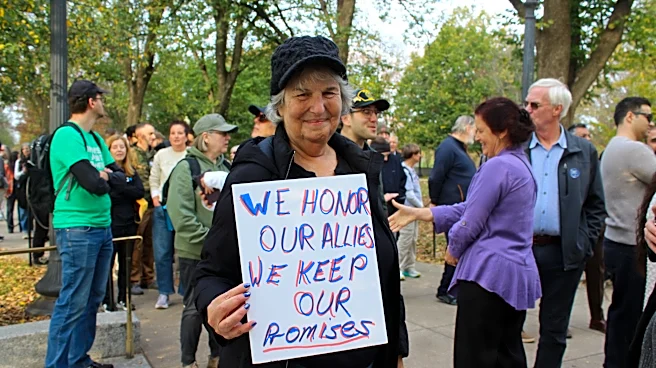
For them, the most immediate hope lies in Congress, where a bipartisan bill would restore TPS for Afghans in the country. That's why on Nov. 11, as the country paused to thank those who fought its wars, veterans, former diplomats, advocates and Afghan allies walked from the Lincoln Memorial to the Capitol so they could press lawmakers for a vote — the last push after three days of knocking on every congressional door.
"We're not willing to just sit idly by while these folks are getting snatched up," said Shawn VanDiver, president and founder of #AfghanEvac. "We're not going to do that. We're going to keep fighting every single day for these folks."
Ezadullah walked with them. The bill would not bring his wife here, but standing among so many people who had not forgotten, he said, gave him hope.
"There are still people that care about those promises that they made," he said.
Holding on to that faith has not been easy. Ezadullah said he completed every step the U.S. immigration system required to bring his wife, who was halfway through a college degree in public administration and health care when the Taliban took over. Only her visa remained. But when she traveled to a third country to apply, she was turned away under the travel ban.

Since then, each new edict has taken something from her – the right to travel alone, her work, her classes – until her world shrank to four walls.
"She’s just sitting in the house all day," Ezadullah said. "She has no freedom."
Around him in Washington, DC, marchers stamped their feet and blew into cupped hands. Veterans in caps that announced their service swapped the names of bases where they had been stationed. A mother clutched the hand of her 5-year-old son. Her two other children remain in Afghanistan.
The column started briskly, then slowed as it stretched along the Mall and strangers fell into conversation, filing past a lawn studded with small American flags. In the crowd was Daniel Mueller, 35, who served eight years in the Army National Guard and had flown in from Michigan.
"As a veteran, there’s the mentality of no man left behind," Mueller said. "We told all these people, if you assist us, you can come to the United States and live here. How can we just back out of that?"

White House spokeswoman Lauren Bis accused the Biden administration of admitting thousands of Afghans without adequate vetting, "including known and suspected terrorists."
In 2022, Pentagon and DHS watchdogs found that while all Afghan evacuees were screened before entering the United States, unused military data and missing records during the chaotic airlift caused initial vetting gaps. When fuller records were later checked, officials flagged about 50 evacuees for potential security concerns — though neither report stated any were known terrorists. The Biden administration maintained that everyone underwent a "rigorous and multi-layered screening and vetting process."
"DHS will continue to work to identify these public safety threats and remove them from American communities," Bis said.
Getting to 218
In August 2021, as Kabul fell, an Afghan friend messaged VanDiver, a Navy veteran in San Diego, from a mountain the Taliban had surrounded. Not knowing what else to do, VanDiver called his congressman, Rep. Scott Peters of California.
The friend made it out. That call was the first thread of what became #AfghanEvac. Five years later, when the marchers reached the Capitol with their letter, the man who had picked up the phone that August was there to take it from them.
The bill they came to champion was introduced in July by Rep. Jason Crow of Colorado, a former Army Ranger who served in Afghanistan, with two other Democrats and two Republicans. When the bill languished without so much as a hearing, Crow and Rep. Sam Liccardo of California reached for one of Congress’s oldest and least dependable levers. On Nov. 9, they filed a discharge petition to force a vote on the bill – a feat lawmakers have pulled off about 60 times in nearly a century.

As of Nov. 16, the petition had garnered 114 signatures, leaving it still 104 short of the 218 it needs. Reps. Don Bacon of Nebraska, one of the bill's original sponsors, and Brian Fitzpatrick of Pennsylvania are the only Republicans to sign.
That's where VanDiver draws his line.
"Don’t tell me that you care about Afghans, if you’re not willing to do the bare minimum to protect them from being hunted down by masked agents of the state," he said. "If your name’s not on the discharge petition, I’m less willing to believe that you want to help Afghans."
Peters called the push to 218 a matter of "political field work," or finding colleagues on the House floor in the slack minutes between votes and reminding them, one by one, to add their names. TPS would be only a stopgap, Peters acknowledged, not the permanent solution he would prefer.
But he wants it passed before the year ends, Peters said, because "there’s such a time element and we don’t want to forget what people are putting up with by being separated from their families, by being on these flights at risk of losing their lives."
And if the bill stalls, Peters hopes the pressure will still carry to the White House, to a president who, for all his bluster, he said, often reads the political signals around him.
"He’s smart enough to read the writing on the wall," Peters said, "so let’s write it on the wall."

'We would have been just stuck in the embassy if we couldn’t have had their help'
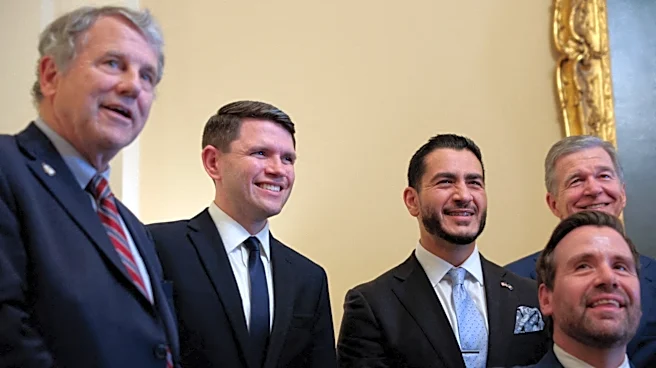
Peters and VanDiver have their eyes on January, too, when a new Congress will be sworn in. Some incoming members walked with the marchers on Nov. 11, among them Brad Lander of New York, Luke Bronin of Connecticut, Richard Ojeda of North Carolina and Eileen Laubacher of Colorado.
For the former diplomats who walked with them, the stakes have names and faces. Richard Driscoll served at the U.S. Embassy in Kabul in 2010, at the height of the troop surge that sent tens of thousands of additional U.S. forces to Afghanistan.
His Afghan colleagues carried his words into every meeting and his plans into every project, he said. When two of them found "night letters" from the Taliban threatening to kill them and their relatives, they kept coming to work anyway.
"We would have been just stuck in the embassy if we couldn’t have had their help," Driscoll said.
Now that some of those Afghans face deportation, Driscoll can barely make sense of it.
"It just seems exactly why we have asylum and refugee laws: to not send people back to be killed," he said.
Joe Relk, a former foreign service officer who served in Afghanistan, thinks often of an interpreter he worked with in 2006. In August 2021, the man stood outside the Abbey Gate at Kabul’s airport for two days, pressed into the crowd desperate to reach the planes, before he gave up and went home. Relk hasn’t heard from him in a long while.
Lately, he has watched the man’s name disappear from the social media groups they once shared.

The Trump administration has said Afghanistan is now stable enough for people to return, and that pausing Afghan cases after an Afghan evacuee was charged in the 2025 shooting of two National Guard members in Washington was necessary for security vetting.
Peters sees something larger at stake.
"It sends a terrible message, and it’s not about Afghanistan; it’s about America," he said. If the country abandons the people who put their lives on the line for American soldiers, he said, no one will believe it the next time it asks for allies.
"It really hurts our national security," Peters said, "in addition to just being the wrong damn thing to do."
'A heart beating'
Rasheed came to the Mall because of his brother, who interpreted for U.S. troops for years. When the government fell, he fled with his three children to a neighboring country, where he renews a temporary visa each year at steep cost, with no guarantee it will be granted again.
"I’m very worried," said Rasheed, who lives in Virginia. "I know he would be in trouble and his life is in danger."

For Afghans already in the United States, the danger can arrive at the front door.
Mohammad Nazeer Paktiawal, a former Afghan special forces soldier who #AfghanEvac says fought alongside U.S. Army Special Forces for more than a decade, was preparing his children for school when ICE officers detained him in March, according to his family.
He died the next morning in a Dallas hospital after complaining of chest pains in an ICE processing room. His asylum case was still pending. He was 41 and a father of six.
Dozens more Afghans remain in detention, unsure whether the next flight will carry them back toward the Taliban, which promised amnesty when it seized power. Despite that pledge, there have been constant reports of Afghans who worked for the United States being taken away, tortured or killed, said Ronald E. Neumann, U.S. ambassador in Kabul from 2005 to 2007.
"So the risk is quite real," he said. "This plan for the deportation of Afghans is a stain on our national honor."

Farzana Noori, 28, was among those who got out in time, leaving Afghanistan in 2021 with a two-day-old baby in her arms. She and her husband had both worked for the U.S. Embassy in Kabul. Noori now works with Lutheran Social Services, helping resettle refugees who arrive the way her family did, with little else but their children and their hope. On Nov. 11, she walked for the ones who could not.
"Behind every policy, there’s a human," she said. "Behind every decision, there’s a heart beating."
This article originally appeared on USA TODAY: They fought beside US troops. Now Afghans plead for protection