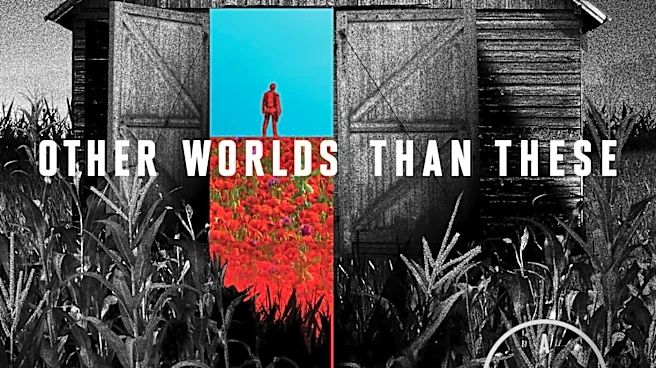




With his new novel “Other Worlds Than These,” Stephen King buttons up two popular fantasy book series. He’s also glad to still be upright.
“It was a big relief, actually,” King tells USA TODAY of closing out both “The Talisman” and “The Dark Tower” stories. “Robert B. Parker died at his desk, and that didn't happen to me with this book.”
At 79, “every time I finish a project like this, particularly one that's as long as this, it just feels like, 'Whew. God, I'm so glad that that's done.'"
The massive 704-page “Other Worlds Than These” also marks a final collaboration between King and his friend Peter Straub, who died in 2022 at 79.

With their 1984 novel “The Talisman,” King’s Constant Readers were first introduced to Jack Sawyer as a 12-year-old
who could flip between his America and an alternate magical landscape known as the Territories. He went from a kid on a road trip to save his mother’s life to a retired LA cop helping track down a Wisconsin murderer in the 2001 sequel “Black House.”
That book revealed that the Territories and Mid-World from the “Dark Tower” saga were one and the same, and in “Other Worlds Than These,” a middle-aged Jack has his work cut out for him while bouncing between both places. A pair of teenage serial-killing lovebirds from Nebraska have crossed over and infected the youngsters of Mid-World with their chaotic and homicidal spirit, and Jack and a team of misfits – his “ka-tet” in Mid-World speak – have to deal with them as well as a growing dark force called the Gullet that threatens to consume all worlds.

"There's a lot of back and forth between Mid-World and our world, but it's all based on the idea of ka – fate – and the idea that there are echoes and everything repeats," the author says.
And lest you think King’s slowing down as he nears 80, the author’s closing another chapter of his literary life: He just finished his next book, “Anything for Holly,” the last novel to feature fan-favorite detective Holly Gibney.
King talks about “Other Worlds Than These,” the real-life serial killer who plays an important role in the plot, and the many connection in the legendary author’s works.
This interview has been edited and condensed for clarity and length.
Question: With such a significant finale to different parts of your bibliography, did you have the ending in mind early on for "Other Worlds"?
Stephen King: I think that the ending became clear to me. John Irving once said to me, “I write the last sentence of a book before I write the book,” and I thought, “What fun is that?” It should be a voyage of discovery, for me anyway. So, I didn't have the ending at the beginning. I just assume on faith that it will take care of that. About three quarters of the way through it, I saw what the ending would be because it is, in a way, the ending of the “Dark Tower” books as well. It's part of my overall idea that everything that goes around comes around. They say those who do not learn from history are bound to repeat it. But we repeat it. We're helpless to do anything different.

Back in the day, how did you and Peter write together?
It wasn't exactly the internet days. Peter got very excited by the idea of saying we could communicate (and) send copy back and forth by modem. I don't know if you remember, but there was this weird tweeting noise, just a howl kind of thing, when the copy was going through. And his came up, to my end, with the dashes turned into question marks. His end, the quotation marks turned into exclamation points. So it wasn't perfect.
The two killers of “Other Worlds” are influenced by real-life 1950s serial murderer Charles Starkweather and his girlfriend Caril Ann Fugate. Starkweather also inspired the movie “Badlands” and the Bruce Springsteen song “Nebraska.” What is it about him that still fascinates us?
He is the modern American shooter. He is everyone who went on a killing spree since then. I mean, there were a lot of school shootings that started (with Columbine) but he was the first modern American spree killer. He went with his girlfriend, and they were kind of romantic in the sense that they were star-crossed lovers. At the end of the Springsteen song, he says, "They're gonna put me in the electric chair, my pretty baby's gonna sit right there on my lap." It's not romantic, of course, to the relatives of the people who are killed. But that is almost, what, 70 years ago now? So it's passed from reality and newspaper headlines into legend.
The line “Other Worlds Than These” is repeated often in the book, referring to our world, Mid-World and potential other realities as well. Is there a world in this Stephen King multiverse that you haven't explored yet and still want to?
Well, there are stories that I would like to tell. I'm running out of road here. It’s getting a little bit narrow, and there are a number of things that I would like to do in this world and in other worlds maybe than those.
Holly is one of your favorite characters. Did you get a little emotional finishing her story, too?
She means a lot to me. She's my dear one. And she means a lot to readers who have followed her for a long time. I didn't cry beautiful tears or anything like that, but yeah, I got a little nostalgic I guess you would say. I always say to myself, well, maybe she'll come back in some form or another, but I really don't think so.
This article originally appeared on USA TODAY: Stephen King finishes two beloved fantasy series in latest book – 'A big relief'