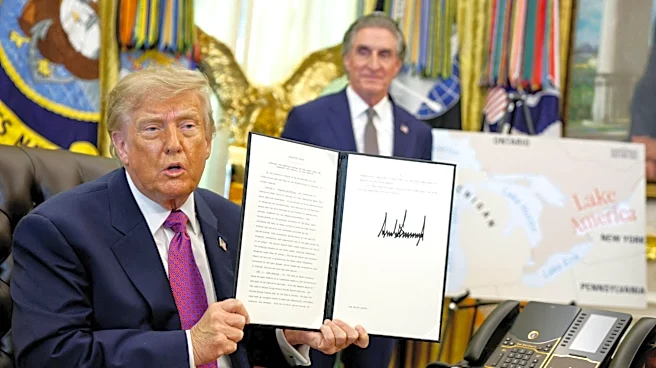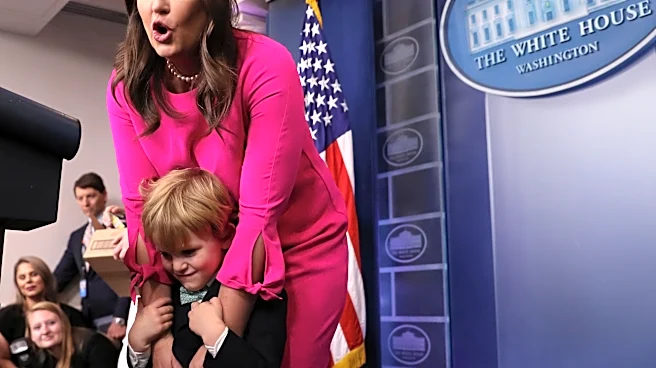






Karoline Leavitt walked into the White House briefing room holding a single sheet of paper as the crowd of reporters fell silent.
She wore a crisp pink pantsuit, her signature gold cross necklace, and kept a cup of coffee at the podium. Just 10½ weeks prior, she'd given birth to her daughter.
The first journalist Leavitt called on asked her for the secret to juggling her hard-charging career with her newborn daughter and 2-year-old son. She said there was none. Just keep showing up.
"Shout-out to my husband who’s home with our babies right now," Leavitt said as she briefly looked down at the podium and smiled. "I look forward to returning home later to be with them, but it’s challenging."
Within a month, Leavitt announced she was quitting. The decision
made her the fourth White House press secretary in seven years to say she was leaving the high-profile job to focus on her family – a pattern that includes women who worked for Presidents Donald Trump and Joe Biden.
Workplace experts told USA TODAY that this dynamic mirrors what happens across the United States as women juggle their families' financial and logistical needs. About 341,000 mothers left the workforce from July 2025 to July 2026, according to researchers at the University of Kansas. A Catalyst study this year cited caregiving as a key factor in the trend.
Press secretaries – some married and some single, some with kids and some without – have described long hours and intense public scrutiny. But a USA TODAY analysis found the mothers who served as White House press secretaries stayed in the job, on average, a year less than everyone else. Those other jobholders include fathers of young children and women with no children.
"It doesn’t allow you to necessarily slip in and express milk or feed a baby or check in on the nanny at home," said Ann Compton, a retired journalist who covered the White House under seven presidents. "It is a suffocating day in terms of the workload the minute you walk in the door."
Compton raised four kids while covering the White House. She said presidents and their chiefs of staff should foster a White House culture that allows women – and men – to raise their families.
"The politicos in the White House are losing out on top talent because they can’t figure out how to create an environment where women can manage that job while also managing their home," said Misty Lee Heggeness, a professor of public administration and economics at the University of Kansas.
"There is a way to do it," Heggeness said.
A historically male role
There have been 37 press secretaries, and until 2017, all but two were men. That pattern shifted when Trump appointed Sarah Huckabee Sanders. On her first day on the job, she had three kids, and the oldest was 5. She stayed for 23 months.

The press secretaries before Sanders stayed an average of just under three years, according to USA TODAY's analysis. That average includes men who served for short periods, including a press secretary who served 31 days under President Gerald Ford, and Sean Spicer, whose tumultuous six-month tenure during Trump’s first term sparked a Saturday Night Live parody.
The average also includes men who had young kids while in the role, such as Jay Carney, who worked under President Barack Obama. He stayed for 40 months before leaving, saying he hoped it would reduce the strain on his wife and kids. When Obama announced his press secretary's departure, he said Carney wasn’t seeing enough of his daughter’s Little League games.
But the new normal for nearly a decade under both Trump and Biden is that only women – Sanders, Stephanie Grisham, Kayleigh McEnany, Jen Psaki, Karine Jean-Pierre, and Leavitt – have served in the role. All of their kids were under age 10 when they started. And they stayed an average of 18 months, or a year and a half, USA TODAY's analysis shows.
Four of those women explicitly said they left their jobs so they wouldn’t miss time with their young kids. Jean-Pierre and McEnany, whose jobs ended when the president’s term did, described missing their kids.
Ari Fleischer, who worked as press secretary under President George W. Bush before becoming a father, told USA TODAY, "I don’t think I could have done the job if I had children back then," adding, "I don’t know how Karoline and others did it."
Long hours at a 'greedy job'
Mothers of young children tend to leave their jobs earlier than men, especially when they feel forced out by "a culture that is inflexible" or where the demands are not compatible with motherhood, said Amy Beacom, a consultant who teaches businesses how to create work-life balance.
Nobel Prize-winning economist Claudia Goldin dubbed these types of careers "greedy jobs" because they pay well – the 2026 salary for the press secretary is $195,200 – but also demand long hours. Similar fields are corporate law and investment banking.
"It was always a challenge because you’re working around the clock, and you can’t control when a press inquiry comes in," Kayleigh McEnany, who held the role for nine months at the end of Trump’s first term, told USA TODAY.
Up by 5 a.m.
Fleischer said he used to wake up by 5 a.m. to catch up on the news ahead of a 7 a.m. senior staff meeting at the White House. He said he left most days around 8 p.m. He also put in some hours on Saturdays and took calls on Sundays.
That kind of schedule can mean parents miss out on dinnertime, bathtime and potentially bedtime. The average toddler wakes up at 6:44 a.m. and goes to bed at 8:15 p.m., according to a 2013 study led by a researcher at the University of Colorado, Boulder.
Carney told USA TODAY he lived about 15 minutes from the White House and tried to get home by 8 p.m. so he could at least put his kids to bed. But he couldn’t do that when he traveled overseas with the president.
Carney said Obama was very sensitive to his family's needs, but that these types of senior White House jobs "are incredibly challenging no matter the White House for folks who have young kids and want to be able to be a decent parent."
"I don’t, for a minute, doubt that, as much as I tried to be and was a present father … it makes sense that it would be even harder for a mom," Carney said.

Moms have been the face of the president
When press secretaries leave their jobs, the public still recognizes them from their televised press briefings. This, combined with the advent of social media and a polarized political environment, put pressure on the mothers.
Sanders recalled at the 2024 Republican National Convention, "My family was denied service and kicked out of a restaurant," she said, because she worked for Trump. "And a parent at my 3-year-old son's preschool spit on my car."
Sanders, the third woman to hold the role, said that political commentators were relentlessly critical of her appearance, her humanity, and even questioned her fitness to be a mother. She said Trump pulled her aside to encourage her to continue.
"Anyone in a government position of power like a freshman congresswoman or an assistant secretary of Defense or a White House press secretary – you are going to draw both admiration and loathing," said Compton, the retired White House correspondent.

Carney said he also dealt with "endless personal attacks" that he learned to tune out, but he said he never had someone attack him as a parent. His kids were 5 and 9 when he started, and he said he prepared them for what to do when they saw online content critical of him.
Karine Jean-Pierre, who adopted her daughter eight years before taking the role for Biden, said on a podcast in 2025 that the job came with "an understanding" of a rigid role that put her "in a box." She stayed 32 months, the longest of any woman to hold the role.
"In my private life as White House press secretary, I was always White House press secretary," she said. "Like, when I would go to the coffee shop, or I would go to the supermarket."
"You don’t turn it off," she added. "It’s hard. It’s hard."
How moms coped with the role: 'You've got this'
McEnany started the job in April 2020 at the height of the COVID-19 pandemic, when her daughter was 4 months old, and McEnany moved on her own to Washington, DC. Her daughter stayed in Florida with her mom and her husband, a professional baseball player who also traveled for work. She said her faith got her through the separation.
"I was holding my daughter, and I started to tear up," McEnany told USA TODAY. "And I literally remember my tears landing on her sweet little body, and it was in that moment she had her first smile. … I took that as God saying, 'You’ve got this. You go do this.'"
McEnany followed Grisham, who had a grown son and a 9-year-old in school in another state before she started the DC job. After a short stint in the president’s press office, Grisham moved to the other side of the White House and became first lady Melania Trump’s press secretary.

Grisham told Fox 10 News in Phoenix in 2019: "The reason that I ultimately left is because I want to bring my little boy out here to live with me full-time, and that kind of schedule as a single parent, it wouldn’t be fair to him."
"The first lady is very, very supportive of me as a single mother, and I’ll be able to work from home if I need to," Grisham said at the time.
Sanders, who had the role before Grisham, left to move back to her home state of Arkansas. "The most important job I’ll ever have is being a mom to my kids," she wrote in June 2019 in a social media post.
She worked for Fox News, offering her opinion occasionally on air from August 2019 until January 2021, when she announced she would run for governor of Arkansas. Her youngest started kindergarten later that year. She won and took office in January 2023.
"As governor, you’re dictating your time and how you spend it," said Heggeness, the Kansas economist. "You’re telling your staff which meetings you want to go to, and you’re the top executive, so there’s nobody above you saying, 'No, no. We have to meet at this time.'"
As governor, Sanders signed a law guaranteeing 12 weeks of paid maternity leave to state government employees, and implemented an "infant at work" policy to provide more flexibility for new moms. Her Instagram shows photos of her hiking and attending sporting events with her family.
"Being a mom, I think, influences everything I do," she told NBC News' "Meet the Press." "I firmly believe I'm a better governor because I'm a parent. Every decision I make, I know will have a direct impact on my kids."
Psaki was White House press secretary under Biden for 15 months before becoming a host for MSNBC, rebranded as MS NOW. She told Fox News in a 2022 interview that she knew, based on her previous job under Obama, the demands of working in the White House:
"I don't want to miss moments or soccer practices or ballet recitals or anything," she said. Her kids were 4 and 6.
Jean-Pierre, who took the job after Psaki, coparented with an ex-partner. She told Vogue in 2023 that a nanny helped her with her then-9-year-old.
She stayed until Biden's term ended. In her final press briefing, she held back tears when she directed her comments to her daughter.
"You have gone too many nights without me being around and without me being there for school drop-offs, and without your mama around," she said.

'A beautiful decision'
Leavitt took a break from her job as a top Trump 2024 spokesperson for the birth of her first child. Four days later, a gunman shot Trump at a campaign stop in Butler, Pennsylvania. And she returned to work immediately.
On May 1, 2026, she became the first White House press secretary in history to give birth to a baby while in the role. She was back on Air Force One traveling with Trump in late June, about seven weeks after giving birth. Her first press briefing after the baby was on July 16.
That’s right on pace with other working mothers in the United States, who, on average, return to work between seven and 11 weeks after giving birth, even if they are entitled to more time off under their employer's policy and federal law, according to Beacom, the workplace consultant.
Beacom said those mothers return early because they feel obligated, but they quit if they don’t need the paycheck. Many will find a more flexible job so they can buy themselves some time as they navigate an "intense identity and role transition," she said.
"Every day as a working mother is a challenge," Leavitt told News Nation on Aug. 27. "You have to make sacrifices. You have to prioritize your time. And you have to say no to a lot of opportunities because you want to be there for bedtime with your kids every night."
Leavitt told reporters on Air Force One on Aug. 21 that she would take a family vacation to her home state of New Hampshire once she leaves the White House. She will then work for a Trump super PAC, just like she did before joining his 2024 campaign.
McEnany praised Leavitt for her skill as a White House press secretary, for doing the job while she was visibly pregnant, and for choosing to be with her kids. "I think that’s a beautiful decision," McEnany said, "and she’s just been a great example of a working mom."
Psaki said on MS NOW on Aug. 13 that she empathized with Leavitt's decision. "I don’t know her, I don’t know all of the reasons, but I certainly understand the difficulty of trying to balance those things," she said.
Compton, the former White House reporter, said it used to be a DC cliché for a man to say he was quitting to spend time with his family because it was a cover for some kind of controversy. Those days are over, and she, too, said she retired because her husband asked for more time with her.
"I left to spend more time with my family, and I’m proud of it," Compton said. "Never a regret. And Karoline will have no regrets either."
This article originally appeared on USA TODAY: Karoline Leavitt and the moms who’ve quit before her