




WASHINGTON — Senate Democrats have been using a lot of baseball analogies lately.
"When the manager takes you to the World Series, you give him another contract," Arizona's Ruben Gallego said Thursday night.
"Why would you fire the manager when you just won the World Series?" added Maine's Angus King.
"The Brewers just had a record season, and next year is not the time to change our management," said Wisconsin's Tammy Baldwin.
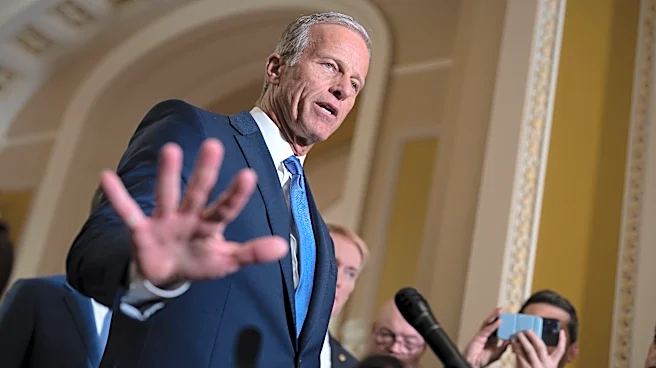
They were talking about Sen. Chuck Schumer, the 75-year-old New Yorker who's led their caucus for a decade, including by steering them to stunning victories in this month's midterm elections.
Yet instead of entirely coalescing around him after the blue wave, other Senate Democrats have cited it as evidence that Americans are
eager for seismic change in Washington. Now, the longtime leader is facing his first real challenge in years.
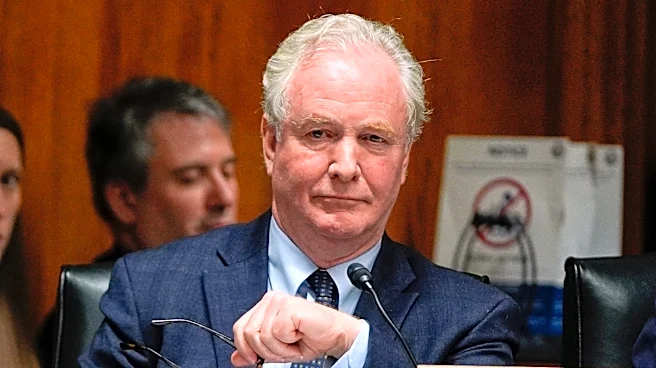
By the end of the Senate’s first week in session following the midterms, Sen. Chris Van Hollen, a 67-year-old progressive from Maryland, officially announced a bid to challenge Schumer. He said in a TV interview that he had the support of at least 10 of his colleagues, but acknowledged he was an “underdog.”

Three days later, on Nov. 15, he told Fox News Sunday that number was up to 15.
Voters “haven't fully hired the Democrats. They've given us a chance," he said on CNN's State of the Union. "And I think we need to earn their trust. And I think that begins by not going back to business as usual.”
Several incoming senators, including Minnesota’s Peggy Flanagan and Michigan’s Abdul El Sayed, swiftly backed Van Hollen, who also said he was also ending his flirtations with a 2028 presidential run.
Schumer, however, has led Senate Democrats for all of Van Hollen’s decadelong Senate career. In that time, he’s fundraised, taken political heat from his members and developed close working relationships with much of the caucus. For many of them, the blowout at the midterm polls calcified their support — at least to start the upcoming Congress.
“You will see, despite all the grumblings, enormous gratitude for the hard work he has done to get us to this position,” Sen. Kirsten Gillibrand, Schumer’s fellow New York Democrat and the head of the caucus’ fundraising arm, told reporters this week.
“We are about to win nine Senate seats,” she went on, banging her hands on a podium for emphasis. “That has never happened in my political history.”
Progressive frustration boils
Democrats in 2026 remade the Senate map, driving into deep red territory like Kansas and Mississippi to pick up seats. Schumer recruited several of the Democrats who flipped seats, including Sens.-elect Roy Cooper in North Carolina and Sherrod Brown in Ohio, and a group affiliated with him spent $1.2 million in Mississippi down the final stretch.
Schumer has said he's locked up the votes to be reelected majority leader. Yet he roiling progressive anger aimed both at himself and at the Democratic establishment that's been several years in the making.
Schumer infuriated some progressives with how he handled government funding fights with Republicans and President Donald Trump. His staunch support for Israel has also become a flashpoint, at a time when the issue has split the Democratic Party and emerged as a litmus test in primaries across the country.
While Schumer's supporters point to his many wins in the midterms, his critics point to his initial backing of 78-year-old Maine Gov. Janet Mills, who eventually dropped out of the state's Senate primary, and of Michigan Rep. Haley Stevens, who lost her primary to El-Sayed and went on to endorse his Republican opponent.
More broadly, progressives are frustrated with a Democratic establishment they feel has blocked their most cherished priorities and been unable to meaningfully reel in Trump — and many view Schumer as part of that establishment.
A unique duo

Exactly a week after Election Day, a unique political duo joined forces on Capitol Hill. Progressive Sen. Bernie Sanders and Sen. Elissa Slotkin, who’s more center-left, called a press conference to deliver a shared message: A challenger to Schumer should come forward.
“Senator Sanders and I disagree on some items, but we agree on the need for change,” Slotkin said.
Both said they wouldn’t back Schumer. But Slotkin still has not explicitly endorsed Van Hollen, either, underlining the complexity of how some Senate Democrats are approaching their considerations.
A closed-door election is expected in early December, when a majority of the 55- to 56-member caucus, depending on the Alaska election results, will decide on the next majority leader.
Some are still weighing their options.

“We're going to talk that through as a caucus,” Sen. Andy Kim, D-New Jersey, told USA TODAY at a gathering of top Democrats in Denver. “We had one meeting so far as a caucus as a whole.”
Regardless of who becomes leader, he said, mapping out the party’s policy agenda will be the most important item on their to-do list.
“I want us to come up with a plan of like, what are our priorities?” he said. “That's really what's key.”
Schumer’s path forward

Under pressure from his caucus to put forth a bold agenda in the majority, Schumer and other top Senate Democrats are already laying the legislative groundwork.
They’re planning to introduce stand-alone bills on major policy priorities, including on issues like healthcare reform and congressional stock-trading bans. If Republicans won’t join with them on straightforward legislation, they’re preparing to eventually move through the more intensive budget process, known as reconciliation, to advance their items with just a simple majority instead of the Senate’s 60-vote threshold — daring Trump to use his veto.
Even before Democrats retake the Senate, however, they’re facing a shorter-term issue. Funding for the federal government expires in just weeks, on Dec. 11, and an expanding group of them is already prepared to risk a shutdown without guarantees from their Republican counterparts to stop funding the war in Iran.

Among the biggest proponents of such a high-stakes strategy: Van Hollen.
“Right now, under our current leadership, we have a situation where they are not willing to use the most important power we have to end the war, which is to defund it,” he told reporters. “My view is we need to be listening to these individuals."
Schumer has gotten used to steering Democrats amid record-breaking shutdowns. Over the past year, several have caused nationwide travel disruptions, food insecurity and economic pain. During those funding crises, many Republicans predicted voters would blame Democrats for their obstruction. North Carolina Rep. Richard Hudson, who ran the House GOP's campaign apparatus, said last October that it would "cost them their seats next November."
Not only did Republicans go on to lose control of the House, but Hudson ultimately lost his own race, too.
Zachary Schermele is the congressional correspondent for USA TODAY. Reach him by email at zschermele@usatoday.com and on Signal @zachschermele.02. Follow him on X at @ZachSchermele.
This article originally appeared on USA TODAY: Chuck Schumer steered Democrats to a midterm blowout. Was it enough?