









They’re similar to Tasers – through they’re lower in power and don't break the skin – and Immigration and Customs Enforcement agents may be wearing them early next year, battery powered gloves capable of delivering brief but painful electric shocks.
ICE plans to spend $10 million to $20 million in 2027 to buy thousands of the electric gloves for its officers and agents, according to an Aug. 10 announcement by the Department of Homeland Security.
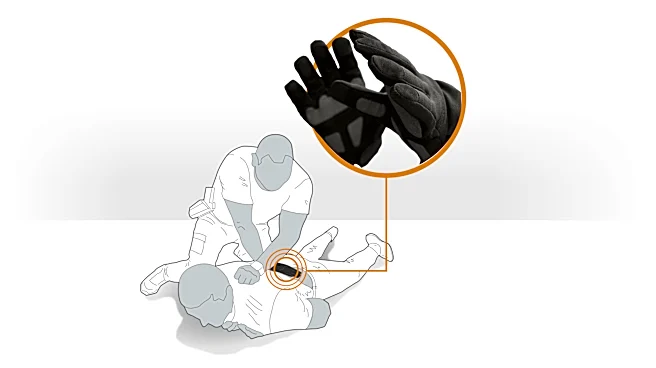
They look like ordinary patrol gloves but they deliver an electric shock only when they're activated by the agent and the glove's palm is in direct contact with bare skin. Recipients don’t pass out, but the pain can force them to cooperate with agents.
What do the electric gloves do?
The device, known as a G.L.O.V.E. – "Generated Low
Output Voltage Emitter" – is less powerful than a Taser but still delivers an electric jolt of up to 380 volts. Tasers differ depending on the model; the maximum output of a Taser X26 is about 1,200 volts, according to the National Library of Medicine.
Can't see our graphics? Click here to reload the page.
It's also different from a Taser, since it does not have probes or needles that attach to the skin, according to manufacturer Compliant Technologies in Lexington, Kentucky. It doesn't affect the body's nervous system, only the area it touches, the company says.
The Glove causes pain and distraction through sustained physical contact. It’s like a bee sting, says John Peters, president of the Institute for the Prevention of In-Custody Deaths, the Guardian reported.
Tasers are designed to incapacitate muscles through pulsed current generated between probes.
Current generated by the Glove "is so low that stimulation can't occur through clothing, hair, metal, plastics or fur," the company says. The device should not be used on elderly people, small children, pregnant women or the severely disabled, according to the Glove manual.
The manual also states the Glove "shall not" be deployed for any of the following:
- Verbal defiance or belligerence.
- Punishment.
- Torture.
- Horseplay.
The Gloves have not been widely used by police departments, according to the New York Times, but some have been deployed by county law enforcement and jails in the United States.
When he first saw the Glove at a conference, "I was skeptical," says Assistant Police Chief Adam Glueck of Cape Girardeau, Missouri, in an interview the company posted on its website.
When the Glove was demonstrated on his arm, "I was absolutely convinced. I went straight down to the mat. I didn’t think about anything other than I wanted that pain to stop.
"I didn't think about trying to pull away or try to fight with you," Glueck said.
ICE appears to be the first federal agency to use the Gloves. They will be issued to Homeland Security Investigations and Enforcement and Removal Operations officers and agents, according to Axios.
Civil rights advocates and former ICE officials under Democratic administrations said they found it troubling that officers could be equipped with a new tool that made it easy to inflict pain, the New York Times reported.
"ICE spent the last year showing this country that they are willing to disregard the law and are too quick to use force, with devastating and at times fatal consequences for citizens and noncitizens alike," said Jenn Rolnick Borchetta, ACLU's deputy director on policing, Axios reported.
Eric King, a spokesperson for the American Civil Liberties Union of Kentucky, said in a statement that the civil rights group is “deeply concerned by plans to provide ICE agents with another tool capable of inflicting pain on people in their custody or during enforcement encounters.”
DHS responded with an emailed statement attributed to a spokesperson: "ICE is constantly assessing the needs of our officers in the field to ensure they have the tools and equipment necessary to safely arrest and remove criminal illegal aliens from our country. Every decision is made with careful consideration and appropriately reviewed to ensure that any technology ICE utilizes is consistent with all applicable law enforcement policies and standards." The department highlighted officer training in de-escalation and increased threats faced by their agents.
Jeff Niklaus, founder and CEO of Compliant Technologies, said in an email to the Louisville Courier Journal, part of the USA TODAY Network, that he was unable to comment.
Contributing: Monroe Trombly, Louisville Courier Journal
Source: USA TODAY Network reporting and research; Reuters; Department of Homeland Security
This article originally appeared on USA TODAY: ICE will spend $20 million on gloves that can literally shock you