








Commercial airliners across the United States were grounded for nearly five hours on Nov. 13 when a communications problem overwhelmed the federal air traffic control network.
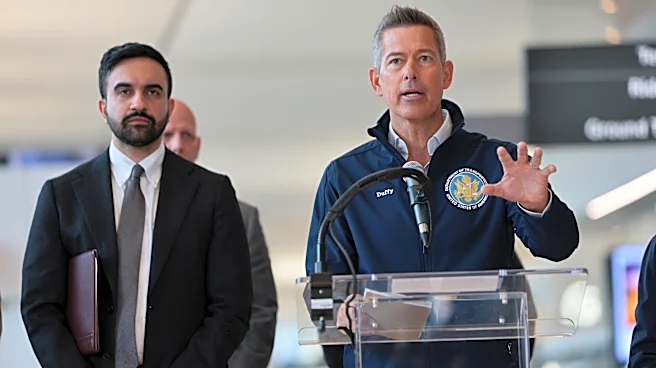
The fault is believed to be connected with a router in a Federal Aviation Administration communications station in El Dorado, Arkansas, which L3Harris Technologies was upgrading from a 20-year-old copper-wire-based system to fiber-optic cable, Transportation Secretary Sean Duffy said on Nov. 14.
Transportation Secretary Sean Duffy said Nov. 17 that he would share the cause once investigators officially determine it. A date for the announcement is pending.
The router upgrade apparently triggered a surge in repeated communication attempts from the El Dorado station and a radar
site in Amarillo, Texas, to 17 of the 22 FAA regional control centers.
"This was the 69th installation of that router," Duffy said on Nov. 17. "Sixty-eight times it worked well. This one, the router started to broadcast into our network and it started to overload the network."
More than 25,000 U.S. flights had been delayed as of 9:30 p.m. ET on Nov. 13, according to flight tracking site FlightAware. Not all were due to the ground stop.
The grounding primarily prevented departures but did not force all aircraft in flight to land. It was the second-longest in duration since the nearly 50-hour nationwide shutdown following the Sept. 11 attacks.
Flight schedules were returning to normal on Nov. 16, USA TODAY reported.
What happened during the FAA grounding
Can't see our graphics? Click here to reload.
17 air traffic control centers were affected
What do FAA routers do?
Routers are industrial-grade electronic devices that direct digital traffic between networks. They transmit information such as flight plans, radar data, and other communications across the federal air traffic control network.
The FAA uses tens of thousands of routers to connect air traffic control towers, radar sites, and radio facilities, according to the New York Times. For safety reasons, the FAA network is on a secured system that can’t be publicly accessed.
A router works something like a post office. It reads the address on an incoming data packet and forwards it to its destination.
If too many data packets are sent in a short period of time, routers may be unable to process them fast enough. This can delay or drop packets, which disrupts communications.
The FAA system received about 1,000 connection attempts every four to five seconds, Duffy said. Older routers became overloaded and began producing unclear data, which prompted the FAA to ground planes.
The router work was being done by contractor L3Harris Technologies, which is headquartered in Melbourne, Florida, Duffy said.
L3Harris manages the FAA Telecommunications Infrastructure, supporting about 45,000 daily U.S. flights and connecting more than 4,400 facilities, according to the company's website. The company converts decades-old copper wire connections with modern high-speed networks, USA TODAY reported.
Contributing: Sara D. Wire, Mike Snider
Source: USA TODAY Network reporting and research; Reuters; Federal Aviation Administration
This article originally appeared on USA TODAY: Inside the FAA router failure that grounded US flights nationwide