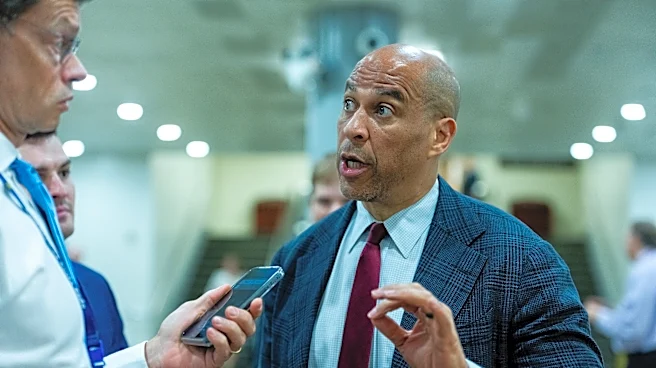







Sports make us "wistful," even if we’re U.S. Senators. It was the word Sen. Cory Booker (D-N.J.) used when talking about his own career.
"How many New Jersey high school football players of the year do you talk to?" Booker told USA TODAY Sports in an interview late last month, with tongue in cheek. "The older I get, the better I was."
The memory isn’t as much of a riff from his home state’s own Bruce Springsteen in "Glory Days" as much as a ballad to where they took him.
Booker, who has held his seat since 2013, was once recruited to play football by Jack Elway (John’s father) at Stanford. He later played at the school for coaches Dennis Green and Brian Billick, who went on to become highly successful in the NFL.
Somewhere from the time his parents
dropped him off at a soccer field as a boy, and when he and an eclectic group of teammates pulled off one of college football’s signature upsets (more on that later), Booker began to realize reaching the pros wasn’t sports' purpose for him.
We don’t have to attract college interest to understand their meaning.
"Sports and the arts aren’t extras," says Booker, 57. "They’re vital for our children's success. And I think we as a country, in the last generation or two, have really shortchanged our children from having not only a fullness in life, but experiences that actually can supercharge their success in other endeavors beyond sports and the arts."
Booker is a co-sponsor of the Let Kids Play Act, which was introduced in May and seeks to end what it terms "vulture practices" by private equity firms involved in youth sports. Congress members accuse them of putting profit – and charging high sums to stay and play at tournaments – before the needs and concerns of children and pricing some families completely out of sports.
"I think one of the biggest things that shocked me when I got to Newark (as a city councilperson) was how my kids didn't get the great fields and facilities that other towns less than 10 miles away had," says Booker, the mayor of the city before he became a Senator. "It seemed profoundly unfair to me that the access and opportunity I had, that changed my life outcome, wasn't universally available to all young people."
Booker spoke with us about his sports story and how his involvement in legislation might help us better navigate the ones our kids are creating.
'I saw miracles': Your accolades are temporary; your experiences last a lifetime
Booker, who grew up in northern New Jersey, has described football as a "jetpack" that lifted him to opportunities that were beyond his dreams.
He was a "rambunctious kid" who his parents threw into sports – baseball, basketball, soccer – as an outlet. He didn’t pick up football until high school. Success came at him like a torrent. After his sophomore year, Street & Smith magazine named him as a preseason all-American.
"Suddenly, my house just started getting deluged with letters from colleges," he says. "And my parents, who would ground me if I brought home a C or threatened to take me out of sports if my grades dipped at all, (started) seeing sports (as) a great opportunity for me."
As a junior in 1985, his high school, Northern Valley Regional at Old Tappan, won a state championship after limited success, Booker says, over the previous two decades. By his senior season, Booker was receiving calls from former President Gerald Ford and Civil Rights leader Andrew Young during his recruiting process.
He was named to USA TODAY’s 1986 All-USA high school football team as a defensive back.
Sports success, and its spoils, can be intoxicating. From the moments we first find it, we gain confidence and feel pretty good about ourselves. But we can quickly learn that, from an individual perspective, success can be fleeting, and that handling sports without it can help mold us.
Jack Elway was gone during Booker’s sophomore year after a 3-6-2 season, and in came Green and Billick.
"They came in and turned our program around," Booker says, "and just in terms of organizational leadership, witnessing this extraordinary coaching staff did so much for me. I learned a lot of great lessons about how do you build team and how do you build pride and a sense of accomplishment and I saw miracles."
The power of team is real, and sometimes it makes you better than you are
Booker has learned how we draw strength and community from our interactions with and faith in others. Think about how those words apply to sports. While Booker got into 22 games in his career at Stanford, catching one touchdown as a tight end, what stays with him was how he learned to believe in teammates who weren’t like him.
Stanford was 1-3 when it traveled to South Bend, Indiana, to face No. 1 Notre Dame on Oct. 6, 1990. Have you noticed around youth sports that there often seems to be that parent who tells you, "We can’t win"? The Cardinal had every right to feel that way.
Booker even remembers his coaching staff telling him and his teammates that Notre Dame has better athletes than them.
"But come Saturday," the message was relayed, "we’re going to be the better team."
Booker keeps a copy of Sports Illustrated in his office that called the 36-31 win the biggest upset of the year next to Buster Douglas toppling Mike Tyson. Stanford would lose its next three games and finish 5-6, but one was enough to create a lifetime memory.
It’s how sports can work for us, especially as kids. A game, or even just a singular experience within it, can exhilarate us.
"Those kind of experiences get seared into your DNA and you begin to understand things beyond the gridiron and how life works and to take this group, this incredibly diverse group of people – diverse racially, diverse religiously, diverse socioeconomically – and to turn us into a fine-tuned machine that could go in and pull off miracles – do impossible things beyond even our own imagination – is something that became the foundation for my future challenges," Booker says. "Like taking on a city like Newark, where so many people had turned their back on it, disregarding it, disrespecting it, or just plain dissing it, and me just telling people, 'We are going to do things that other people think are impossible in this city, and we're going to turn around generational trends.'
"And I really felt in many ways of going back to the start of pulling a team together, being the coach and getting us to get other people to believe that we could do great things."
'My kids feel like we don't care about them': How do we get the most out of youth sports in today's world?
Booker admits it’s much harder today for kids and parents to navigate today’s system.
What can we do as a parent?
Booker isn’t one himself (yet) but he has seen the psychological impact on Newark’s kids who traveled to state-of-the-art facilities and wondered why they didn’t have them for themselves.
"My kids feel like we don't care about them," parents would tell him.
We want to give our kids the world, so if they love sports, we might drive them anywhere, even if it means reducing our household budgets in other areas.
"Some trend happened in the last decade that is stunning to me," Booker says. "We're seeing sports, which, for me was just my parents buying me a pair of cleats and sending me out to the soccer field, is now, for many parents, something that puts them into really serious financial stress. There is a woman in Montclair (New Jersey) who sticks out (who) had to take out side jobs just to get her 11-year-old son in sports.
"These are stories I hear hundreds of times over about how difficult it is to put their child in a position to have what was for me … the only thing I had to do was show up and compete. But now families are really stuck with high barriers just to get their kid to be able to compete for the opportunities that came without putting my family in debt."
Booker made it a mission to transform Newark fields and courts and facilities with state-of-the-art turf and lights, cobbling together funds, he says, from every imaginable source – federal grants, state grants, city bonding money, "and a whole lot of philanthropy."
There is power in consensus, even at a much less grand scale. Our job as parents, whether we’re talking about sports or education or anything else that affects our children, is to push back if something doesn’t seem right, whether it be a "bad" coach or unsatisfactory team situation.
"Your pain and frustration of trying to come up with an extra $1,000 to $5,000 a year for your kid, you're not alone," Booker says. "And your voice right now is really needed because this is not a right or left issue. This is a, 'What's going to define American life?' Wide access to sports, or creating an exclusivity, that, unfortunately, works to the detriment of all of us. So, my real hope is that parents begin to speak up and speak out more about these trends that are really working against them and their families. …
"All change, whether it's voting rights or union rights, never comes from Washington; it always comes to Washington for people who stand up and do something. You don't have to do everything, but you can't allow your inability to do everything to undermine your determination to do something on the issues that matter."
What's the latest on the Let Kids Play Act?
The Let Kids Play Act, introduced by Democrats in May, seeks to hold private equity companies accountable for their activity within youth sports and weed out those who engage in any activity that causes "harm or creates long-term risk of harm to an acquired entity in order to extract profit, assets, or other value for the benefit of a covered firm or its affiliates."
"I am a big believer that infusing capital into a situation can save fields, or save facilities," Booker says. "But I really do worry about the norm here, which is the investment of private capital has restricted access, jacked up costs unnecessarily, and really created an unlevel playing field that has squeezed out many working class families. And so the trend in general to me has been a very negative thing. I'm one of these people that is not gonna throw a whole category of investment into the trash heap but I have seen the ills of private equity in many industries, and this is definitely one where, net net, it's been more bad than good."

Since the bill was introduced, some Congress members at a bipartisan hearing of the House Subcommittee on Early Childhood, Elementary and Secondary Education, challenged us to look deeper at what private equity’s influence means in specific cases.
"Investment’s important but it’s when the mission (is) our kids, not investors," Rep. Burgess Owens (R-Utah) said at the hearing. "And we’re seeing too much of this. We’re gonna lose the soul of our nation if we don’t get this right."
Rep. Bobby Scott (D-Virginia) said we are spending about $3 billion to $4 billion under the Elementary and Secondary Education Act and suggested Congress could make more effort to use funds for more school sports.
As parents and school administrators, though, we can push harder, too, and contact Congress members on both sides of the aisle and urge them into action for funds for more sports options.
"I've seen movement and momentum growing and I've been around the Senate long enough to know how this goes: The more awareness is raised and the more you're hitting that pain point, the more momentum a bill will have," Booker says. "And I think this is a bill that will get passed. It may take until January of 2029. If Democrats control the House, the Senate, and the White House, I think bills like this become a lot more possible, but right now you need that bipartisan support to get it through the Senate and I think this is something that can gain that kind of support as well."
Remember: Our sports careers are more about what they bring to us than what we leave behind
I was once talking to my sons, when they were in elementary or middle school, about the meaning of Springsteen’s "Glory Days," It’s about how we hold onto our past athletic accomplishments, sometimes so long that they become who we are.
Instead, I told them, we can learn to appreciate what we did and how it helped push us forward.
"I literally would not be standing here if it wasn't for my involvement in sports as a young person," Booker said at a news conference last spring to introduce the Let Kids Play Act.
Rep. Owens spoke at the Congressional hearing last month about how he started out in Pop Warner football and made it all the way to the NFL for 10 seasons as a defensive back. However, he says, playing sports as a student was foundational for his personal development, too.
"Sports gave me the confidence to grow from a young man who was a very quiet introvert to a U.S. Congressman representing hundreds of thousands of Utahns."
Senator Chris Murphy (D-Connecticut), Booker’s co-sponsor of the bill, had opened the news conference by saying, "Assembled here is the washed up former athlete caucus."
It was a joke that no athlete lasts forever. But what we take from sports can.
We can use this moment to think about what sports means for our kids, and what we can do about their situation. Are they getting equal playing time? Is the extensive travel worth it? Are we paying too much? What are the long-term benefits?
"I used to tell people football became my ticket, not my destination," Booker says.
Steve Borelli, aka Coach Steve, has been an editor and writer with USA TODAY since 1999. He played baseball in high school, rowed in college and spent 10 years coaching his two sons’ baseball and basketball teams. He and his wife, Colleen, are now sports parents to a college and high school baseball player. His Coach Steve column is posted weekly. For his past columns, click here.
Got a question for Coach Steve you want answered in a column? Email him at sborelli@usatoday.com. at sborelli@usatoday.com.
This article originally appeared on USA TODAY: How can a youth sports experience form a life? A US Senator explains