








This is the first column in USA TODAY Opinion columnist Rex Huppke’s new series, “America’s Looming Farm Crisis.” Farmers across the country are struggling to keep their heads above water, reminding some of the lead-up to the devastating 1980s farm crisis. This series explains why all of us need to be concerned.
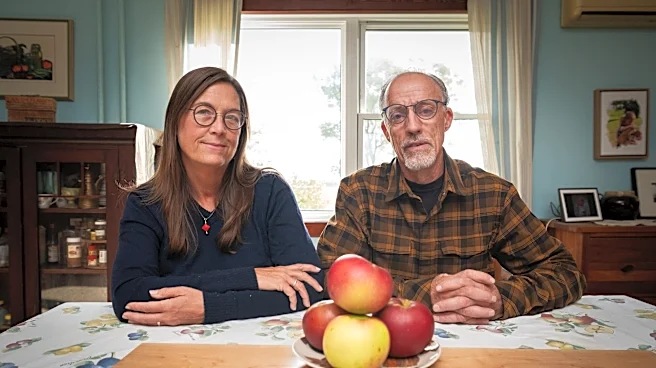
CLINTON, Minnesota — Kathy Draeger, whose husband's family has farmed the land in west-central Minnesota’s Big Stone County for generations, knows trouble is coming for America’s farmers. She can feel it like storms rolling off the plains of neighboring South Dakota.
Her fellow farmers feel it. too. The squeeze. The pressure of debt on their chests. She knows one nearby farmer already selling land to make ends meet.
“I was with a group
of farmers recently and asked if it felt now like it did in the 1980s,” Draeger said. “They all nodded their heads.”

That statement alone should alarm us all. The 1980s farm crisis was an agricultural cataclysm of bankruptcies and foreclosures that devastated and forever reshaped rural America. It was the worst economic crisis in farming since the Great Depression.
Whether you're a farmer or a finance executive who has never seen a farm, the health of U.S. agriculture is vital to you. American farmers keep grocery shelves full, restaurants stocked and protect our national security by giving us a sound domestic food supply. Basically, when farming gets a cold, America gets sick.
'This does remind me so much of the '80s'
Minnesota saw the most farm bankruptcies in the country in the first quarter of this year, and the fall harvest arrived with record-high diesel prices cutting into thin to nonexistent profit margins.
But it’s not just here, among rolling hills of corn as high as your head and tidy rows of soybeans waving on land farmed by generations of the same families, that you’re hearing echoes of the 1980s farm crisis.
“This does remind me so much of the '80s,” said Pam Johnson, a retired Iowa farmer and past president of the National Corn Growers Association. “We were farming in the '80s and we almost had survivors guilt because we had friends and neighbors that didn’t survive, by no fault of their own. You know the old standard: Pull yourself up by your bootstraps, and if you work, you're gonna be able to make it. Well, that theory was kind of bashed."
Brian Kuehl, a principal at Pinion, an advisory firm that works with the agriculture industry, described the current moment in American farming like this: “I think that this is a farm crisis that is as significant as the 1980s. It’s different. We don’t have the high interest rates that you had in the '80s. But I think you’ve got a lot of the same dynamics unfolding, and a lot of farmers being hurt.”
The cost of everything that goes into farming is sky-high
The issues farmers are facing include: the high and rising cost of farm inputs like seeds, fertilizer and equipment; crop prices that aren't doing enough to offset high input costs; record-high farm debt; and rising interest rates that make borrowing more difficult and loan payments harder to manage.
Anne Schwagerl, a Big Stone County farmer and vice president of the Minnesota Farmers Union, told me: “I think people are in a farming-to-survive mode. Right, so we're gonna do anything we can to hang on and hope for better conditions in the future.”
Farmers are small in number, but vital to America's well-being
Farming can, admittedly, be a difficult topic to get people to think or care about. It’s a job few Americans do, but all Americans rely on.
To put that in context, the American Farm Bureau Federation puts the number of farm and ranch families in America at less than 2% of the U.S. population. But more than 80% of the food we eat, according to the U.S. Department of Agriculture, comes from the domestic supply chain, so that tiny percentage of farmers does a lot to keep us fed.

Even if you don’t know a farmer, even if you have zero connection to or concern for rural America, if you care about a steady food supply and about what you’re eating, the state of agriculture in America should be of significant concern.
The total number of U.S. farmers may be small, but the ripple effect of any crisis in the agriculture industry is felt everywhere, from tractor dealerships and shops in rural towns like Clinton, Minnesota, to grocery stores and upscale restaurants in big cities like Chicago nine hours southeast.
Politicians pander to farmers, but rarely help
And yet, perhaps because most of us are so disconnected from the land that we forget where the food in our refrigerators comes from, farmers tend to be easily ignored. They’re paid lip service by politicians of both parties who swear their allegiance to America’s great farmers, but such patter uses “farmers” more as a code word for “rural America.”
The reality is farmers are a tiny voting bloc, so they’re easily leveraged while campaigning, then just as easily forgotten once a politician takes office. There’s no clearer example of that than the fact that Congress hasn’t passed a new farm bill – a package of federal legislation dictating agricultural and food policy that's supposed to be renewed every five years – since 2018.
The Kansas-based Barry Flinchbaugh Center for Ag and Food Policy noted earlier this year that since 2018, “input costs have spiked dramatically. Trade uncertainty – including significant tariff volatility – has created risks that existing commodity programs were never designed to address. … Agricultural labor challenges have grown more acute with no clear legislative resolution.”
The lack of a farm bill makes farmers’ already uncertain lives more uncertain.
The number of farmers keeps going down, a dangerous trend line
With economic pressures and lawmakers failing to hear the voices of U.S. farmers, it’s no surprise their numbers are shrinking. According to the USDA, there were 1.865 million U.S. farms in 2025, down 15,000 farms from the previous year.
In 2018, the total number of farms was just over 2 million. So in just seven years, the nation lost close to 10% of its farms. (It's worth noting that, according to the USDA, as of 2024, 86% of farms are still small, family operations.)
Draeger, walking with her husband, Mike Jorgenson, and their friend and local farmer Clayton Brobst near the fields of her and Jorgenson’s farm in Clinton, Minnesota, said that in the 1950s, there were about 400 dairy farms in Big Stone County.
“And now, as of St. Patrick's Day of this year,” she said, “there are zero dairy cows in this county.”
"Every Friday night growing up, farmers were bringing their cream cans to the creamery in Clinton,” Jorgenson recalled. “I can hear the cream cans clanging in the back of pickups. You know that's part of my early childhood.”
When farms fail, the economic ripples spread to other businesses

Now the fields in Big Stone County are primarily used for corn and soybeans. Farms have grown bigger, but the number of farm families has dropped, hollowing out the infrastructure of small towns.
Not far from Draeger’s farm, in the town of Clinton, Bonnie’s Hometown Grocery Store is one of the few independent groceries left in the area.
“Clinton has been hit hard,” said Bonnie Maas, the owner.
She ticks off the local businesses lost in recent years: a cafe, an auto repair, a beauty shop. Even the local school was shut down and consolidated.
Many farmers need off-farm jobs just to get by

Brobst, a 41-year-old farmer, said his wife works a full-time job to help them get by financially: “The people I'm most familiar with, most of them have a day job. We live a nice life in lieu of her wages and the health insurance she grabs for us, and we're happy doing what we're doing. But is it the American dream to say, ‘Well, we're going to both work a town job, and we’re going to farm a little bit’? I'd like to just farm.”
Draeger, who is executive director of the Minnesota Institute for Sustainable Agriculture and an adjunct professor at the University of Minnesota, also worries about the knowledge drain. Fewer farmers means fewer people with the skills and know-how to run a farm.
“You lose a whole body of skills,” she said. “I think one of the things we need to conserve and preserve is that body of skills that we are losing. … Probably 75% of crops are farmed using GPS guidance, and so you're getting in a tractor and you don't even necessarily need to know how to keep it in a row. You just set it and go, and then you call the co-op to apply pesticides if you see you’ve got an aphid problem. So you don't even know how to spray.”
Farm bankruptcies jump 46%, and signs of desperation rise
Farming has always been a high-risk occupation, with unpredictable weather and unexpected swings in commodity prices. But for many farmers, the risk has grown considerably in recent years, following shifts in the global marketplace, climate change, tariffs, and now the spiking fuel and fertilizer costs associated with the Iran war.
Chapter 12 family farm bankruptcies jumped by 46% last year, and the trend has continued this year. Bankruptcies hit a six-year high in April, rising as much as they did during the COVID-19 pandemic
At Farm Aid, a farm advocacy group that grew out of the 1980s farm crisis, calls to the crisis hotline have been on the rise.
“Farmers will often call only when it’s the last choice, only when they’ve gotten notice the bank is accelerating the loan and they’re running out of time,” said Jennifer Fahy, co-executive director of Farm Aid. “The number of farmers who are calling and identifying as financially distressed is much bigger. About 80% of farmers who are calling are saying they need support.”
Now is the time to pay attention to what's happening in American farming
This is the first in a series of columns on America’s looming farm crisis. The columns are based on more than two dozen interviews with current and retired farmers, agricultural economists, historians, financial advisers who work with farmers, and advocates who assist agricultural communities across the country.
The 1980s farm crisis serves as a backdrop for these columns, not because there’s a one-to-one comparison between then and now. There isn’t. Things are different today, and there are steps that can be taken, by stabilizing markets, breaking up monopolies that control farm inputs and outputs, and moving toward more sustainable farming practices, to avoid disaster.
But what’s clear right now is there are lights flashing red in American agriculture and we must pay attention. There were warning signs before the 1980s farm crisis as well, and they were ignored.
Because of that, rural America and the farmers who form the backbone of our very existence were irrevocably changed.
Follow USA TODAY columnist Rex Huppke on Bluesky at @rexhuppke.bsky.social and on Facebook at facebook.com/RexIsAJerk.
This article originally appeared on USA TODAY: Farmers fear a crisis coming. America can't afford to ignore them | Opinion