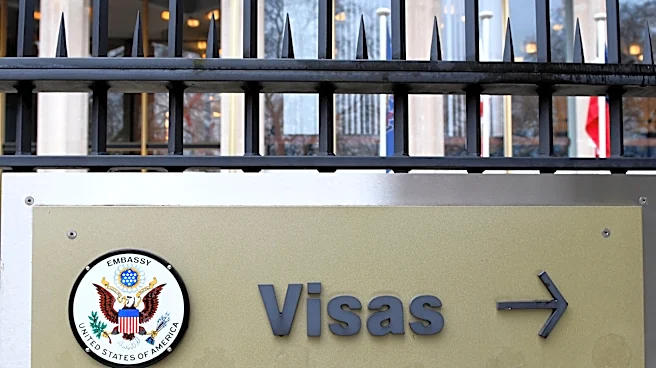






A federal judge in California ordered the Trump administration to continue processing thousands of diversity visa cases for 10 days beyond a deadline that would typically end applicants' chances of immigrating to the United States — an extraordinary extension meant to make up for time the judge found the government lost by failing to promptly comply with his earlier ruling.
The decision offers a new lifeline to people who have spent months watching a rare chance to immigrate to the United States slip away.
U.S. District Judge Edward Davila on Sept. 30 found the State Department’s compliance with his August order was “less than substantial,” saying officials waited 10 days to tell embassies and consulates to resume processing and then moved at an “unprecedented
glacial pace.” His ruling gives U.S. Diversity Visa Program selectees those 10 days back.
“Courts must be equipped with the tools necessary to ensure orders are not meaningless,” Davila wrote, rejecting the government’s argument that the passing of the program's Sept. 30 deadline left him without authority to provide such relief. To accept otherwise, he said, could leave the judiciary “completely disarm[ed]” at the whims of another branch of government.
The State Department did not immediately respond to USA TODAY's request for comment. In a previous statement, a spokesperson said the department was "following and abiding by court orders."
The Diversity Visa Program offers up to roughly 55,000 immigrant visas each year to people from countries with historically low rates of immigration to the United States. More than 20 million people entered the lottery for 2026, and about 129,500 applicants and family members were selected.
For some of those winners, the selection reshaped their lives. Families interviewed by USA TODAY sold homes, spent hundreds or thousands of dollars and moved across countries as they prepared for interviews and medical exams. Some were hoping for a way out of war-torn nations or an escape from political persecution. All were racing toward the same deadline because, under federal law, their chance to receive a visa disappears when the fiscal year ends Sept. 30.
But in December, the Trump administration halted diversity visa issuances while it reviewed screening and vetting procedures. A separate administration policy later paused immigrant visa processing for nationals of 75 countries, placing another barrier in the path of many selectees.
The freezes stretched deep into the fiscal year. It was not until August, with little more than a month remaining before the deadline, that federal judges in separate cases ordered the government to restart processing. Davila’s Aug. 28 ruling directed the State Department to reconsider applications caught in the pauses and resume ordinary adjudication of pending cases.
Yet as Sept. 30 drew closer, thousands of selectees remained in limbo.

Attorneys for the selectees repeatedly accused the State Department of running out the clock. Ten days after Davila’s ruling, they returned to court saying no new interviews had been scheduled and some previously scheduled appointments had been canceled.
The State Department did not dispute that no interviews had been conducted or visas issued during that period, according to court documents, and said it had needed time to develop instructions for consular posts.
Davila was already warning then of what those delays could mean.
“With each day that passes,” he wrote, “hundreds of selectees lose their opportunity to receive a diversity visa.”
He ordered the State Department to begin reporting its progress three times a week.
Processing resumed, but slowly. Through Sept. 21, the State Department was adjudicating about 83 diversity visas a day worldwide, according to figures cited by Davila — roughly a third of the 230 a day it had averaged during September 2025.
At the same time, applicants were encountering new hurdles.
The department had rolled out a "global training initiative" on public charge — the longstanding provision of immigration law that can bar people deemed likely to become primarily dependent on the government for support — that generally required consular posts to complete new training before processing immigrant visas. The government said the project had been planned for months, before Davila issued his order.
Attorneys for the selectees saw it differently, describing it in court filings as “a new pause wearing public charge clothing.”
In court records, the selectees' attorneys accused officials of “manufacturing delay rather than curing it.”
Some applicants who did get appointments were again placed in administrative processing or told their cases required additional review. Others were running into delays that could extend beyond the date when they remained eligible for a visa.
Davila found the State Department had not told him about the effect the public charge training would have on processing, just as it had not initially told him that officials were still developing guidance to implement his August ruling. In both instances, he wrote, the department responded only after attorneys for the selectees raised the delays in court.
Its “lack of diligence” was “of exceptional significance,” Davila wrote. The delays, he concluded, had “materially frustrated” his order.
The pace eventually accelerated. But by then, the deadline was days away.
During a Sept. 29 hearing, attorneys for the selectees asked Davila to preserve all of the diversity visas that would otherwise go unused — roughly 40,000, by their estimate — and allow processing to continue after Sept. 30. The government argued that courts could not extend diversity visa eligibility beyond the fiscal year, pointing to a federal appeals court decision that overturned a similar remedy in litigation over an earlier visa freeze.
Ultimately, Davila declined the applicants’ broader request. The government is not required to issue every diversity visa Congress makes available, he wrote, and setting aside roughly 40,000 visas would be “untethered and overbroad.”
But he drew a distinction between preserving visas simply because applicants had run out of time and remedying time lost because the government had failed to comply with a court order. And he settled on a narrower remedy: a 10-day extension.
Without that power, Davila wrote, a court could find “an egregious lack of compliance” with its ruling but become powerless to do anything about it simply because the government had managed to reach the statutory deadline.
“Such a result would be ‘absurd,’” he wrote.
The State Department must now continue reconsidering cases affected by the diversity visa and 75-country pauses and resume ordinary adjudication of pending applications for an additional 10 days. Davila ordered officials to continue reporting their progress three times a week and to notify him promptly if any new problems interfere with compliance.
The parties are due back in court Oct. 15.
This article originally appeared on USA TODAY: Judge extends diversity visa processing, blames State Dept.'s 'glacial pace'