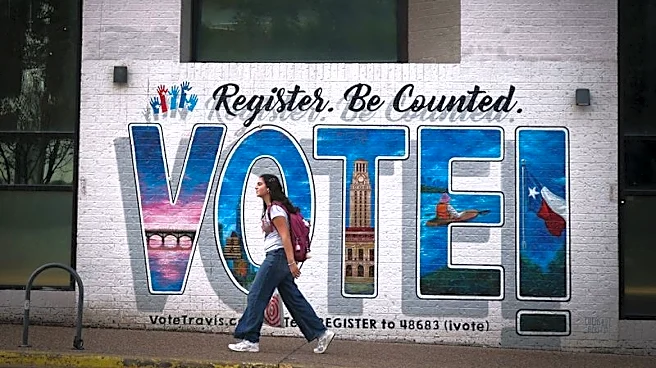






If you think the Nov. 3 elections are only about control of Congress in Washington, D.C., think again. Voters across the country are also deciding on ballot measures that affect their everyday lives.
Thirty-nine states will decide on more than 140 ballot measures, according to the National Conference of State Legislatures. Many ballot measures would change laws. Others would amend state constitutions. Some are specific to cities and counties, but most will be decided statewide.
Americans will cast ballots on matters affecting voter identification, transgender policies, abortion rights and campaign finance laws. In one state, voters will even decide whether to ditch recreational marijuana. In another, they'll vote on their official state gun.
Here's
a sampling of ballot measures across the country.
Voter ID
Proposition 144 in Arizona would amend the constitution to require ID for mail voting and allow the legislature to determine the details for how to show the ID. Additionally, voters who cast their ballot on Election Day would get the option of having them counted at their polling location, and all foreign nationals would be prevented from contributing money or "anything of value" to campaigns.
Nevada Question 7 would add a section to the constitution requiring photo ID to vote in person and require an identification number to vote by mail. Voters already approved the measure in 2024, and if they pass it a second time, it will become part of the constitution.
Issue 3 would add a voter ID requirement to the Ohio Constitution. The state legislature already approved a strict voter ID law in 2022, but the constitutional amendment would be much harder to overturn than a law. The measure would also allow the legislature to decide whether to require an ID for mail-in voting.
Abortion and reproductive rights
Question 6 in Nevada would amend the state constitution to establish the right to an abortion without interference by state or local governments. If passed, Nevadans' right to abortion would apply from the start of pregnancy until the fetus has a significant likelihood to survive outside the womb or when necessary for the pregnant woman's health or life.
Question 1 would add a section to the Virginia Constitution's Bill of Rights protecting the "fundamental right to reproductive freedom" that includes a spectrum from prenatal care to postpartum care, abortion, and miscarriage management. Still, the law would allow the state to restrict abortions in the third trimester of pregnancy.
Voters in Missouri, under their Amendment 3, have the opportunity to repeal the state constitutional right to reproductive freedom, which they established in 2024. The repeal would prohibit abortions, except in cases of medical emergencies or incest, but those abortion procedures must be completed in the first 12 weeks of pregnancy.
Gun laws
Issue 2 would expand the Arkansas Constitution's provision on gun rights. The right to bear arms would be updated to be the right to "keep and" bear arms. The text includes specific provisions on hunting and firearm parts, and says that the right "is a natural, fundamental, and individual right that shall not be infringed."
Idaho is asking voters an Advisory Question of what should be the official state gun. There are six models to choose from that include handguns, rifles, and the famous "Gun That Won the West." The state legislature would need to pass a law to designate an official state gun.
Massachusetts Question 9 asks voters whether to repeal a landmark 2024 gun control law that included a red flag provision, prohibition on ghost guns, changes to gun licensing, an expanded definition of a machine gun, and a ban on assault-style weapons.
Marijuana, betting and the Pledge of Allegiance
In Nebraska, a pair of ballot measures would start the process of legalizing online sports betting. Initiative 440 would authorize the state legislature to make laws allowing online sports betting. Initiative 441 would allow the state gaming commission to regulate online sports betting.
Idaho law already says English is the state's official language, but House Joint Resolution 6 would enshrine that in the state constitution. "Except as required by federal law," the initiative would codify English as the language used for official proceedings and documents in the state.
Statewide Amendment 3 in Alabama would require local school boards to have schools start the day with the Pledge of Allegiance and authorize student-led prayer. Then, voters can choose whether the first stanza of the national anthem, "The Star-Spangled Banner," should be required to be broadcast once a week in schools in Statewide Amendment 4.
In Question 8, Massachusetts voters could effectively eliminate recreational marijuana sales and allow only for a small amount to be possessed by people age 21 or older. One poll, though, said six in 10 Massachusetts voters are expected to vote against this.
Transgender athletes and care
In Arizona, Proposition 318 would expand a ban on student-athletes assigned male at birth from joining girls' sports teams to private schools and athletic associations. The proposition would also prohibit privates schools and athletic associations from allowing people to use restrooms or locker rooms not designated for a person's sex assigned at birth.
Proposition 134, also known as Initiative 109, in Colorado would require schools from the elementary level through college to have student athletes play on male-only, female-only, or co-ed sports teams, terms that are defined in the proposal. Proposition 135, also known as Initiative 110, would prevent healthcare professionals from performing surgery on minors with the intention of altering their sex characteristics.
Nebraska Initiative Measure 442 would amend the state constitution to require public schools to designate male, female, and co-ed sports teams using what the measure calls "biological sex." The measure also says female sports teams "shall not be open to students of the male sex."
Washington Initiative Measure 638 would prohibit “biologically male students from competing with and against female students" in school sports. It would also require students to be evaluated by medical providers, who then sign off on a form, in order to participate in female sports.
Campaign Finance
California doesn’t allow public financing of political campaigns, which means candidates rely on private donations to pay for their elections. Proposition 4 would allow state and local governments to create public financing systems but does not create a specific program.
Initiative 194 would prohibit corporate and nonprofit campaign contributions in Montana. If one of these entities contributes to a campaign, it would lose key operating privileges in the state. The measure is a novel strategy to mitigate the type of campaign spending that has proliferated since the 2010 U.S. Supreme Court decision known as Citizens United.
Contributing: Reuters; USA TODAY Network
This article originally appeared on USA TODAY: Voter ID, guns and culture: These issues are on the ballot Nov. 3