







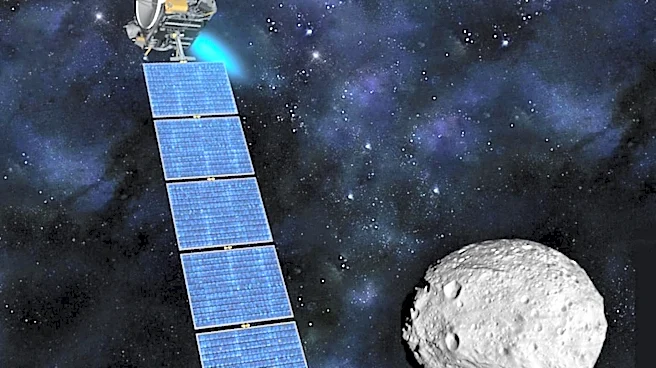

NASA's ambitions to send humans to Mars to get an up-close look at Earth's planetary neighbor are no secret. But did you know the U.S. space agency also has interest in studying the red planet's dual moons?
That's right, NASA is integral to a Japan-led mission that in the coming days could send an uncrewed spacecraft toward Mars with the goal of surveying both of the planet's moons – and even landing on one of them.
The mission comes as NASA has set its sights firmly on Mars as it looks to send humans deeper and deeper into the solar system under its Artemis program.
Here's what to know about the Mars mission and how to watch NASA officials give an update today, Oct. 15.
NASA to provide update on upcoming Mars mission
NASA officials will provide an update on an upcoming mission to send an uncrewed
spacecraft to Mars, according to a press release. The mission, known as Martian Moons eXploration (MMX,) is headed by Japan's space agency, JAXA, with contributions from NASA.
How to watch NASA livestream
Audio of the news briefing will be available to stream live at 4 p.m. Thursday, Oct. 15 on NASA's YouTube channel.
What is Japan's Martian Moons eXploration (MMX) mission?

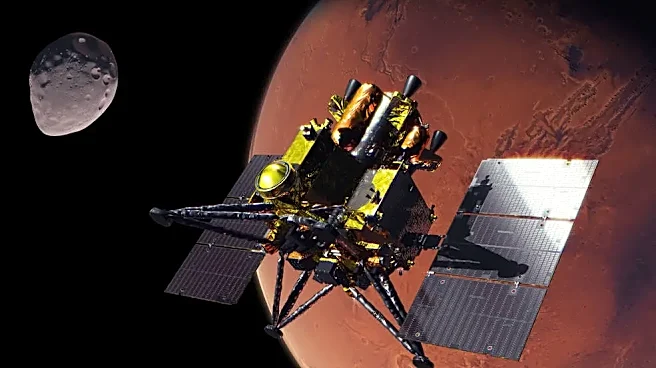
Led by the Japan Aerospace Exploration Agency, the MMX mission will send a spacecraft to Mars to study the planet's two moons, Phobos and Deimos.
If the mission launches on schedule, the MMX spacecraft would be expected to arrive at Mars by August 2027. The vehicle won't just orbit near the moons, but will also land on Phobos in December 2028 and collect a sample from the moon that could be returned to Earth by 2031, according to NASA.
Scientists suspect that the smaller asteroid-sized moons could either be the remnants of something that crashed into Mars, or themselves could be asteroids captured in the planet's gravity. The objective of the mission is to survey the two moons – including studying the elemental composition of Phobos surface – to determine their origin and evolution, according to NASA.
What to know about Phobos and Deimos

Translated as "fear" in Greek, Phobos is much closer to Mars than its brother Deimos, according to NASA. Orbiting Mars three times a day, Phobos is also the larger of the two moons.
Unlike Deimos ("dread," in Greek), which is drifting ever-outward and will eventually leave Mars' orbit, Phobos is on a collision course with the red planet. Because Mars' strong gravity is drawing Phobos about 6 feet closer to it every century, the moon is expected within the next 50 million years to either crash into Mars or break up into a planetary ring like Saturn's.
When, where is the launch?
The mission is scheduled to launch Monday, Oct. 19 from JAXA’s Tanegashima Space Center in Japan.
What was NASA's contribution to Mars mission?
NASA helped develop an instrument on the MMX spacecraft known as the MEGANE gamma-ray and neutron spectrometer, which will assist in sample collection on Phobos' surface.
NASA also funded scientists from the U.S. participating on the MMX science team, and will provide communications and navigation support from the agency’s array of giant radio network antennas on Earth known as the Deep Space Network.
Eric Lagatta is the Space Connect reporter for the USA TODAY Network. Reach him at elagatta@usatodayco.com
This article originally appeared on USA TODAY: NASA-backed mission aims to land on Mars moon, bring samples home