
From the WNBA to the NWSL and beyond, the professional women’s sports boom is no secret. But progress is a mixed picture, with girls facing significant barriers as it pertains to entering and remaining
in competition.
That’s all according to the Women’s Sports Foundation (WSF) founded by Billie Jean King in 1974, which released its inaugural WSF Sport Report on Wednesday. The first-of-its-kind annual assessment examines the state of girls’ and women’s sports throughout every stage (youth sports, college, professional, Olympic and Paralympic levels), based on surveys of more than 6,100 parents and children and 60 women’s sports professionals.
While women’s professional sports continue to experience unprecedented growth and visibility, some of the most glaring red flags uncovered in WSF’s report include that girls are hampered by a high cost of entry into sports, a declining sense belonging and a lack of awareness of their rights provided by Title IX.
One of the report’s most notable findings is the gap between girls’ interest in sports and actual participation. Among girls ages 8 to 18 who have never played organized sports, 54% said they would like to participate, nearly identical to boys at 52%. However, only 45% of girls currently play organized sports, compared with 52% of boys.
The report also found that growing visibility for women’s sports has not yet translated into stronger athlete connections. Nearly half of girls could not name a favorite professional athlete, while 2% of boys identified a woman athlete as their favorite
Cost remains a major obstacle for girls, whose families spend a median of $500 annually on sports participation compared to $400 for boys. That 25% difference of a financial burden is particularly significant for lower-income households, where girls are more than twice as likely to cite cost as a reason they’ve never played organized sports.
WSF’s report also highlights a growing sense of disconnection among adolescent girls. While 80% of both girls and boys ages 8 to 10 believe sports are “for someone like me,” that feeling declines among teenagers. Just 66% of girls ages 14 to 18 report feeling they belong in sports, compared with 73% of boys
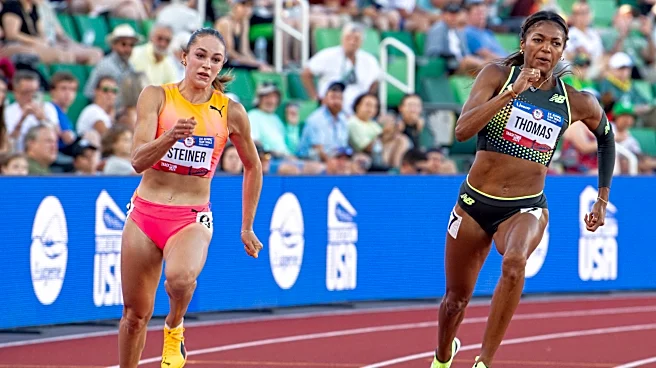
No one can speak to those realities better than Gabby Thomas, a three-time Olympic Track and Field champion for Team USA and a Women’s Sports Foundation Trustee.
“I bring a very unique perspective of just being the lived experience of what we're trying to do,” Thomas told USA TODAY. “I think the outside world is not incredibly supportive of women’s sports, and that really is my experience. But what I really leaned on was those who were close to me, like my family and my mom. She was incredibly encouraging and supportive and made me feel like not only did I belong in sports, but like I was very important in sports.”
Thomas, who is Black, was born in Atlanta but grew up in Northampton, Massachusetts.
Thomas' mother Jennifer Randall, a professor who earned her PhD from Emory University, made sure her daughter competed in sports because of early research she found like WSF’s.
“One thing that she read, when I was young, was about how helpful sports are for young girls and how it gives them something positive to work towards, especially girls of color and of lower socioeconomic status,” Thomas said. “She was essentially scared into putting me into sports. She was worried what would happen if I didn't.”
Thomas graduated from Harvard University as a student-athlete with an undergraduate Bachelor of Arts degree in neurobiology and a secondary concentration in global health and health policy in 2019. While she’s now regarded as one of the fastest 200-meter sprinters of all time, running wasn’t her first choice.
“I did recreational soccer as a young girl. As I got better, it became clear that soccer was one of those sports where if you weren't doing the travel teams and (everything else) you fall behind,” Thomas said. “it became kind of a big financial stress on our household. And so we stopped doing that.”
To excel on the track, all Thomas needed was pair of tennis shoes.
“I had the opportunity because there was such a low barrier to entry. I think every girl deserves that,” she said.
Also highlighted in the WSF report is a widespread lack of awareness surrounding Title IX. Nearly eight in 10 girls surveyed and more than half of parents said they had never heard of the landmark gender-equity law. The finding comes as 47% of sports industry experts identified weakened Title IX enforcement as the biggest threat to future progress in women’s sports.
Thomas said even before her time at Harvard and during it, Title IX “wasn’t something that was talked about.” While she feels that her experience shows progress, she acknowledged it’s a problem in a widespread sense.
“I could be in the world of sports and not have to think too much about that. I think that's kind of what we're we're striving towards,” Thomas said. “It is a slippery slope, I think, to not understand the work that has been done before you. Because it can just as easily be taken away.”
At higher levels of competition, the report found stark differences between professional and collegiate sports. Ninety-three percent of experts said progress toward gender equity improved in professional sports over the past year. In contrast, college athletics was the only segment where more experts reported declining progress than improvement.
Experts cited unequal resources, disparities in name, image and likeness (NIL) opportunities, revenue-sharing concerns and the ongoing impact of the House v. NCAA settlement as key challenges facing women college athletes.
“NIL, revenue sharing and litigation are rebuilding an outdated economic model from the ground up, and women don’t yet have a guaranteed seat at the table,” WSF CEO Danette Leighton said. “This report exists to name where that work is needed and to hold the field accountable to getting it done.”
This article originally appeared on USA TODAY: As pro women's sports boom, study finds red flags in pipeline | Exclusive