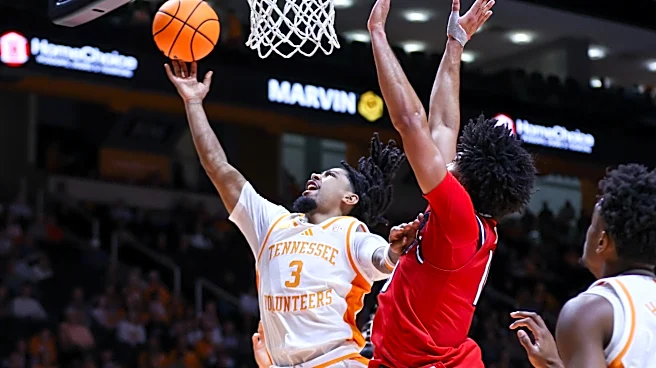



The Tennessee men’s basketball program has proposed to the university a model for a collective bargaining agreement, or CBA, that addresses topics related to compensation, player movement and more, according to a term sheet shared with USA TODAY Sports.
Created in conjunction with Athletes.org, a players association for college athletes, the term sheet has been discussed with school leadership, including athletic director Danny White.
“We take a lot of pride in being extremely athlete-centric, and listening to our players’ interests through Athletes.org has shown that sharing perspectives through meaningful dialogue isn't something to be afraid of,” White said in a statement.
wild
“Without athletes, we don’t have championships to win, we don’t have 102,000 coming into Neyland Stadium. In my conversations with athletes over the years, they want the same things we want.”
While not a binding CBA, the proposal “provides the model for CBA terms between players and conferences that can be adapted across college sports,” according to Athletes.org.
“Rather, it offers the clearest picture to date of the issues a CBA could address, the accountability mechanisms that could protect athletes and an institution, and what athletes can achieve when they have a direct role in deciding the terms of the industry they power.”
Among the proposed terms are a “Universal Athletic Service Agreement” that replaces revenue-sharing and university-affiliated contracts. “Players are paid for their athletic services, not for influencer deliverables,” the term sheet reads.
In the same vein, players would begin to receive payments at enrollment or first team activity, which ever comes first, with “financial consequences” for universities that fail to meet their contractual responsibilities.
The proposals also include the creation of postseason revenue pools and player performance pools, as well as a retention pool for “athletes who stay, and play, at the same university for at least two years.”
To address the transfer portal, the term sheet offers a 15-day transfer window that opens one week after the national championship game and “enforceable anti-tampering rules.”
In terms of enforcement, the term sheet proposed an independent grievance process handled by a neutral arbitrator.
From a player health perspective, the term sheet calls for guaranteed compensation for athletes on injured reserve and at least two additional years of health coverage after the end of eligibility and lifetime health coverage for “catastrophic injuries.”
While not a ratified agreement, the Volunteers’ model offers a blueprint for what a CBA could address and “provides the model for CBA terms between players and conferences that can be adapted across college sports,” according to Athletes.org.
Athletes.org created the term sheet alongside three player representatives chosen by the men’s basketball team: graduate student Tyler Lundblade, junior Campbell Duncan and freshman DeWayne Brown II.
These representatives worked with the association to produce the proposed agreement and then met with their teammates in late September to discuss the term sheet.
“Some people say we’re kids, that we’re immature or that we don’t understand,” Brown said. “But we’re the ones living this experience, and our opinions matter. We know what we want and how we want to move forward. Working through the collective bargaining process has been great and I hope it's just a stepping stone for more college athletes to replicate our process with their own schools.”
Athletes.org has also engaged in conversations with representatives from Tennessee’s football program.
“This CBA term sheet shows that with athletes at the table, everyone in college sports can win,” said Brandon Copeland, the association’s executive director. “If we repeated this process with every Power Four university today, we could solve most of college sports’ problems by tomorrow afternoon.”
This article originally appeared on USA TODAY: Tennessee basketball’s CBA blueprint could solve college sports’ biggest problems