



NASA's cutting-edge Nancy Grace Roman Space Telescope is due in the coming days to hitch a ride to space from Florida.
The latest flagship telescope in NASA's fleet, the Roman telescope is meant to rove the cosmos nearly 1 million miles away while working in concert with iconic observatories like the James Webb and Hubble space telescopes.
But before Roman can commence its mission to spend the next several years helping scientists unravel some of the universe's biggest mysteries, it has to get off of Earth.
For that, NASA is turning to SpaceX and its mighty Falcon Heavy rocket. The commercial spaceflight company, founded in 2002 by tech mogul Elon Musk, will provide launch services to help the Roman telescope reach space and get into the desired
orbit.
Here's what to know about the upcoming launch of NASA's Nancy Grace Roman Space Telescope.
What is NASA's Nancy Grace Roman Space Telescope?
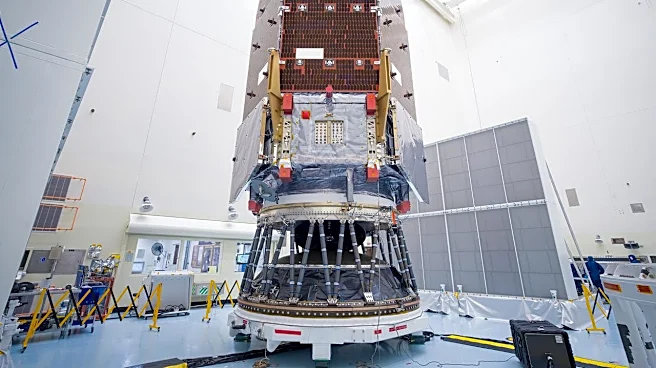
The Nancy Grace Roman Space Telescope represents NASA's next flagship astrophysics mission.
Spanning 42 feet long and more than 14 feet wide, the observatory is designed to explore the outer solar system and beyond – prying into the previously unobservable edge of the universe to study dark energy and search for exoplanets.
Roman is outfitted with two primary instruments to accomplish its mission, including a wide multi-band near-infrared camera and a coronagraph designed to reduce the glare from distant stars so it can photograph distant worlds. The telescope and its mission is managed by NASA’s Goddard Space Flight Center in Greenbelt, Maryland.
"Roman, NASA’s newest space telescope, will change the way we see the universe and settle essential questions in astronomy, helping researchers understand how the universe has changed over time, what drives its expansion, and the worlds that exist beyond our solar system," NASA explains.
When is the Nancy Grace Roman Space Telescope due to launch?
NASA is working toward an Aug. 30 launch of the Nancy Grace Roman Space Telescope, with liftoff taking place no earlier than 7:26 a.m. ET, according to the agency.
Where will the Nancy Grace Roman Space Telescope launch take place?
The telescope will get off the ground and be propelled into space from the historic Launch Complex 39A – the site of many Apollo moon mission launches – at NASA’s Kennedy Space Center near Cape Canaveral, Florida
How will the observatory get to space? SpaceX Falcon Heavy to provide liftoff
The telescope will hitch a ride atop SpaceX's Falcon Heavy rocket, which will provide the initial burst of thrust to help it reach space.
The 230-foot-tall Falcon Heavy rocket is similar to SpaceX's well-known Falcon 9, except it is composed of not one, but three reusable core boosters from SpaceX's Falcon 9 – each powered by nine engines in the company's Merlin family. The design, classifying Falcon Heavy as a super-heavy launch vehicle, means the rocket is capable of transporting much bigger payloads to orbit.
While Falcon 9 launches happen multiple times a week between Florida and California, Falcon Heavy launches are rare. In fact, the last time Falcon Heavy got off the ground at the end of April was its first liftoff since the rocket helped launch NASA's Europa Clipper mission in October 2024.
The Nancy Grace Roman Space Telescope has officially been encapsulated inside the Falcon Heavy rocket’s 43-foot-tall fairing, which protects the spacecraft on its trip through Earth's atmosphere. The fairing is next due to be mounted atop the rocket before it's rolled out to the launch pad, NASA said in an Aug. 24 blog post.
What happens after launch?
The last Falcon Heavy launch April 29 from Florida caused two sonic booms in Brevard County near the Atlantic Coast as the rocket's two side boosters returned to Earth faster than the speed of sound and landed less than eight minutes later. Since Falcon Heavy's center core stage is expendable, it is not recovered after separating from the upper-stage that flies in space.
During the ascent, the fairing will protect the Roman telescope from "acoustic vibrations, aerodynamic pressure, and heating," according to NASA.
A few minutes into the flight, the fairing will separate from the telescope, allowing Roman to continue toward a specific orbit around the sun. The fairing halves will return to Earth to be recovered by SpaceX.
As for the Nancy Grace Roman Space Telescope, the observatory's primary mission is expected to last five years, though NASA designed it for a five-year extension.
Contributing: Brooke Edwards, USA TODAY Network
Eric Lagatta is the Space Connect reporter for the USA TODAY Network. Reach him at elagatta@usatodayco.com
This article originally appeared on USA TODAY: SpaceX chosen to launch NASA's next great space telescope. Here's when