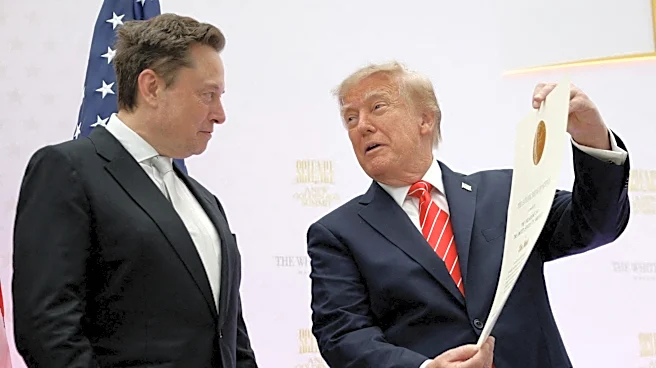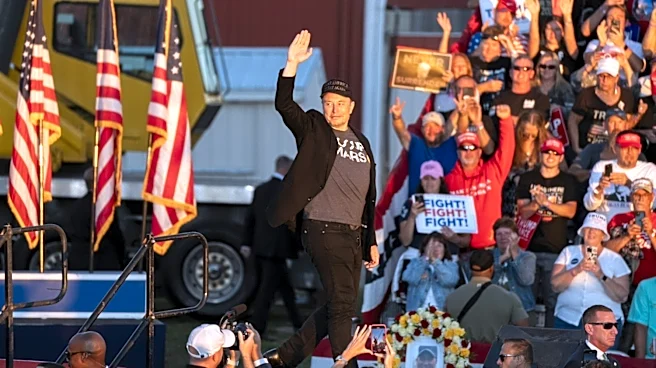



The tech billionaire who once sported a custom, black-and-gold Make America Great Again hat at rallies for President Donald Trump said this week, "I'm not MAGA."
Elon Musk made the comment in a remote interview from China with the the New York Times on Nov. 18. He spoke in a calm and steady tone as he sat on a couch for his biggest public interview since the Nov. 3 elections.
Musk said he supports divided government, in which different parties control different parts of Congress or the presidency, and that his goal was to have 51 Republican senators in 2029. "Which failed, by the way," he added.
"I feel pretty foolish about having spent so much money and not seeing much for it," Musk said. "But it certainly shows that American elections are not just
about money. You can put a lot of money into elections and have an effect that's relatively minor."
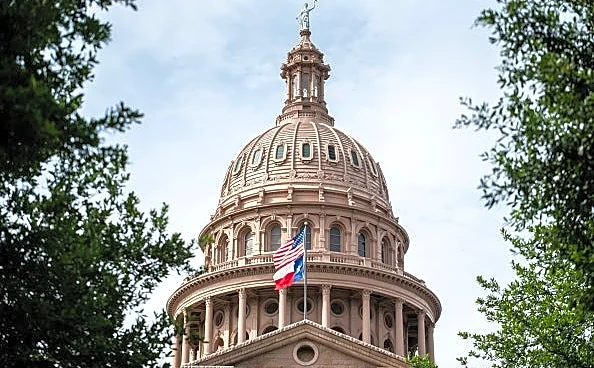
Musk spent more than $445 million during the midterm election cycle, according to Open Secrets, a nonprofit that tracks campaign finance spending. The bulk of it went to back Republican Ken Paxton in Texas, where Musk lives, but Paxton lost to Democrat James Talarico by 12 percentage points.
Talarico and other Democrats raised record amounts of money from individual donors, while Republican candidates trailed far behind with fundraising from supporters. Instead, the Republican Party and its campaign arms spent heavily with donations from people like Musk.
"It’s like he went into a casino, lost a ton of money and said, 'Well the odds are already in favor of the house,'" said Raymond La Raja, a political science professor at the University of Massachusetts Amherst. "For the most part, placing your money on bets to defend yourself is a losing proposition when it’s that much of a wave."
La Raja said super PACs, the type of political action committees where Musk sent a lot of his money, are not as effective as individual campaigns at spending money to win elections. But he said Republicans needed very wealthy people to give to super PACs because they don't have limits on how much money they can raise or spend.
Musk said he wanted Republicans to control either the House, the Senate or the presidency. He said he was trying to prevent a "worst-case scenario" of a supermajority of Democrats in 2029, but added, "I'm not in favor of a supermajority of Republicans, either. I think we want to have some checks and balances here."
He said he would've spent less money if he could go back. But he also said he didn't put "a lot of personal attention" into the election, citing his work for SpaceX and Tesla.
"I think I'm ideologically quite moderate," Musk said. "I don't think I have, like, any kind of extreme political views. I mean, you've known me for a long time. Can you think of any kind of extreme views that I have?"
Andrew Ross Sorkin, the interviewer, pointed to Musk's comments in support of MAGA.
"I'm not MAGA," Musk said. "At least, I'm not like - I'm not sure what MAGA means. But if that means sort of blind adherence to a set of policies by the Republican Party, then I certainly don't have that. I think there are positives and negatives in both parties.

"But politics is very tribal and a lot of people cannot see any good in the other party and cannot see any bad in their own party," he said. "Because they're more or less invested in their own party, you know, like it's their hometown sports team."
Musk also offered an assessment of Gina Hinojosa, the Democrat who won the Texas governorship.
"The new governor, actually, I think is going to be quite moderate," Musk said. "I don’t think she’s sort of a far-left governor, and based on everything I’ve heard about her, I think everything will be fine in Texas with Gina as governor."
This article originally appeared on USA TODAY: Elon Musk declares 'I'm not MAGA' after losing millions on election